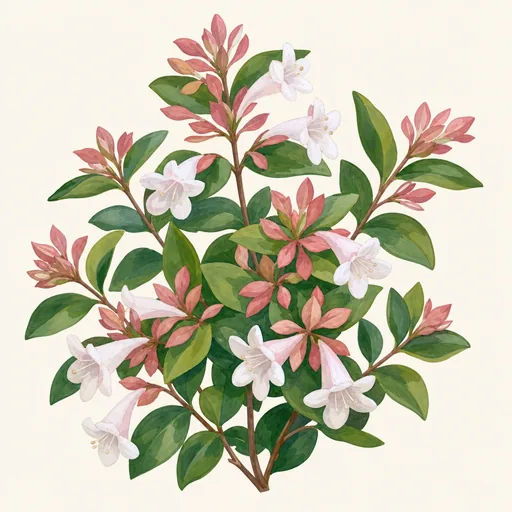
Abelia
Abelia x grandiflora · Caprifoliaceae
- Plant outFrom 2 weeks before to 4 weeks after the last frostMar 27 – May 14
- Plant in autumn6–8 weeks before the first autumn frostAug 30 – Sep 19
- Space0.9–1.8 m (3–6 ft) apart
Description
Abelia is a genus of flowering shrubs in the honeysuckle family (Caprifoliaceae), known for its ornamental appeal and versatility in garden landscaping. Originating primarily from East Asia and Mexico, Abelia plants are semi-evergreen to deciduous, depending on the climate in which they are grown.
One of the most popular species is Abelia x grandiflora, often referred to as glossy abelia. This hybrid is celebrated for its glossy, dark green leaves that turn a beautiful bronze or reddish hue in the fall. The plant produces an abundance of small, tubular flowers from summer to fall, typically in shades of white, pink, or lavender, attracting pollinators like bees and butterflies. The fragrant blossoms can offer delightful scents in the garden.
Abelia shrubs are generally low maintenance. They thrive in well-drained soil and prefer full sun to partial shade, although they can tolerate a range of soil types. They are relatively drought-tolerant once established and can withstand mild frost, making them suitable for many regions.
These plants typically grow to a height of 3 to 6 feet and can spread up to 6 feet wide, making them excellent for borders, hedges, or as standalone specimens. Regular pruning helps maintain their shape and encourages denser growth.
Abelia's resilience and beauty make it a favorite among amateur gardeners, providing year-round interest and a lovely structure to gardens.
Growing Conditions
0.9–2.4 m (3–8 ft) tall, 0.9–2.4 m (3–8 ft) wide
- Smallest
- Largest
Full sun
Tolerates part sun, part shade
Moderate
Keep evenly moist, not soggy.
Survives down to −23 °C (−9 °F)
pH 5.5–7.5 · acidic to neutral
Where it Grows
Planting
When to Plant
Abelia, particularly the popular Abelia x grandiflora, is a versatile and attractive shrub that is loved for its long-lasting blooms and lush foliage. Determining the best time to plant Abelia is crucial for ensuring its successful establishment and growth.
Ideal Planting Seasons
-
Spring Planting: The ideal time to plant Abelia is during the spring, after the last frost date in your area. This typically falls between late March and early June, depending on your region. Spring planting encourages the shrub to take advantage of the warmer weather and increased rainfall, allowing it to develop a strong root system before the heat of summer sets in.
-
Fall Planting: Fall is another suitable time for planting Abelia, especially in regions with mild winters. If you plant during the fall, aim for late September to early November. This timeframe allows the plant to establish roots before winter, taking advantage of the cooler temperatures and moisture.
Key Conditions to Consider
-
Soil Temperature: Before planting, check the soil temperature. Ideally, it should be consistently above 60°F (15°C) for optimal root development.
-
Frost Dates: Be mindful of your local frost dates. Planting too close to frost can damage young plants. Use a frost date calculator specific to your area to determine the safest window for planting.
-
Watering Needs: Planting during periods of consistent moisture, whether naturally occurring or through supplemental watering, will help Abelia establish without added stress.
Special Considerations
-
Container Plants: If you are planting container-grown Abelia, these can often be planted at any time of the year, provided the ground is not frozen. Just ensure you prepare the planting hole adequately and water regularly until the plant is established.
-
Climate Zones: Abelia grows best in USDA hardiness zones 5 to 9. If you live in a colder zone, spring planting is generally recommended, as it gives plants the warm months to settle in before winter sets in.
-
Spacing and Sunlight: Choose a location that receives full sun to partial shade for optimum growth. Adequate spacing between plants (typically 3 to 5 feet apart, depending on your design) is important for airflow and to minimize competition.
Conclusion
Knowing when to plant Abelia is essential for optimal growth and flowering. By focusing on spring or early fall planting, keeping an eye on soil temperatures, and accounting for frost dates, you can successfully introduce this lovely shrub into your garden, ensuring a thriving and bountiful display of blooms in the seasons to come.
How to Plant
Planting Abelia, a cherished choice for its fragrant flowers and glossy foliage, requires attention to detail for optimal growth. Begin by selecting a suitable location with well-drained soil and full sun to partial shade, as Abelia flourishes best in these conditions.
-
Soil Preparation: Prior to planting, amend the soil with compost to enhance drainage and fertility. Abelia prefers slightly acidic to neutral soil (pH 6.0 to 7.0).
-
Planting Time: The ideal time to plant is in the spring or fall when the weather is mild, which minimizes transplant shock.
-
Planting Procedure: Dig a hole twice the width of the root ball and slightly shallower than its depth. Gently remove the plant from its container, loosening any tightly bound roots. Position the plant in the hole, ensuring the top of the root ball is level with the ground surface to avoid rot.
-
Backfill: Fill the hole with soil, patting it down lightly to eliminate air pockets. Water thoroughly immediately after planting to settle the soil.
-
Mulching and Watering: Apply a layer of mulch around the base to retain moisture and suppress weeds. Regular watering during the initial weeks will support establishment.
By following these steps, your Abelia will thrive, providing beauty to your garden for years to come.
Planting Calendar
- Plant outdoors: from 2 weeks before to 4 weeks after the last frost
- Autumn planting: 6–8 weeks before the first autumn frost
- Plant out: Mar 27 – May 14
- Autumn planting: Aug 30 – Sep 19
Care
Care Calendar
- Prune · Feb 27 – Apr 2
Remove dead or crowded stems before new growth begins. - Mulch · Apr 10 – May 14
Spread mulch over the root zone, keeping it away from the stems.
Watering
When watering an Abelia plant, it's essential to balance moisture without over-saturating the soil. These shrubs prefer well-draining soil, so a good strategy is to water deeply but infrequently. Ideally, allow the top inch of soil to dry out between watering sessions, especially during the growing season in spring and summer.
In general, Abelia plants require approximately 1 inch of water per week, either from rainfall or supplemental watering. During particularly hot weather or while the plant is establishing, increase frequency slightly, ensuring that water penetrates the root zone. Utilize a drip irrigation system or water at the base of the plant to avoid wetting the foliage, which can cause fungal issues. Always monitor the plant’s response, adjusting your watering schedule based on environmental conditions and the moisture level of the soil. Proper watering promotes a healthy, vibrant Abelia with abundant blooms.
Pruning
Pruning an Abelia plant is essential for maintaining its shape, encouraging growth, and enhancing flowering. The best strategy involves timing and technique. Prune in late winter or early spring, before new growth begins, to avoid cutting off any developing blooms. Start by removing any dead or damaged branches, which will help prevent disease and promote healthy growth.
Next, thin out crowded areas to improve air circulation, which reduces the risk of fungal issues. You can also cut back older stems by one-third to a half to stimulate new growth from the base. Be sure to maintain the plant's natural shape; Abelia often thrives with a loose, open form. Always use clean, sharp pruning shears to make clean cuts, minimizing stress on the plant. After pruning, consider applying a balanced fertilizer to support healthy recovery and flowering through the growing season.
Weeding
Weeding around an Abelia plant is crucial for its health and growth, as competition from weeds can reduce nutrient and water availability. The best strategy for weeding involves a few key steps:
-
Timing: It’s best to weed in the early morning or late afternoon when the soil is moist. This makes it easier to pull out weeds, roots and all.
-
Manual Removal: Use garden gloves and a hand weeder or trowel to gently remove weeds, ensuring that you pull them from the roots to prevent regrowth.
-
Mulching: After clearing the area, apply a 2-3 inch layer of organic mulch around the base of the Abelia. This helps suppress future weed growth, retains moisture, and adds organic matter as it decomposes.
-
Regular Maintenance: Establish a routine to check for and remove weeds every few weeks during the growing season, which ultimately aids the Abelia's robust growth and flowering.
Mulching
Mulching is an effective method to enhance the health of an Abelia plant, providing benefits such as moisture retention, weed suppression, and temperature regulation. The best strategy includes the following steps:
-
Timing: Apply mulch in early spring or fall. This allows it to settle before the extreme temperatures of summer or winter.
-
Material Selection: Use organic materials like shredded bark, pine needles, or wood chips. These decompose over time, enriching the soil around the Abelia.
-
Application Depth: Spread a layer of mulch 2 to 3 inches deep around the base of the plant, ensuring to keep it a few inches away from the stems to prevent rot.
-
Maintenance: Regularly check the mulch over the growing season, replenishing as necessary to maintain the desired depth and effectiveness.
By following this strategy, gardeners can help ensure robust growth and flowering of their Abelia plants.
Fertilizing
Fertilizing an Abelia plant effectively is crucial for promoting robust growth and vibrant blooms. The best strategy begins in early spring, just as new growth begins to emerge. Using a balanced, slow-release fertilizer that has an N-P-K ratio of about 10-10-10 or similar will provide the necessary nutrients without overwhelming the plant.
Applying about one pound of fertilizer per 100 square feet of garden bed should suffice for most average-sized plants. Make sure to lightly rake the fertilizer into the top layer of soil and water thoroughly after application to activate the nutrients. It’s important to avoid over-fertilization, which can lead to excessive foliage growth at the expense of flowering. A twice-a-year schedule—once in spring and once in early summer—typically supports optimal growth, allowing the plant to thrive throughout the growing season. Always follow up with monitoring for any signs of nutrient deficiencies or toxicities.
Growing in Containers
Grows well in a pot of at least 30 litres (7.9 US gallons), with drainage holes. Best kept outdoors.
Propagation
From cuttings
- Take 10–15 cm softwood cuttings in late spring or early summer.
- Remove the leaves from the lower half of each cutting.
- Insert the cuttings into moist, free-draining propagation mix.
- Keep them in bright, indirect light and maintain moisture until roots form.
- Pot up rooted cuttings and gradually acclimate them to outdoor conditions.
By layering
- In spring, choose a flexible, low-growing stem.
- Wound the underside lightly where it will touch the soil.
- Pin that section into the soil, leaving the tip exposed.
- Keep the soil moist until roots form, then cut the stem from the parent and transplant it.
Common Problems
- Yellowing leaves
- Sticky residue on leaves
- Black sooty coating
- Curled or cupped leaves
Aphids are small, soft-bodied insects that feed by piercing plants and drawing out sap. The group includes many…
- Yellowing leaves
- Sticky residue on leaves
- Black sooty coating
- Stunted growth
Scale insects are small, sap-feeding insects that settle on garden and houseplants. Adults often look like bumps on…
- Pale speckles or stippling
- Yellowing leaves
- Brown or crispy leaf edges
- Fine webbing
Spider mites are tiny, plant-feeding arachnids in the family Tetranychidae, not insects. Several species attack garden…
- Yellowing leaves
- Wilting
- Stunted growth
- Leaves dropping
Root rot is a general name for the decay of plant roots, not a single disease with one scientific name. It can result…
Varieties
Its yellow-edged leaves develop orange and red tones later in the season.
- compact
- colorful foliage
- white flowers
Pink calyces remain showy after the white flowers fade.
- compact
- white flowers
- pink calyces
This shrub bears lilac-pink flowers on arching stems.
- pink flowers
- arching habit
Its dense, low growth suits small gardens and foundation plantings.
- compact
- white flowers
Its green leaves have creamy-white margins.
- compact
- variegated foliage
- white flowers
Yellow-margined leaves brighten the shrub throughout the growing season.
- variegated foliage
- compact
- white flowers
More about varieties
Abelia, a genus of flowering shrubs belonging to the honeysuckle family (Caprifoliaceae), is cherished for its attractive foliage, fragrant flowers, and hardiness. The most commonly cultivated species and cultivars include:
-
Abelia × grandiflora (Glossy Abelia) This is perhaps the most widely known species, valued for its glossy, ovate leaves and abundant, tubular flowers that bloom from late spring to fall. The flowers are usually white or pale pink, attracting pollinators like bees and butterflies. Glossy Abelia's growth habit is semi-evergreen, making it a favorable choice for year-round interest.
-
Abelia x 'Edward Goucher' This cultivar of Abelia × grandiflora is particularly noted for its compact size and abundant lavender-pink flowers. It presents a lovely display, especially in late summer, and the foliage transitions to lovely bronze hues in the fall, adding seasonal interest.
-
Abelia x 'Kaleidoscope' A more recent cultivar, 'Kaleidoscope' features variegated leaves that show off bright yellow margins with green centers. The showy foliage contrasts beautifully with the white to pink flowers that emerge from early summer to fall. Its compact and rounded habit makes it suitable for smaller gardens or containers.
-
Abelia x 'Radiance' This hybrid shrub is known for its slightly larger, showy flowers and distinctively bright green leaves, which turn a warm yellow-orange in the fall. 'Radiance' remains compact, growing well in borders or as part of a mixed garden bed.
-
Abelia mosanensis (Korean Abelia) This species is admired for its arching branches, fragrant pink flowers, and dense growth habit. It is more tolerant of cold temperatures than other species, making it suitable for various climates. The glossy leaves turn reddish in the fall, providing seasonal beauty.
-
Abelia schumannii Known for its delicate, pale yellow flowers, this species offers a more understated charm compared to some hybrid forms. It has a more upright growth habit and can serve as a wonderful specimen plant or low hedge.
-
Abelia × 'Sunrise' 'Sunrise' combines the best traits of its parents, exhibiting vibrant foliage that transitions from rich green in summer to bright golden yellow during fall. Its flowers are smaller but still add delight from late spring through early fall.
Growing Conditions and Care
While not species-specific, Abelia plants generally thrive in well-draining soil with moderate moisture. They prefer a full sun to partial shade environment and are relatively drought-tolerant once established. Regular pruning in early spring can enhance flowering and maintain a tidy shape. Abelia's adaptability to various soil types and its low maintenance make it an excellent choice for amateur gardeners looking to add beauty to their landscapes.
With a range of varieties, from the classic Glossy Abelia to newer hybrids like 'Kaleidoscope', there is an option for every garden style and climate preference.
Health Benefits
Abelia, particularly the species Abelia x grandiflora, is known for its aesthetic appeal in gardens due to its attractive foliage and fragrant flowers. While primarily cultivated for ornamental purposes, it does possess qualities that may contribute to wellness. Traditionally, in folk medicine, the roots and leaves of Abelia have been utilized in various cultures for their potential therapeutic properties.
Some studies suggest that components found in Abelia could have anti-inflammatory effects, which might help alleviate mild skin irritations when applied topically. Moreover, the plant is rich in antioxidants, which can combat oxidative stress in the body, potentially contributing to a healthier immune response.
In addition to these medicinal qualities, incorporating Abelia into garden landscapes can enhance mental well-being. Gardening activities, including caring for Abelia, can offer stress relief, boost mood, and promote physical activity—a holistic benefit that directly correlates with wellness.
While further research is needed to substantiate specific health claims, Abelia’s presence in home gardens supports both aesthetic pleasure and a connection to nature, contributing to overall mental and physical health benefits for gardeners and hobbyists alike.
Fun Facts
-
Variety of Species: Abelia is a genus that includes approximately 30 species, with the most popular one for gardeners being Abelia x grandiflora, a hybrid known for its vibrant flowers and lush foliage.
-
Long Blooming Season: This shrub is known for its extended blooming period, often producing fragrant flowers from spring to fall, which can attract butterflies and hummingbirds to the garden.
-
Low Maintenance: Abelia plants are relatively low maintenance, requiring minimal pruning and being drought-tolerant once established, making them a great choice for busy gardeners.
-
Versatile Landscaping Use: With their attractive arching branches and glossy leaves, Abelia shrubs are commonly used in borders, hedges, or as focal points in mixed plantings, adding both color and texture to landscapes.
-
Variegated Varieties: Some cultivars, such as ‘Kaleidoscope’ and ‘Miss Lemon’, feature variegated leaves that provide additional visual interest and contrast in the garden, making them stand out even when not in bloom.
Notice an error or have a question about Abelia? Contact us