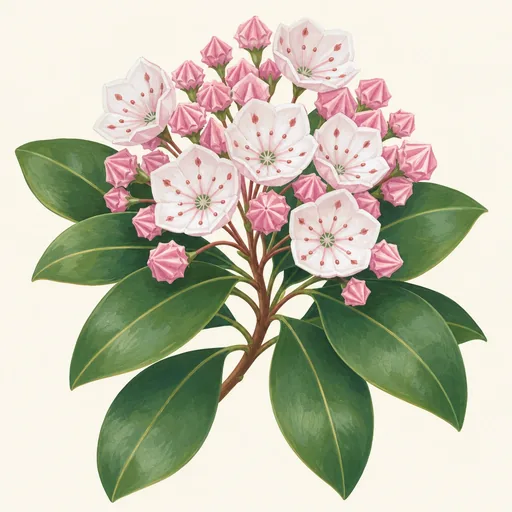
Mountain Laurel
Kalmia latifolia · Ericaceae
- Plant outFrom the last frost until 4 weeks afterApr 10 – May 14
- Plant in autumn6–8 weeks before the first autumn frostAug 30 – Sep 19
- Space1.5–3 m (5–10 ft) apart
Description
Mountain Laurel (Kalmia latifolia) is an evergreen shrub or small tree native to the eastern United States, particularly prevalent in regions with acidic soils, such as the Appalachian Mountains. This plant is known for its stunning clusters of flowers, which bloom in late spring and early summer, offering a vibrant display of colors ranging from white to deep pinks and purples. The flowers are notable for their unique, star-shaped structure and are often likened to miniature paper lanterns.
Mountain Laurel typically grows to be 5 to 15 feet tall, with a similar spread, making it a versatile choice for gardens, borders, or as part of a naturalistic landscape. Its glossy, dark green leaves are leathery, oval-shaped, and can measure up to 4 inches long, providing year-round interest.
This plant thrives in well-drained, acidic soil and prefers partial shade, although it can tolerate full sun if adequately watered. It is relatively low-maintenance once established, requiring infrequent pruning primarily to remove dead or damaged wood.
While the Mountain Laurel is beloved for its ornamental qualities, it is important to note that it is toxic if ingested, containing substances that can affect the heart. As such, caution is advised if there are pets or small children in the vicinity.
Overall, Mountain Laurel's visual appeal, tolerance for various conditions, and evergreen foliage make it an excellent addition to many garden settings, especially in woodland or naturalized areas.
Growing Conditions
1.5–4.5 m (5–15 ft) tall, 1.5–4.5 m (5–15 ft) wide
- Smallest
- Largest
Part shade
Tolerates full sun, part sun, full shade
Moderate
Keep evenly moist, not soggy.
Ideal 15–24 °C (59–75 °F)
Survives down to −34 °C (−29 °F).
pH 4.5–6 · acidic
Where it Grows
Planting
When to Plant
Mountain laurel (Kalmia latifolia) is a beautiful evergreen shrub native to the eastern United States, prized for its attractive flowers and glossy leaves. Understanding the optimal planting time is crucial for ensuring the healthy establishment of this stunning addition to your garden.
Ideal Planting Season
The best time to plant mountain laurel is during the early spring or early fall. These seasons offer mild temperatures and increased moisture levels, which are conducive to root development and overall plant health.
-
Spring Planting: Late March to early June is ideal, particularly when the danger of hard frost has passed. Spring planting allows the plant to establish its roots before the heat of summer.
-
Fall Planting: Late September to early November is effective as well, especially if you live in a region with mild winters. Planting in the fall gives the mountain laurel time to acclimate and establish its roots before the cold sets in, promoting stronger growth in spring.
Considerations for Climate and Region
-
Hardiness Zone: Mountain laurel thrives best in USDA hardiness zones 4 to 9. Be sure to check your local hardiness zone to confirm suitable planting times and conditions.
-
Local Climate: In warmer regions, early spring planting might be more favorable, while in cooler areas, early fall can allow the shrub to establish itself before winter.
-
Soil Temperature: Ideally, soil temperatures should be above 60°F (15°C) for optimal root growth. You can use a soil thermometer to gauge this before planting.
Preparing for Planting
Before the actual planting, it’s important to prepare the site by ensuring it has well-drained soil and the appropriate level of sunlight. Mountain laurel prefers partial shade to full sun, thriving best in locations protected from harsh afternoon sunlight, especially in hotter climates.
In summary, whether you choose to plant in spring or fall, timing your mountain laurel planting with respect to local climate, soil conditions, and temperature will aid in establishing a robust, blooming shrub that enhances your garden for years to come.
How to Plant
Planting a Mountain Laurel (Kalmia latifolia) requires careful preparation to ensure successful growth and vibrant blooms. This evergreen shrub thrives in USDA hardiness zones 4 to 9 and prefers well-drained, acidic soil enriched with organic matter.
First, choose a location that receives partial shade to full sun, as Mountain Laurel can struggle in overly sunny sites. Before planting, improve the soil's composition by mixing in compost or peat moss to enhance acidity and drainage.
Dig a hole that is twice as wide as the root ball but no deeper than it. Gently loosen any tightly bound roots before placing the plant in the center of the hole. Be careful not to bury the root crown, as this can lead to rot.
Backfill the hole with native soil mixed with organic materials, gently pressing down to eliminate air pockets. Water thoroughly after planting, providing a deep soaking to encourage root establishment. Mulching around the base will help retain moisture, suppress weeds, and maintain a consistent soil temperature.
Remember to water regularly, especially during the first growing season, to establish a strong root system. With proper care, Mountain Laurels can thrive for years, displaying stunning clusters of blooms in late spring to early summer.
Planting Calendar
- Plant outdoors: from the last frost until 4 weeks after
- Autumn planting: 6–8 weeks before the first autumn frost
- Plant out: Apr 10 – May 14
- Autumn planting: Aug 30 – Sep 19
Care
Care Calendar
- Feed · Mar 27 – Apr 30
If growth is weak, apply a light dose of fertilizer for acid-loving shrubs. - Mulch · Apr 10 – May 14
Renew a shallow layer of organic mulch, keeping it away from the stems. - Prune · May 8 – Jun 25
Prune lightly just after flowering so you do not remove next year's buds. - Protect · Oct 11 – Nov 14
Shield young or exposed shrubs from drying winter wind and sun with burlap.
Watering
Mountain Laurel (Kalmia latifolia) requires careful attention to watering, particularly in its early stages of growth. The ideal strategy ensures the plant receives adequate moisture without becoming waterlogged.
Initially, establish a regular watering schedule, particularly during the first year after planting. Water deeply once a week, ensuring the soil remains consistently moist but not soggy. Use a soaker hose or drip irrigation to deliver water directly to the roots and minimize evaporation.
In established plants, monitor soil moisture, watering more during hot, dry spells and reducing frequency during cooler, wetter periods. It’s crucial to only water when the top inch of the soil feels dry to the touch—Mountain Laurel prefers slightly acidic, well-drained soil. Over- or under-watering can lead to root rot or stress, so maintaining a balanced moisture level is key for thriving Mountain Laurel plants.
Pruning
Pruning Mountain Laurel (Kalmia latifolia) is crucial to maintain its health and shape. The best strategy is to perform pruning in late winter to early spring, just before new growth begins. This timing minimizes shock and encourages robust flowering.
Start by removing any dead, diseased, or damaged branches to promote healthy growth. Next, thin out crowded areas by selectively cutting back branches that cross or rub against each other. Aim to maintain the plant's natural shape while encouraging an open canopy for light penetration and air circulation.
For shaping, prune lightly, removing no more than a third of the plant to avoid stress. If needed, pinch back new growth in the summer to enhance bushiness. Regularly assess your Mountain Laurel after blooming to ensure regular maintenance, helping to foster a vibrant, flowering display for years to come.
Weeding
Weeding around Mountain Laurel (Kalmia latifolia) is crucial for maintaining its health and promoting growth. The best strategy begins with timing; target weeding during early spring and late fall when weeds are easily identifiable. Hand-pulling is often the most effective method to avoid disturbing the shallow roots of the Mountain Laurel. It’s important to remove weeds when the soil is moist, as this makes it easier to uproot them, roots and all.
Mulching is a beneficial strategy to prevent future weed growth. Use a layer of organic mulch, such as wood chips or shredded bark, around the base of the plant, keeping it a few inches away from the stem to prevent rot. Regular monitoring and maintenance, along with strategic weeding and mulching, will help ensure your Mountain Laurel thrives in a weed-free environment.
Mulching
Mulching is an essential practice for ensuring the health and vitality of Mountain Laurel (Kalmia latifolia) plants. The best strategy begins with selecting an organic mulch, such as shredded bark, wood chips, or pine needles, which not only enhances aesthetic appeal but also improves soil health as it decomposes.
Applying a 2-4 inch layer around the base of the plant helps retain moisture, suppress weeds, and regulate soil temperature. Be sure to keep the mulch a few inches away from the trunk to prevent rot and discourage pests. Timing is key; apply mulch in late spring after the threat of frost has passed, allowing for better moisture retention during hot weather.
Regularly replenish the mulch as it breaks down, typically every year or two, to maintain its effectiveness. Overall, proper mulching can significantly boost the growth and flowering of your Mountain Laurel.
Fertilizing
When fertilizing Mountain Laurel (Kalmia latifolia), it’s crucial to approach it with care, as these native shrubs prefer acidic, well-draining soil. The best strategy involves using a slow-release, balanced fertilizer formulated for acid-loving plants, typically containing nitrogen, phosphorus, and potassium in a ratio like 10-10-10 or similar.
Fertilization should occur in early spring, just as new growth begins, ensuring you don’t disrupt the flowering cycle. Apply the fertilizer according to package instructions, generally at a rate of 1 pound per 100 square feet, and avoid over-fertilizing, which can harm roots and promote excessive foliage at the expense of blooms.
Additionally, incorporating organic matter like compost or mulched pine needles can improve soil structure and provide gradual nutrient release throughout the growing season, enhancing the overall health and vibrancy of the Mountain Laurel.
Growing in Containers
Grows well in a pot of at least 50 litres (13 US gallons), with drainage holes. Best kept outdoors.
Propagation
From seed
- Collect ripe seed capsules in autumn.
- Scatter the tiny seeds on the surface of a moist, acidic seed-starting mix.
- Leave the seeds uncovered and place them in bright, indirect light.
- Keep the mix moist until the seeds germinate.
- Transplant seedlings once they are sturdy enough to handle.
From cuttings
- Take semi-hardwood stem cuttings in late summer.
- Remove the leaves from the lower part of each cutting.
- Dip the cut ends in rooting hormone.
- Insert the cuttings into a moist, free-draining rooting mix.
- Keep them humid and in indirect light while they root.
By layering
- Choose a low, flexible branch in spring.
- Lightly wound the underside where it will touch the soil.
- Pin the wounded section into moist soil, leaving the tip exposed.
- Keep the soil moist while roots develop.
- Sever and transplant the layer once it has established roots.
Companion Plants
Good neighbors
- Rhododendrons: They share mountain laurel’s preference for acidic, well-drained soil and partial shade.
- Azaleas: They are commonly grown alongside mountain laurel in acidic woodland gardens.
- Christmas ferns: They suit the same shaded woodland setting and can grow beneath mountain laurel.
Common Problems
- Spots on leaves
- Yellowing leaves
- Leaves dropping
Fungal leaf spot is a general name for diseases caused by many different fungi, not a single species. These fungi…
- Yellowing leaves
- Wilting
- Stunted growth
- Leaves dropping
Root rot is a general name for the decay of plant roots, not a single disease with one scientific name. It can result…
- Yellowing leaves
- Sticky residue on leaves
- Black sooty coating
- Stunted growth
Scale insects are small, sap-feeding insects that settle on garden and houseplants. Adults often look like bumps on…
- Yellowing leaves
- Brown or crispy leaf edges
- Stunted growth
Iron chlorosis is a nutrient disorder in which a plant cannot obtain enough usable iron to make chlorophyll. It is not…
Varieties
This slow-growing selection suits smaller gardens.
- compact
- white flowers
Its pink buds open to white flowers with a maroon band.
- compact
- pink buds
- white flowers
Bright red buds open to pink flowers.
- red buds
- pink flowers
Dark red buds open to richly colored pink flowers.
- red buds
- deep pink flowers
Its white flowers have distinctive red markings radiating from the center.
- white flowers
- red-striped flowers
This small, rounded selection bears pink buds and flowers.
- compact
- pink flowers
More about varieties
Mountain laurel, scientifically known as Kalmia latifolia, is a stunning evergreen shrub native to the eastern United States, celebrated for its attractive foliage and beautiful flowers. This plant produces gorgeous clusters of blooms in late spring to early summer, attracting pollinators and providing garden interest. While there are numerous cultivars of mountain laurel, some common varieties include:
-
'Roseum'
- Description: This cultivar is known for its striking rose-pink flowers, which form in dense clusters. The blooms typically have a darker center, adding depth to their visual appeal.
- Height: Approximately 5 to 10 feet tall.
- Use: Ideal for mixed borders and as a specimen plant due to its vibrant coloration.
-
'Minuet'
- Description: A dwarf variety, 'Minuet' features small, delicate pink flowers adorned with darker pink markings. It typically blooms a bit earlier in the season than other varieties.
- Height: About 3 to 4 feet tall.
- Use: Excellent for smaller landscapes or container gardening.
-
'Olympic Fire'
- Description: This variety is known for its vibrant red buds that open into white flowers with a hint of pink. It's considered one of the most colorful mountain laurel selections.
- Height: Grows 5 to 6 feet tall.
- Use: Suitable for foundation plantings and as a focal point in any garden.
-
'Carousel'
- Description: 'Carousel' is appreciated for its attractive bi-colored flowers, featuring a combination of pink and white blooms with striking patterns. The flowers tend to be larger than those of other cultivars.
- Height: Typically grows to about 4 to 5 feet.
- Use: Great for attracting pollinators and enhancing garden aesthetics.
-
'Tiddlywinks'
- Description: This compact, low-growing variety produces lovely pink blooms. It is particularly popular for its charming appearance and suitability for small gardens.
- Height: Reaches around 2 to 3 feet tall.
- Use: Perfect for rock gardens and borders.
-
'Soft Caress'
- Description: Noted for its gentle, soft pink flowers, this variety offers a more subtle aesthetic compared to others. Its blooms are slightly fragrant, which is a nice bonus in the garden.
- Height: Generally grows to about 4 to 5 feet.
- Use: Ideal for shaded areas and woodland gardens.
Growing Conditions and Care
Mountain laurels thrive in well-drained, acidic soils and prefer partial shade to full sun. It's essential to ensure adequate moisture, particularly in dry spells, as this plant can be sensitive to drought conditions. Pruning should be done immediately after flowering to maintain shape and encourage growth without sacrificing blooming potential for subsequent seasons.
Conclusion
Choosing the right variety of mountain laurel depends on your specific landscaping needs and the aesthetic goals you aim to achieve. Each cultivar offers unique attributes that can enhance your garden's beauty and biodiversity. Always consider local climate and soil conditions to foster optimal growth and flowering in this captivating plant.
Health Benefits
Mountain laurel (Kalmia latifolia), known for its stunning floral displays and evergreen foliage, is not just admired for its beauty; it has been historically associated with various health and wellness applications, although caution is necessary.
Traditionally, Native American tribes have utilized parts of the mountain laurel for medicinal purposes. For instance, decoctions made from the leaves and flowers were sometimes used to treat ailments such as fevers and rheumatism. It's essential to note, however, that mountain laurel contains toxic compounds called grayanotoxins, which can cause serious health issues if ingested in sufficient quantities. As such, any medicinal use should be approached with caution and ideally under professional guidance.
In contemporary wellness practices, the plant has found some mention in the fields of aromatherapy and herbalism, primarily for its aesthetic and serene presence. The flowers can be admired in gardens and landscapes, promoting mental well-being through natural beauty and connection with nature. However, it is paramount for individuals to enjoy mountain laurel responsibly and recognize its potential toxicity rather than seeking direct health benefits from its raw components.
Fun Facts
-
Native Beauty: Mountain laurel is native to the eastern United States, thriving in wooded areas and rocky slopes, where it adds a stunning display of flowers to the landscape.
-
Unique Flowers: The plant produces intricate, cup-shaped flowers, usually in shades of pink or white, that are composed of five petals with peculiar markings. These blooms can measure up to an inch across and are known for their striking beauty.
-
Longevity: Mountain laurel is a hardy perennial that can live for several decades, often reaching an age of 50 years or more under optimal conditions.
-
Toxicity: All parts of the mountain laurel plant contain toxic compounds called grayanotoxins, which can be harmful if ingested by humans or pets. This characteristic makes them a plant to admire rather than consume!
-
Cultural Significance: Mountain laurel is the state flower of Connecticut and Pennsylvania, celebrated for its stunning blooms that attract various pollinators, including bees and butterflies, contributing to local ecosystems.
Notice an error or have a question about Mountain Laurel? Contact us