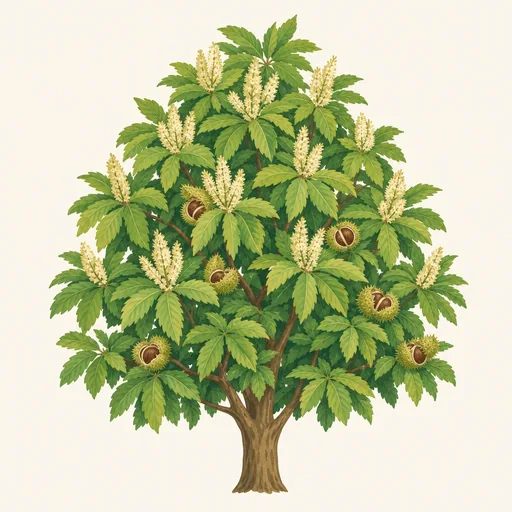
Chestnut
Castanea · Fagaceae
- Plant outFrom 4 weeks before the last frost until the last frostMar 13 – Apr 16
- Plant in autumn4–8 weeks before the first autumn frostAug 30 – Oct 3
- Space9–15 m (30–49 ft) apart
- BloomAfter 3–10 years
Description
The chestnut plant, primarily represented by the genus Castanea, encompasses several species, most notably the American chestnut (Castanea dentata), European chestnut (Castanea sativa), and the Chinese chestnut (Castanea mollissima). Chestnuts are deciduous trees typically found in temperate regions of the Northern Hemisphere.
These trees can grow to heights of 50-150 feet (15-45 meters) depending on the species and environmental conditions. They have a distinctive oval canopy and can live for several hundred years. Chestnut leaves are broad, serrated, and glossy, usually measuring 5-10 inches (12-25 cm) in length.
In mid to late summer, chestnut trees produce spiky burrs that encase one to three glossy, brown nuts. The nuts are edible and typically harvested in autumn, contributing not only to culinary dishes but also to traditional holiday fare in many cultures. Chestnuts are lower in fat compared to other nuts and are a good source of complex carbohydrates, vitamins, and minerals.
Historically, chestnut trees were significant in their ecosystems and economies. However, the American chestnut faced near extinction in the 20th century due to a blight caused by a fungal pathogen (Cryphonectaria parasitica), severely diminishing its populations.
Chestnut trees prefer well-drained, slightly acidic soils and full sun. They require moderate watering, especially during dry spells but should not sit in standing water. Growing chestnuts can be rewarding, as they are not only beautiful shade trees but also bear essential nuts for both wildlife and human use.
Growing Conditions
10–30 m (33–98 ft) tall, 10–20 m (33–66 ft) wide
- Smallest
- Largest
Full sun, 6+ hours
Moderate
Keep evenly moist, not soggy.
Ideal 15–30 °C (59–86 °F)
Survives down to −34 °C (−29 °F).
pH 5–6.5 · acidic
Where it Grows
Planting
When to Plant
Planting a chestnut tree (Castanea spp.) requires attention to timing, as proper planting significantly increases the likelihood of healthy growth and fruit production. Here are several key factors to consider when determining the best time to plant a chestnut tree:
Climate Considerations
-
Hardiness Zone: Chestnut trees thrive in USDA hardiness zones 4 to 8, depending on the species (for example, the American chestnut is suitable for zones 4-8, while the Chinese chestnut is typically hardy to zone 5). Knowing your hardiness zone will help you determine if chestnuts are suitable for your area.
-
Frost Dates: It's crucial to consult local frost dates. Chestnut trees should generally be planted after the last spring frost has passed. This is typically between late April and early June, but it can vary significantly based on your geographical location. For regions with mild winters, planting may be done in late winter as well.
Soil Preparation
-
Soil Temperature: Ideal soil temperature for chestnut planting is around 60°F (15°C) or warmer. Monitoring soil temperature will help you avoid planting too early when the soil is still cold.
-
Soil Condition: Before planting, ensure that the soil is well-drained and has been prepared adequately. You can test the soil moisture to make sure it's not too wet or too dry, ideally working within a slightly moist soil environment.
Seed vs. Seedling
-
Direct Sowing: If you are planting seeds, they are often best sown in late spring or early summer after the risk of frost has passed. Chestnut nuts must be harvested fresh or stored properly to maintain viability.
-
Transplanting Seedlings: If you are planting seedlings, fall is often the best time, as it provides cooler weather and ample moisture without the stress of summer heat. Alternatively, spring transplantation, after the last frost, can also be effective.
General Recommendations
-
Late Spring or Early Fall: For most regions, late spring (May or early June) is ideal for planting chestnut trees or seeds, as this timing helps establish roots before summer-heat stress. Alternatively, early fall (September) can also be an opportunistic time for planting, allowing the tree to take advantage of cooler temperatures and moisture.
-
Local Expertise: Always consult local agricultural extensions or horticulturists for precise timing tailored to your climate and specific chestnut variety.
By considering these factors and aligning your planting schedule accordingly, you can improve the chances of successful growth and establishment of your chestnut trees. Happy planting!
How to Plant
Planting a chestnut tree can be a rewarding endeavor, as these trees not only provide delicious nuts but also enhance the landscape. The best time to plant chestnuts is in spring or fall, depending on your climate. Here’s a step-by-step guide to ensure successful implantation.
-
Choosing the Right Species: Select a chestnut variety that is suited to your region, such as the American chestnut (Castanea dentata), European chestnut (Castanea sativa), or Chinese chestnut (Castanea mollissima).
-
Location: Find a well-drained site with full sun, ideally with acidic to neutral soil (pH 5.5-7.0). Ensure there’s enough space for the tree to spread, as they can grow quite large.
-
Preparing the Seed or Seedling: If planting seeds, soak them for 24 hours before planting to enhance germination. If using seedlings, ensure they are healthy and free of pests.
-
Planting: Dig a hole that is about twice the diameter of the root ball or approximately 6 inches deep for seeds. For seedlings, plant at a depth equal to the current height of the root system.
-
Watering and Mulching: Water thoroughly after planting and apply mulch to retain moisture and suppress weeds.
-
Care: Regularly check for pests and maintain consistent watering during dry spells, especially in the first few years.
By following these guidelines, you’ll set the foundation for a thriving chestnut tree in your garden.
Growth Timeline
- Establishing 3 years
- First flowers possible years 3–10
Planting Calendar
- Plant outdoors: from 4 weeks before the last frost until the last frost
- Autumn planting: 4–8 weeks before the first autumn frost
- Plant out: Mar 13 – Apr 16
- Autumn planting: Aug 30 – Oct 3
Care
Care Calendar
- Prune · Feb 13 – Apr 2
Remove dead or crossing branches while the tree is dormant. - Mulch · Mar 27 – May 14
Spread organic mulch around the tree, keeping it clear of the trunk. - Feed · Apr 10 – May 14
Feed young trees lightly in spring if soil or growth indicates a need. - Protect · Sep 27 – Nov 14
Check guards on young trunks for rodent and deer damage.
Watering
Watering a chestnut plant requires a balanced approach to ensure its health and vigor. The best strategy is to consistently maintain soil moisture without over-saturating. Young chestnut trees thrive when the soil is kept evenly moist, particularly during their establishment phase, which typically lasts the first couple of years after planting.
To achieve this, water deeply and infrequently, allowing the top inch of soil to dry out between watering sessions. This encourages deep root growth. In the first summer after planting, weekly watering is advisable, increasing frequency during particularly hot or dry spells. As the tree matures, less frequent watering may be needed, depending on rainfall and soil drainage.
Avoid watering directly on the leaves to prevent fungal diseases, and always check soil moisture before watering. Proper mulching can also help retain soil moisture and regulate temperature around the roots.
Pruning
Pruning a chestnut plant is essential for promoting healthy growth, improving air circulation, and enhancing fruit production. The best strategy involves timing and technique.
-
Timing: Prune your chestnut tree during the dormant season, ideally late winter to early spring (February to March), before new growth begins. This minimizes stress on the tree and reduces the risk of disease.
-
Tools: Use sharp, clean pruning shears or loppers to create clean cuts.
-
Technique: Start by removing any dead, damaged, or crossing branches. Thin out crowded areas to improve light penetration and air circulation. Aim for an open center structure to allow sunlight to reach all parts of the tree. Make cuts at a slight angle just above a bud or branch junction to encourage healthy regrowth.
-
Monitoring: After pruning, monitor the tree for signs of stress or disease, and adjust care practices accordingly.
This balanced approach ensures vibrant growth and better nut yields in future seasons.
Weeding
Weeding around a Chestnut plant is essential for promoting healthy growth and minimizing competition for nutrients and water. The best strategy involves a combination of manual weeding and mulching.
Start by regularly inspecting the area around the Chestnut plant, especially in the early growth stages when weeds tend to proliferate. Manual removal of weeds is effective; gently pull them out by hand or use a hand tool to avoid disturbing the roots of the chestnut tree.
Incorporating a layer of organic mulch, such as wood chips or straw, around the plant can significantly reduce weed growth by blocking sunlight and retaining moisture. Aim for a mulch depth of about 3-4 inches, keeping it a few inches away from the trunk to prevent rot.
Regularly monitoring and maintaining the area will help keep weeds at bay, ensuring that your Chestnut plant has the best chance to thrive.
Mulching
Mulching is essential for promoting healthy growth in Chestnut plants, as it helps retain soil moisture, suppresses weeds, and improves soil quality. To mulch effectively, follow these steps:
-
Timing: Apply mulch in early spring after the soil warms up, ensuring no frost danger remains, or late fall before the first frost to protect roots.
-
Material: Use organic materials like wood chips, shredded bark, straw, or grass clippings. These not only provide insulation but also enrich the soil as they decompose.
-
Depth: Aim for a 3 to 4-inch layer of mulch around the base of the Chestnut plant. Avoid piling mulch directly against the trunk, as this can lead to moisture-related issues.
-
Maintenance: Replenish the mulch annually, especially in the spring, to maintain coverage and support ongoing soil health.
By following these strategies, you'll ensure your Chestnut plant has the best possible conditions for thriving.
Fertilizing
Fertilizing a Chestnut plant effectively involves understanding its nutrient needs and soil conditions. Begin by conducting a soil test to determine nutrient levels and pH; Chestnuts thrive in slightly acidic to neutral soils (pH 6-7). Based on the test results, apply a balanced fertilizer, such as a 10-10-10 (N-P-K) formulation, in early spring as new growth begins.
Typically, 2-4 pounds of fertilizer per 100 square feet is advisable, but adjust according to soil fertility. If the test shows low nitrogen, consider an additional application of a nitrogen-rich fertilizer in late spring or early summer to support growth. Always water the plant after fertilization to help the roots absorb nutrients effectively. Avoid over-fertilizing, as this can lead to excessive foliage growth at the expense of fruit production. Regular mulching can also enhance soil health and moisture retention, complementing your fertilization efforts.
Growing in Containers
Not well suited to growing in pots.
Propagation
From seed
- Collect fresh, mature nuts in autumn.
- Keep the nuts moist and refrigerate them for two to three months.
- Sow each nut about 1 inch deep in a deep pot or prepared bed.
- Protect seedlings from rodents and keep the soil evenly moist.
By grafting
- Collect dormant scion wood from the desired chestnut variety.
- Choose a healthy, compatible chestnut rootstock.
- Graft the scion onto the rootstock in spring.
- Wrap and seal the graft union.
- Remove shoots that grow from below the graft.
Common Problems
- Wilting
- Leaves dropping
- Stunted growth
- Soft or rotting stems
Canker is a general name for a localized area of dead bark and underlying tissue on a woody stem or branch, not a…
- Yellowing leaves
- Wilting
- Stunted growth
- Leaves dropping
Root rot is a general name for the decay of plant roots, not a single disease with one scientific name. It can result…
- Stems chewed or cut through
- Stunted growth
Deer are browsing mammals that feed on many garden plants. “Deer” refers to several species in the family Cervidae…
Varieties
Its flowers produce little usable pollen, so plant a compatible pollinator nearby.
- large nuts
- early
This cultivar needs a separate pollen-producing chestnut.
- large nuts
- gall wasp resistant
Plant it with another compatible chestnut for a reliable crop.
- sweet nuts
- blight tolerant
This named Chinese selection needs a compatible pollination partner.
- sweet nuts
- blight tolerant
Allow room for a full-sized tree and plant a compatible pollinator.
- large nuts
- vigorous
More about varieties
Chestnuts are beloved not only for their distinctive flavor but also for their versatility in culinary applications. There are several common varieties of chestnut, each with unique attributes, growing conditions, and uses. Understanding these varieties can help gardeners and hobbyists choose the right type for their gardens or orchards.
1. American Chestnut (Castanea dentata)
The American Chestnut is native to the eastern United States and was once a dominant tree in American forests. However, it was largely decimated by the chestnut blight in the early 20th century. Here are some key features:
- Size: Can grow up to 100 feet tall.
- Nuts: Sweet, edible nuts that are large and have a soft texture.
- Cultivation: Requires well-drained, acidic soils and can grow in various conditions. However, due to its vulnerability to blight, the cultivation focus has shifted towards breeding blight-resistant variants.
2. European Chestnut (Castanea sativa)
Predominantly grown in Europe, the European Chestnut is prized for its timber and edible nuts. It is also resilient compared to its American counterpart.
- Size: Grows up to 100 feet tall.
- Nuts: Nut size is generally medium and has a sweet flavor, popular in many culinary dishes, particularly in Mediterranean cuisine.
- Cultivation: Thrives in well-drained loamy soils and is drought-resistant once established. It prefers full sun and can be grown in a range of climates.
3. Chinese Chestnut (Castanea mollissima)
Native to China and parts of Korea, the Chinese Chestnut is another species that has found its way into gardens and orchards worldwide. It's known for its fast growth and resistance to blight.
- Size: Typically reaches 30 to 50 feet in height.
- Nuts: Smaller compared to the American and European varieties; they are sweet and often considered a culinary delicacy.
- Cultivation: Adaptable to different soil types, but prefers slightly acidic, well-drained soil. It’s known for its relatively hardy nature and ability to produce nuts in less favorable conditions.
4. Japanese Chestnut (Castanea crenata)
The Japanese Chestnut is cultivated primarily in Japan and parts of Asia. It has gained popularity for its productivity and quality of nuts.
- Size: Generally grows between 30 to 60 feet tall.
- Nuts: These nuts are sweet and have a size and flavor profile similar to that of the Chinese chestnut.
- Cultivation: Prefers well-drained soils and is more tolerant of cooler climates, making it suitable for northern regions where other chestnuts may struggle.
5. Hybrid Chestnuts
Due to the devastation of the American Chestnut by blight, various cross-breeding projects have emerged to develop hybrid chestnuts that combine the hardiness of American varieties with the blight resistance of Chinese varieties.
- Features: These hybrids often have desirable growth characteristics and nut sizes while maintaining some of the classic American Chestnut traits.
- Cultivation: Hybrids can be grown in a wide range of environments, with many exhibiting resistance to diseases that affect traditional chestnut trees.
Conclusion
Choosing the right variety of chestnut plant can greatly influence your gardening success and culinary enjoyment. Each type has its unique characteristics and growing requirements, so consider your local climate, soil conditions, and personal preferences when selecting a chestnut variety for cultivation. Whether you are looking to recreate historic orchards, enjoy fresh roasted chestnuts, or explore new flavors in your cooking, chestnuts offer a rewarding experience for gardeners and food enthusiasts alike.
Health Benefits
Chestnuts, particularly sweet chestnuts (Castanea spp.), have been valued not only for their culinary properties but also for various health and wellness applications. These nuts are low in fat and high in complex carbohydrates, making them an excellent energy source. Nutritionally, they are rich in dietary fiber, which aids in digestion and promotes gut health.
Moreover, chestnuts contain significant amounts of vitamins C and B6, as well as essential minerals like magnesium, potassium, and iron. Vitamin C is crucial for immune function and skin health, while B6 plays a role in brain health and metabolic processes. The antioxidant properties of chestnuts help combat oxidative stress, potentially reducing the risk of chronic diseases.
In traditional medicine, chestnuts have been used for their anti-inflammatory benefits, which can be helpful for conditions like arthritis or joint pain. Additionally, extracts from the chestnut tree bark and leaves are sometimes used in herbal remedies for their astringent properties, useful in treating respiratory issues and promoting overall health.
Incorporating chestnuts into a balanced diet not only enhances flavor but also supports wellness, making them a valuable addition to healthy eating practices.
Fun Facts
-
Nutritional Powerhouse: Unlike many other nuts, chestnuts are low in fat and high in carbohydrates, making them a healthy option. They also contain vitamin C, fiber, and various essential minerals.
-
Edible Varieties: There are several species of chestnut trees, but the most commonly consumed are the American chestnut (Castanea dentata) and the European chestnut (Castanea sativa). Both provide delicious nuts, but they have different growth habits and flavors.
-
Historical Significance: Chestnuts played a crucial role in the diet of many cultures. In ancient times, they were often referred to as "the bread of the poor" because they were a staple food for communities in regions where they grew abundantly.
-
Unique Harvesting: Chestnuts have a prickly husk that encases the nuts, making harvesting a bit challenging. The nuts fall from the trees when mature, and gatherers must wear protective gloves to avoid the sharp husks when collecting them.
-
Chestnut Blight: The American chestnut population faced a severe decline in the early 20th century due to a fungal disease known as chestnut blight, caused by the pathogen Cryphonectria parasitica. This has led to extensive attempts at breeding disease-resistant hybrids, sparking interest in conservation and reforestation efforts.
Notice an error or have a question about Chestnut? Contact us