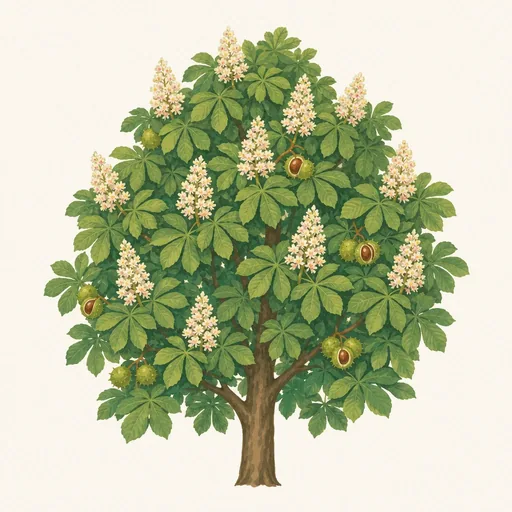
Horse Chestnut
Aesculus hippocastanum · Sapindaceae
- Plant outFrom 4 weeks before the last frost until the last frostMar 13 – Apr 16
- Plant in autumn4–6 weeks before the first autumn frostSep 13 – Oct 3
- Space12–20 m (39–66 ft) apart
- BloomAfter 10–20 years
Description
The Horse Chestnut (Aesculus hippocastanum) is a large deciduous tree native to the Balkan Peninsula but widely planted across Europe and North America for its ornamental value. It typically reaches heights of 50 to 75 feet (15 to 23 meters) and can spread up to 40 feet (12 meters) in width. The tree features a broad, rounded crown and palmate leaves—each consisting of five to seven leaflets that radiate from a central point, contributing to its lush appearance.
In spring, Horse Chestnut trees produce showy clusters of white to pink flowers, often resembling candles, which attract bees and other pollinators. These flowers bloom in dense upright panicles, adding to the tree's aesthetic appeal. The tree bears large, spiky green fruits, often referred to as “conkers,” which contain one or more shiny brown seeds. While the seeds are technically edible, they contain toxic compounds that can be harmful if consumed raw.
Horse Chestnut trees thrive in a variety of soil types but prefer well-drained, moist soils and full sun to partial shade. They are generally considered low-maintenance and are valued for their shade and ornamental properties, making them popular choices for parks and public spaces. However, they can be susceptible to diseases, such as horse chestnut leaf miner and various fungal infections.
Overall, the Horse Chestnut is admired for its beauty, ecological benefits, and historical significance, making it a cherished addition to many landscapes.
Growing Conditions
15–25 m (49–82 ft) tall, 12–20 m (39–66 ft) wide
- Smallest
- Largest
Full sun
Tolerates part sun, part shade
Moderate
Keep evenly moist, not soggy.
Survives down to −40 °C (−40 °F)
acidic to neutral to alkaline
Where it Grows
Planting
When to Plant
When to Plant a Horse Chestnut
The Horse Chestnut tree (Aesculus hippocastanum) is a deciduous tree known for its striking flowers and large, palmate leaves. When determining the best time to plant a Horse Chestnut, several key factors come into play, including the season, local climate, and seed or sapling choice.
Ideal Planting Season
The best time to plant a Horse Chestnut tree is during the early spring or fall. This timing allows the tree to establish its root system before facing the stress of summer heat or winter cold. In most temperate climates, here are some guidelines:
-
Spring Planting: As a general rule, plant when the soil is workable and temperatures consistently rise above freezing, typically from mid-March to May.
-
Fall Planting: If you prefer to plant in the fall, aim to do so at least six weeks before the first expected frost. This usually falls between late September and October in many regions.
Seed or Sapling
The method of propagation will influence your timing:
-
Planting Seeds: If you're planting Horse Chestnut seeds (known as conkers), it's beneficial to stratify them, as the seeds require a period of cold to germinate effectively. This means you can plant them directly in the ground in the fall, or you can collect the seeds in the fall, stratify them in a refrigerator for a few months, and then plant them in spring.
-
Planting Saplings: If you have purchased a young sapling, it's usually ready for immediate planting in spring or fall, depending on how it has been cared for prior to purchase.
Local Climate Considerations
Always consider your local climate when planning your planting schedule. In warmer climates, early spring may be the best option to avoid excessive heat stress, while in colder climates, fall planting may be too risky due to the potential for frost damage.
Site Preparation
Regardless of when you choose to plant, preparing your planting site in advance is crucial. Horse Chestnuts thrive in well-drained soil with good sunlight and sufficient space to grow, as these trees can become large and majestic. Clear the area of weeds and debris, and consider improving soil quality with organic matter.
By following these guidelines, you can establish a healthy Horse Chestnut tree that will offer aesthetic value and shade for years to come.
How to Plant
Planting a Horse Chestnut (Aesculus hippocastanum) requires careful consideration to ensure healthy growth. Ideally, late spring or early autumn is the best time to plant, as this allows the tree to establish roots before extreme weather conditions.
First, choose a suitable location that offers plenty of sunlight and enough space for the tree to grow—Horse Chestnuts can reach heights of 50 feet or more with a wide canopy. The soil should be well-draining, as the tree doesn’t thrive in waterlogged conditions.
To plant, dig a hole that is approximately twice the width and the same depth as the root ball. If you’re planting from seed, it’s advisable to stratify the seeds by soaking them in water for 24 hours and then chilling them in the refrigerator for a few months before planting in spring. When ready, place the seed or seedling in the center of the hole, ensuring the top of the root ball is level with the soil surface.
Backfill the hole with a mix of native soil and organic compost to provide nutrients, water thoroughly, and mulch around the base to retain moisture and suppress weeds. Regular watering is crucial, especially during dry periods, as the Horse Chestnut establishes itself.
Growth Timeline
- Establishing 10 years
- First flowers possible years 10–20
Planting Calendar
- Plant outdoors: from 4 weeks before the last frost until the last frost
- Autumn planting: 4–6 weeks before the first autumn frost
- Plant out: Mar 13 – Apr 16
- Autumn planting: Sep 13 – Oct 3
Care
Care Calendar
- Prune · Feb 13 – Apr 2
While dormant, remove dead or damaged branches and avoid heavy pruning. - Mulch · Apr 10 – May 14
Spread mulch over the root area, keeping it clear of the trunk.
Watering
Watering a Horse Chestnut plant (Aesculus hippocastanum) requires a balanced approach to ensure healthy growth. Young trees should be watered deeply to establish strong roots, particularly during dry spells. The ideal strategy involves checking the top 1-2 inches of soil; if it feels dry, it’s time to water. Aim for a thorough soak, applying approximately 10-15 gallons of water per session.
In the first few years, watering should occur every week or two, decreasing in frequency as the tree matures and develops deeper roots. Mulching around the base can help retain moisture and regulate soil temperature. During particularly hot or windy conditions, be sure to increase watering frequency. Monitoring for signs of stress, such as leaf wilting or browning, will also guide you in adjusting your watering strategy. Proper watering practices will promote a robust, resilient Horse Chestnut tree.
Pruning
Pruning a Horse Chestnut (Aesculus hippocastanum) should be approached with care, as these trees have a unique growth structure. The best strategy involves pruning during late winter or early spring, just before new growth begins. This timing minimizes stress and promotes healthy regrowth.
Start by removing any dead, damaged, or diseased branches to enhance air circulation and overall tree health. Thin out any crossing branches to prevent rubbing, which can lead to wounds susceptible to disease. Maintain the natural shape of the tree by selectively trimming back branches that are growing inward or are overly crowded.
Avoid heavy pruning, as it can lead to stress and the production of an excessive number of water sprouts. Aim to retain the tree’s natural form, promoting sunlight penetration and airflow throughout the canopy. After pruning, monitor the tree for signs of stress or disease to ensure it remains healthy and vibrant.
Weeding
Weeding around a Horse Chestnut (Aesculus hippocastanum) is crucial for its health and vigor. The best strategy involves both manual and preventive measures. Begin by assessing the area around the plant and removing visible weeds by hand, ensuring to pull them out from the root to prevent regrowth. This is best done when the soil is moist, which makes it easier to extract deep-rooted weeds.
Mulching is an effective preventive strategy; applying a layer of organic mulch, like wood chips or straw, reduces weed competition while retaining soil moisture and regulating temperature. Be sure to maintain a mulch depth of about 2-3 inches and avoid mulch touching the tree trunk to prevent rot. Regular maintenance, including periodic inspection and removal of emerging weeds, will help keep the area around your Horse Chestnut healthy and thriving. Additionally, be mindful of nearby plants that may compete for nutrients and sunlight.
Mulching
Mulching is an essential practice for Horse Chestnut (Aesculus hippocastanum) care, offering numerous benefits including moisture retention, temperature regulation, and weed suppression. The best strategy begins with selecting the right mulch; organic options such as wood chips, bark, or shredded leaves are ideal. Begin by applying a 2-4 inch layer around the base of the tree, ensuring it extends to the tree's drip line but keeping it at least 6-12 inches away from the trunk to prevent rot.
Before mulching, clear any weeds or grass from the area. It's advisable to mulch in late spring or early summer when the soil is warm, which helps in moisture retention during the drier months. Monitor the mulch layer over time, replenishing it as necessary to maintain depth and ensure effectiveness. This strategy will promote healthier growth and resilience in your Horse Chestnut plant while fostering a thriving garden ecosystem.
Fertilizing
When fertilizing a Horse Chestnut (Aesculus hippocastanum), the best strategy is to focus on a balanced approach. This deciduous tree benefits from a slow-release, granular fertilizer that is high in nitrogen, phosphorus, and potassium (N-P-K ratio of 10-10-10 or similar). Fertilization should typically occur in early spring, just before new growth begins.
Apply the fertilizer evenly around the tree's root zone, avoiding direct contact with the trunk to prevent burning. Water thoroughly after application to help the nutrients penetrate the soil. It's essential to monitor the tree’s growth; if leaves are yellowing or growth is stunted, consider a soil test to determine nutrient deficiencies. Additionally, avoid over-fertilizing as it can lead to weak growth and increased susceptibility to pests and diseases. Ideally, fertilization should be supplemented with organic matter like compost to improve soil structure and health.
Growing in Containers
Not well suited to growing in pots.
Propagation
From seed
- Collect ripe conkers when they fall in autumn and remove their husks.
- Sow them promptly, about 3 cm deep, in pots of well-drained compost.
- Keep the pots outdoors through winter, protected from rodents, and keep the compost slightly moist.
- Transplant the seedlings after they emerge in spring.
Common Problems
- Winding tunnels in leaves
- Spots on leaves
- Leaves dropping
Leaf miners are the larvae of several kinds of flies, moths, beetles, and sawflies, rather than a single species with…
- Spots on leaves
- Yellowing leaves
- Leaves dropping
Fungal leaf spot is a general name for diseases caused by many different fungi, not a single species. These fungi…
- Wilting
- Leaves dropping
- Stunted growth
- Soft or rotting stems
Canker is a general name for a localized area of dead bark and underlying tissue on a woody stem or branch, not a…
- Brown or crispy leaf edges
- Bleached or scorched patches
- Yellowing leaves
- Wilting
Leaf scorch is a description of leaf damage, not a single disease with a scientific name. It develops when leaves lose…
Varieties
Its long-lasting white flower clusters make it useful where fallen conkers would be a nuisance.
- double flowers
- rarely sets conkers
It has a narrower crown than a typical horse chestnut but still needs room to grow.
- upright habit
- white flowers
Its deeply divided leaflets give the tree a distinctive, delicate appearance.
- finely cut leaves
- ornamental foliage
More about varieties
The Horse Chestnut (Aesculus hippocastanum) is a large deciduous tree belonging to the Sapindaceae family, most recognized for its distinctive palmate leaves and showy flower clusters. While the Horse Chestnut is primarily known as a single species, there are several notable varieties and closely related species that are appreciated by gardeners and enthusiasts alike. Below are some of the common varieties and species associated with the Horse Chestnut.
1. Aesculus hippocastanum (Common Horse Chestnut)
- This is the most well-known species, native to the Balkan Peninsula and widely planted in parks and large gardens. Its large white flower spikes bloom in the spring, followed by the formation of spiky seed capsules.
2. Aesculus x carnea (Red Horse Chestnut)
- A hybrid between Aesculus hippocastanum and Aesculus pavia, this variety is cherished for its striking red to pink flowers. It grows slightly smaller than the common horse chestnut, making it suitable for urban settings.
3. Aesculus pavia (Red Buckeye)
- Native to the eastern United States, this smaller tree is appreciated for its red, tubular flowers and is often planted for its ornamental value. Unlike the common horse chestnut, it produces smaller, non-edible nuts.
4. Aesculus octandra (Yellow Buckeye)
- This species is characterized by its large, yellow flowers and is often found in the southeastern United States. The foliage turns a vibrant yellow in the fall, adding seasonal interest to landscapes.
5. Aesculus chinensis (Chinese Horse Chestnut)
- Originating from China, this species is prized for its lovely pale yellow to white flowers and attractive, glossy leaves. It can tolerate different soil types and is sometimes used for ornamental purposes in gardens.
6. Aesculus flava (Sweet Buckeye)
- Known for its sweet, edible nuts (though they must be processed to make them safe for consumption), this species yields large, yellow flowers and is native to the eastern United States. Its nuts are a food source for wildlife.
7. Aesculus californica (California Buckeye)
- This species is native to California and has a more shrub-like form. It features large clusters of pale flower spikes and is drought-tolerant, making it an excellent choice for low-water gardens.
Conclusion The Horse Chestnut and its relatives offer a wide range of ornamental and practical benefits for gardeners. While many of these species share similar traits like large leaves and impressive flowers, they each bring unique characteristics that can enhance a landscape. When choosing a variety, consider factors such as hardiness, flower color, and growth habits to ensure the right fit for your gardening needs.
Health Benefits
Horse Chestnut (Aesculus hippocastanum) and its Health Applications
Horse chestnut, known for its striking appearance and large seed pods, has been utilized in traditional medicine for centuries. The primary health applications stem from its active component, aescin, which is found in the seeds and can offer various wellness benefits.
One of the most recognized applications of horse chestnut is in managing chronic venous insufficiency (CVI). This condition involves inadequate blood flow in the veins, often leading to symptoms like leg swelling and discomfort. Aescin is believed to strengthen blood vessel walls and reduce inflammation, thereby improving circulation and alleviating symptoms associated with CVI.
Additionally, horse chestnut is often used topically to reduce symptoms of hemorrhoids and varicose veins due to its anti-inflammatory and anti-edema properties. This topical application can help soothe affected areas, reducing swelling and pain.
Caution should be exercised, as unprocessed seeds and other parts of the plant can be toxic. It's essential to use commercial preparations that ensure safety and efficacy. As interest in herbal remedies continues to grow, horse chestnut remains a prominent choice in herbal medicine for supporting vascular health.
Fun Facts
-
Not for Consumption: Despite its name, the Horse Chestnut is not related to the edible chestnuts (Castanea species) and its seeds are toxic to humans if ingested, containing compounds that can cause nausea and neurological symptoms.
-
Distinctive Seed Appearance: The seeds of the Horse Chestnut, often referred to as "conkers," have a shiny brown surface with a lighter scar where they were attached to the tree, making them easily recognizable.
-
Cultural Significance: Conkers have been traditionally used in a children's game in the UK, where the hard seeds are strung on a rope and used to strike another's conker, with the goal of breaking it. This game celebrates the natural habitat and brings communities together.
-
Beautiful Flowers: Horse Chestnut trees bloom in mid to late spring, producing large, upright clusters of white or pink flowers, which serve as an important nectar source for bees and other pollinators.
-
Medicinal Uses: The extract from the seeds of Horse Chestnut is used in herbal medicine to treat various conditions, notably chronic venous insufficiency, where it is said to help improve blood circulation and alleviate symptoms like swelling and pain in the legs.
Notice an error or have a question about Horse Chestnut? Contact us