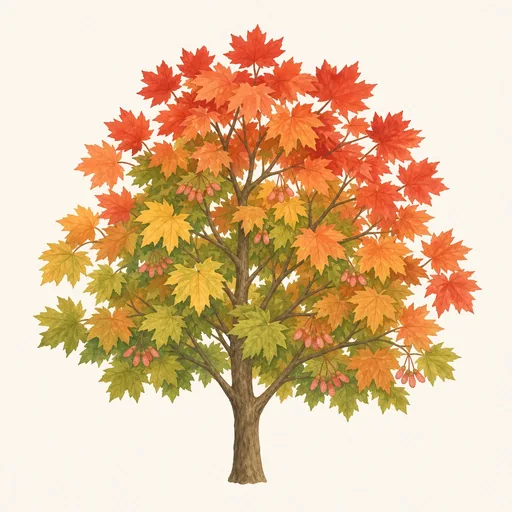
Maple
Acer · Sapindaceae
- Plant in autumn4–8 weeks before the first autumn frostAug 30 – Oct 3
Description
The maple is a genus of trees and shrubs known as Acer, widely recognized for their stunning foliage and distinctive leaf shape. There are approximately 150 species of maples, predominantly found in North America, Asia, and Europe. Maples are admired for their vibrant fall colors, with leaves that often turn shades of red, orange, and yellow as temperatures cool.
Maple leaves typically have a palmate structure, meaning they have lobes radiating from a central point, making them easily identifiable. They grow on trees that vary in size and shape, ranging from small ornamental varieties to large shade trees that can reach heights of over 100 feet (30 meters).
The wood of maple trees is prized for its strength and elegant appearance, making it a popular choice in furniture-making and flooring. Additionally, many species of maple yield sap that can be harvested to produce maple syrup, a sweet syrup commonly used as a topping for pancakes and waffles.
Maples are generally hardy plants, thriving in a variety of soil types as long as they are well-drained and receive adequate moisture. They prefer full sun to partial shade, making them suitable for different garden settings. In addition to their aesthetic appeal, maples can provide habitat and food for wildlife, enriching the ecosystem.
With their striking seasonal changes and practical uses, maples are a popular choice among gardeners looking to create visually appealing landscapes or sustainable gardens. Their versatility and resilience make them ideal candidates for planting in both urban and rural environments.
Growing Conditions
Part shade
Tolerates full sun, part sun
Moderate
Keep evenly moist, not soggy.
Survives down to −40 °C (−40 °F)
acidic to neutral
Where it Grows
Planting
When to Plant
When to Plant a Maple Tree
Planting a maple tree can be a rewarding experience for any gardener or hobbyist. These majestic trees, known for their vibrant fall foliage and sturdy growth, require careful consideration regarding timing. Here are the key factors to keep in mind when deciding when to plant a maple tree:
1. Season Timing
Spring and Fall Planting: The best time to plant a maple tree is during the early spring or late fall. Spring planting allows the tree to establish roots before the summer heat, while fall planting gives it a head start on dormancy, allowing the roots to grow in cooler soil.
- Spring Planting: Aim to plant your tree after the last frost date in your area. This timing ensures that the ground is no longer frozen, allowing the roots to expand and acclimatize before the heat of summer.
- Fall Planting: If you're considering fall, look to plant at least six weeks before the ground freezes. This time frame allows roots to establish before winter.
2. Soil Temperature
Monitor Soil Conditions: Maple trees prefer well-drained soil. Before planting, check the soil temperature; it should ideally be between 50°F and 60°F (10°C to 16°C). If the ground is too cold, the roots may not establish well.
3. Weather Conditions
Avoid Extreme Weather: When choosing a planting date, ensure that you avoid extreme weather conditions. Planting during a rainy spell can lead to muddy conditions that might harm the roots, while hot, dry weather can stress the young tree. Aim for a calm, overcast day if possible.
4. Varietal Considerations
Choose the Right Species: Different species of maple have varying tolerances to climate and soil types, which can also influence your planting timing. For example, the Sugar Maple (Acer saccharum) is well suited for cooler climates, while the Red Maple (Acer rubrum) is more adaptable and can thrive in a wider range of conditions. Research the specific type of maple you intend to plant to understand its requirements better.
5. Local Climate Zones
Know Your Growing Zone: Understanding your USDA plant hardiness zone is crucial in determining optimal planting times. Maple trees generally thrive in USDA Hardiness Zones 3 to 9, but knowing your specific region can help refine the best planting dates based on your local climate.
6. Post-Planting Care
Aftercare Considerations: Once you have planted your maple tree, be prepared not only for the initial planting but also for post-planting care that includes regular watering, mulching, and protection from pests. Proper aftercare will enhance the tree’s success, no matter when you've planted it.
By taking into account these factors, amateur gardeners can successfully establish maple trees that will flourish for generations to come. Happy gardening!
How to Plant
Planting a maple tree involves several key steps to ensure healthy growth and establishment. First, choose a location with well-drained soil that receives full sunlight to partial shade; most maple species thrive in these conditions. The ideal time for planting is in early spring or fall, when the soil is workable and temperatures are moderate.
Begin by digging a hole that is at least twice the width of the root ball and as deep as the root ball itself. Loosen the soil at the bottom of the hole to encourage roots to spread. Remove the tree from its container or burlap and gently massage the roots to relieve any circling or compacted roots. Place the maple in the center of the hole, ensuring the top of the root ball is level with the surrounding soil.
Backfill the hole with native soil, avoiding the addition of amendments unless the soil is poor. Water thoroughly after planting to settle the soil and eliminate air pockets. Mulching around the base helps retain moisture and suppress weeds. Lastly, establish a watering schedule, especially during dry periods, to support your maple tree’s initial growth. With proper care, your maple will flourish in its new home.
Planting Calendar
- Autumn planting: 4–8 weeks before the first autumn frost
- Autumn planting: Aug 30 – Oct 3
Care
Care Calendar
- Mulch · Apr 10 – May 14
Spread 2–3 inches of mulch over the root zone, keeping it clear of the trunk. - Prune · Jun 5 – Aug 6
Remove dead or crossing branches in summer; avoid heavy pruning. - Protect · Oct 11 – Nov 14
Fit a ventilated trunk guard to young trees where rodents or winter sunscald are a risk.
Watering
When caring for a Maple plant, proper watering is crucial for healthy growth. The best strategy involves establishing a consistent schedule based on the plant's age, size, and environmental conditions.
For young Maples, water them deeply about once a week during dry spells, ensuring that the soil remains moist but not waterlogged. Mature Maples typically require less frequent watering, usually every 10 to 14 days, depending on rainfall and soil moisture.
Observe the soil: if the top inch feels dry, it’s time to water. During hot summer months or drought periods, you may need to increase frequency. Avoid overhead watering to minimize leaf disease; instead, aim for the soil’s root zone. Mulching around the base can help retain moisture and regulate soil temperature. Always tailor your watering routine to the specific needs of your Maple variety and local climate conditions for optimal results.
Pruning
Pruning a Maple plant requires careful timing and technique for optimal health and aesthetics. The best strategy begins in late winter to early spring, just before new growth begins, when the tree is dormant. This timing minimizes sap loss and stress on the plant.
Begin by removing any dead, diseased, or damaged branches to promote overall health. Next, focus on shaping the tree by selectively removing branches that cross or crowd one another, which improves air circulation and sunlight penetration. Aim for a balanced canopy by cutting back excessively long or erratically growing branches.
Utilize clean, sharp pruning shears for cuts, ensuring they are angled appropriately to promote healing. Avoid heavy pruning; typically, pruning no more than 20% of the canopy is advisable in a single season. Finally, step back frequently to evaluate the tree’s shape throughout the process, ensuring a natural and pleasing silhouette.
Weeding
Weeding around a maple plant is essential for its healthy growth and development. The best strategy involves a few key steps:
-
Observation: Regularly inspect the area surrounding the maple for unwanted weeds. Early detection makes it easier to manage them.
-
Hand Weeding: For small infestations, hand-pulling is effective. Ensure you remove the entire root to prevent regrowth. This is best done after rain when the soil is soft.
-
Mulching: Applying a layer of organic mulch around the base of the maple helps suppress weed growth, retain moisture, and improve soil quality. Aim for 2-3 inches of mulch, keeping it away from the trunk.
-
Cultivation: Lightly cultivate the soil around the maple, being cautious not to damage the roots. This aerates the soil and disrupts weed growth.
-
Herbicides: If using chemical options, select targeted herbicides that won't harm the maple. Always follow label instructions for application.
Implementing these strategies will ensure a healthier environment for your maple plant.
Mulching
Mulching is a vital practice for maintaining the health of a Maple plant. The best strategy begins with selecting the right mulch material, such as shredded bark, wood chips, or straw, which helps conserve moisture and suppress weeds.
Start by applying a layer of mulch 2-4 inches thick around the base of the Maple, ensuring it extends out to the drip line of the plant. It's vital to keep mulch a few inches away from the trunk to prevent moisture buildup that can lead to rot or disease.
Mulching in early spring is ideal, as it helps regulate soil temperature and retains moisture during warmer months. Additionally, replenish mulch as needed throughout the growing season to maintain coverage. Regularly monitoring the moisture level in the soil beneath the mulch is essential, as well; this ensures that the Maple receives sufficient water while still benefiting from the protective layer.
Fertilizing
Fertilizing a maple plant requires an understanding of its specific needs and growth stage. The best strategy is to use a balanced, slow-release fertilizer with an N-P-K ratio of 10-10-10 or similar. This promotes overall plant health.
Apply fertilizer in early spring, as this is when maples begin their active growth phase. If using granules, evenly distribute them around the root zone, avoiding direct contact with the trunk to prevent burning. Water thoroughly after application to help the nutrients penetrate the soil.
In addition to granular fertilizers, consider supplementing with organic options such as compost or well-rotted manure, which enhance soil quality and promote beneficial microbial activity. Regularly monitor your plant for signs of nutrient deficiency, such as yellowing leaves, and adjust your fertilization approach as needed. Always remember that over-fertilization can be harmful, so err on the side of caution.
Growing in Containers
Grows well in a pot of at least 50 litres (13 US gallons), with drainage holes. Best kept outdoors.
Propagation
From seed
- Collect ripe winged seeds from a healthy tree.
- Sow spring-ripening seeds promptly; keep fall-ripening seeds moist and cold-stratify them if the species requires it.
- Sow in a well-drained seed-starting mix.
- Keep the mix moist until seedlings emerge.
- Transplant seedlings after they develop sturdy roots.
From cuttings
- Take softwood cuttings from new growth in late spring or early summer.
- Remove the lower leaves and dip the cut ends in rooting hormone.
- Insert the cuttings into a moist, free-draining rooting mix.
- Keep them humid and out of direct sun until rooted.
- Pot up rooted cuttings and acclimate them gradually.
By grafting
- Collect dormant scion wood from the cultivar you want to reproduce.
- Choose a compatible maple rootstock of similar stem thickness.
- Join the cut surfaces so their cambium layers touch, then secure the graft.
- Keep the graft sheltered until it begins growing.
- Remove shoots that emerge below the graft.
Common Problems
- Spots on leaves
- Brown or crispy leaf edges
- Bleached or scorched patches
- Leaves dropping
Anthracnose is a name for several fungal diseases, not a single species. Depending on the plant, the cause may be a…
- Yellowing leaves
- Sticky residue on leaves
- Black sooty coating
- Curled or cupped leaves
Aphids are small, soft-bodied insects that feed by piercing plants and drawing out sap. The group includes many…
- Brown or crispy leaf edges
- Bleached or scorched patches
- Yellowing leaves
- Wilting
Leaf scorch is a description of leaf damage, not a single disease with a scientific name. It develops when leaves lose…
- Yellowing leaves
- Sticky residue on leaves
- Black sooty coating
- Stunted growth
Scale insects are small, sap-feeding insects that settle on garden and houseplants. Adults often look like bumps on…
- Yellowing leaves
- Brown or crispy leaf edges
- Wilting
- Stunted growth
Verticillium wilt is a soilborne disease caused mainly by the fungi Verticillium dahliae and V. albo-atrum. The fungi…
Varieties
A widely grown Japanese maple with dark leaves that hold their color well in partial shade.
- purple foliage
- small tree
Its colorful young stems stand out after the leaves fall.
- coral-red bark
- winter interest
This green-leaved selection is valued for its vivid scarlet autumn display.
- red fall color
- small tree
A large shade tree selected for reliable autumn color.
- red fall color
- shade tree
Its leaves often turn red later in autumn than those of other red maples.
- late fall color
- shade tree
This red maple–silver maple hybrid grows quickly and needs room for its mature canopy.
- fast-growing
- red fall color
A sugar maple selection suited to spacious sites with well-drained soil.
- shade tree
- orange fall color
More about varieties
Maple trees are beloved for their stunning fall colors, distinctive leaves, and structural beauty. They belong to the genus Acer, which comprises approximately 128 species native to Asia, Europe, and North America. Here’s a look at some of the most common varieties of maple plants, often favored in gardens and landscapes:
1. Sugar Maple (Acer saccharum)
- Description: Known for its vibrant foliage in fall, sugar maple can display hues of gold, orange, and red.
- Uses: This species is renowned for its sap, which is harvested to make maple syrup.
- Growth Conditions: Prefers well-drained, loamy soil and full sun to partial shade.
2. Red Maple (Acer rubrum)
- Description: Featuring red flowers in early spring and brilliant red or yellow foliage in autumn, this tree is widely distributed across North America.
- Uses: Popular for beautifying landscapes; its adaptability makes it suitable for various soil types.
- Growth Conditions: Thrives in wet to moderately dry conditions, often found in floodplains or near water.
3. Norway Maple (Acer platanoides)
- Description: This hybrid tree can grow quite large and is known for its broad, dense canopy.
- Uses: Its shade and attractive leaves make it a common choice in urban landscapes.
- Growth Conditions: Tolerant of adverse conditions, making it adaptable to a variety of soils.
4. Japanese Maple (Acer palmatum)
- Description: Famous for its delicate, finely cut leaves and compact growth habit, Japanese maples come in many cultivars showcasing various leaf colors and forms.
- Uses: Often used in ornamental settings for gardens, bonsai, and as focal points in landscaping.
- Growth Conditions: Prefers well-drained acidic soil and partial shade, particularly in hotter climates.
5. Silver Maple (Acer saccharinum)
- Description: Recognized for its deeply lobed leaves and rapid growth, silver maple is often found along streams and rivers.
- Uses: Valued for its quick shade; however, it has a weaker wood structure.
- Growth Conditions: Grows best in moist, well-drained soil and can tolerate wet conditions.
6. Black Maple (Acer nigrum)
- Description: Often considered a variation of the sugar maple, black maple features similar foliage but has a darker bark.
- Uses: Also tapped for syrup production, its leaf shape is slightly different with a unique greenish hue.
- Growth Conditions: Prefers rich, moist soils and is frequently found in woods and along rivers.
7. Amur Maple (Acer ginnala)
- Description: A smaller tree often reaching 15-20 feet, it offers brilliant fall foliage.
- Uses: Its compact size makes it suitable for smaller gardens, hedges, or as a border plant.
- Growth Conditions: Thrives in well-drained soils and is drought tolerant once established.
Conclusion Each variety of maple boasts unique characteristics that enhance various landscapes and gardening styles. When selecting the right maple for your garden, consider factors such as climate, soil type, and intended use. Whether it’s for shade, ornamental beauty, or even syrup production, there’s a maple species to suit every gardener's needs.
Health Benefits
The maple tree, particularly the sugar maple (Acer saccharum), is well-known for its culinary and health applications, primarily through maple syrup. This natural sweetener is not only a delicious alternative to refined sugars but also boasts a range of health benefits.
Maple syrup is rich in antioxidants, which help combat oxidative stress in the body. It contains various vitamins and minerals, including riboflavin (vitamin B2), zinc, and manganese, all essential for energy production and immune support. Additionally, the presence of phenolic compounds in maple syrup has been shown to have anti-inflammatory properties.
Beyond syrup, the leaves and bark of the maple tree have been utilized in traditional medicine. Infusions made from maple leaves are believed to aid digestion and can serve as a diuretic, promoting kidney health and fluid balance.
Furthermore, the sap of maples has become popular in health beverages, often enjoyed for its hydrating properties and lower sugar content compared to traditional soft drinks. As a natural source of enzymes, amino acids, and electrolytes, it serves as an excellent post-workout refreshment.
In summary, maple trees offer multiple health benefits, primarily through their syrup and sap, representing a delicious and nutritious addition to a balanced diet.
Fun Facts
-
Diverse Species: There are over 100 species of maple trees, with the most common ones being the Sugar Maple (Acer saccharum), Red Maple (Acer rubrum), and Norway Maple (Acer platanoides). Each species has unique characteristics and adaptations.
-
Stunning Fall Foliage: Maple trees are renowned for their vibrant autumn colors, ranging from brilliant reds to deep oranges and yellows. This is due to the pigments in their leaves, which become more pronounced as chlorophyll breaks down in the fall.
-
Maple Syrup Production: One of the most famous products derived from specific maple species, particularly the Sugar Maple, is maple syrup. The sap collected in late winter and early spring is boiled down to produce this sweet syrup, with about 40 gallons of sap needed to make just one gallon of syrup.
-
Longevity: Maples are known for their longevity, with some species living for over 300 years. Their strength and resilience make them a perfect choice for both urban and suburban landscapes.
-
Ecological Importance: Maple trees provide critical habitats for various wildlife, including birds, insects, and mammals. Their flowers are a source of nectar for pollinators in the spring, and their seeds offer food for various animals.
Notice an error or have a question about Maple? Contact us