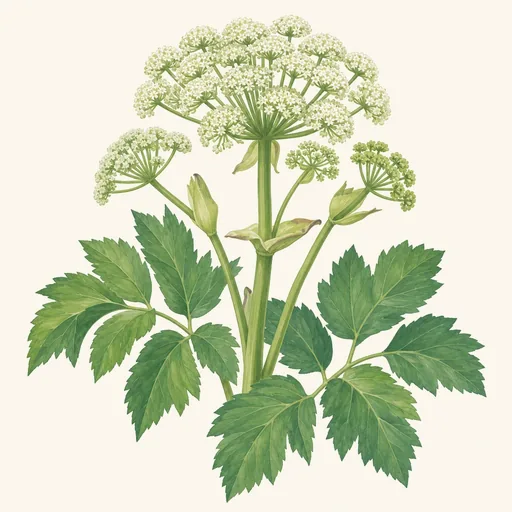
Angelica
Angelica archangelica · Apiaceae
- Start indoors8–10 weeks before the last frostJan 30 – Feb 19
- Sow outdoorsFrom 4 weeks before the last frost until the last frostMar 13 – Apr 16
- Plant outFrom the last frost until 2 weeks afterApr 10 – Apr 30
- Plant in autumn6–8 weeks before the first autumn frostAug 30 – Sep 19
- Space60–90 cm (2–3 ft) apart
- Harvest90–120 days after plantingJul 9 – Sep 18
Description
Angelica, also called garden angelica, is a tall, short-lived perennial herb in the carrot family, Apiaceae. It usually spends its first year forming a clump of leaves, then flowers in its second or third year. The flowering stem often dies after setting seed. In rich, moist soil, plants commonly reach 1–2.5 m tall. Their sturdy, hollow, ridged stems can be green or purplish, and their large, divided leaves have toothed leaflets. In summer, broad, rounded clusters called umbels carry many small greenish-white flowers. These are followed by paired, ribbed fruits, often casually called seeds. The plant has a strong, sweet, musky scent, especially when its leaves or stems are crushed.
Angelica favors cool climates and damp places, including riverbanks, wet meadows, and stream edges. In gardens, give it full sun in cool areas or some afternoon shade where summers are warmer, along with fertile soil that stays moist but drains well. Allow generous room for its broad leaves and tall flower stalks. Sow fresh seed promptly, because its viability falls quickly. Angelica can self-seed freely when flowerheads are left in place. Because individual plants may die after flowering, gardeners often keep a few seedlings each year to maintain a patch. Remove flowerheads before seeds mature if spreading is unwanted.
The flowers attract bees, hoverflies, and other insects. Young stems are traditionally candied for baking, while leaves and fruits are used sparingly to flavor foods and drinks. Roots are used in some herbal preparations and liqueurs. Correct identification matters: the carrot family includes highly poisonous lookalikes, so never harvest an uncertain plant from the wild. Angelica sap may increase skin sensitivity to sunlight; wear gloves when handling it. Seek professional advice before using it medicinally, particularly during pregnancy or when taking medication.
Growing Conditions
1.2–2.4 m (4–8 ft) tall, 0.6–1.2 m (2–4 ft) wide
- Smallest
- Largest
Part sun, 4+ hours
Tolerates full sun, part shade
High
Keep the soil consistently moist.
Ideal 10–21 °C (50–70 °F)
Survives down to −34 °C (−29 °F).
pH 6–7.5 · acidic to neutral
Where it Grows
Planting
When to Plant
For garden angelica (Angelica archangelica), the easiest time to sow is late summer or autumn, as soon as fresh seeds ripen. Seeds lose viability quickly, and winter cold helps break their dormancy; seedlings usually appear the following spring. If you buy seed in spring, check whether it has already been cold-stratified. If not, refrigerate it in a moist medium for about four to six weeks before sowing outdoors once the soil is workable. Germination can be slow and uneven, so do not assume the seeds have failed after a few weeks.
Set out young plants in spring after the worst frosts have passed, or in early autumn where winters are mild. Avoid moving established plants: angelica develops a substantial taproot. Choose a time when you can keep the soil consistently moist while seedlings establish. Angelica usually flowers in its second year and often dies after setting seed, so allow some plants to self-sow for future crops.
How to Plant
Choose a spot with fertile, moisture-retentive but well-drained soil. Angelica grows well in full sun where summers are cool; give it afternoon shade in hotter areas. Work compost into the planting area and clear competing weeds. Because mature plants can grow large, plan to space them about 2 to 3 feet (60 to 90 cm) apart.
For direct sowing, use fresh seed if possible. Scatter seeds thinly over prepared soil, press them into the surface, and cover them only very lightly with fine soil. Water gently so they stay in place. Keep the seedbed evenly moist, not waterlogged, through germination. Thin seedlings when they are large enough to handle, leaving the strongest plants at their final spacing.
If planting nursery-grown angelica or seedlings started in pots, transplant while they are still young to minimize disturbance to the taproot. Dig a hole wide enough for the root ball, set the plant at the same depth it grew in its pot, firm the soil, and water thoroughly. Add a thin layer of mulch to conserve moisture, keeping it away from the stem. Water regularly during dry spells, especially during the first growing season.
Growth Timeline
- Germination 14–30 days
- Seedlings indoors 4–9 weeks
- Growing in the garden 90–120 days
- Harvest 12–20 weeks
Planting Calendar
- Start seeds indoors: 8–10 weeks before the last frost
- Sow outdoors: from 4 weeks before the last frost until the last frost
- Plant outdoors: from the last frost until 2 weeks after
- Autumn planting: 6–8 weeks before the first autumn frost
- Germination: 14–30 days
- Start indoors: Jan 30 – Feb 19
- Sow outdoors: Mar 13 – Apr 16
- Plant out: Apr 10 – Apr 30
- Autumn planting: Aug 30 – Sep 19
- Harvest: Jul 9 – Sep 18
Care
Care Calendar
- Feed · Mar 27 – Apr 30
Top-dress with compost as growth resumes. - Thin · Apr 24 – May 28
Thin crowded seedlings to give each plant room to mature. - Mulch · Apr 24 – May 28
Apply organic mulch to help keep the soil evenly moist. - Deadhead · Jun 5 – Aug 6
Remove spent flower heads before seeds disperse if you do not want self-sown plants.
Watering
Keep garden angelica’s soil consistently moist, especially during its first growing season and in hot weather. Water deeply when the top inch (2–3 cm) of soil begins to dry, aiming to moisten the root zone rather than giving frequent light sprinkles. In an average week without rain, about 1 inch (2.5 cm) of water is a useful starting point; adjust for your soil, temperature, and rainfall. Plants in containers dry out faster and may need checking daily during summer. Water at the base of the plant when possible, since leaves that stay wet can encourage disease. Angelica likes moisture but not stagnant water, so use well-drained soil and avoid leaving containers in full saucers. Drooping leaves can indicate dryness, while persistently soggy soil and yellowing growth may signal overwatering.
Pruning
Angelica needs little routine pruning. Remove yellow, damaged, or diseased leaves with clean shears, taking care not to injure the central crown. Cutting young leaf stalks for kitchen use also helps keep the plant tidy, but leave enough foliage to support its growth. Garden angelica is usually biennial: it forms leaves in its first year, then flowers, sets seed, and dies in its second. If you do not want seedlings, cut off flower heads before the seeds ripen. If you want to collect seed or let the plant self-sow, leave some umbels in place. Removing a flower stalk may delay seed production, but it will not reliably turn a flowering plant into a long-lived perennial. After the plant has died back, remove the spent stalk and compost it unless it shows signs of disease.
Weeding
Keep the area around young angelica plants free of weeds, which compete for the moisture and nutrients this large herb needs. Weed regularly while unwanted plants are small, particularly in spring, rather than waiting for dense growth to develop around the crown. Pull weeds by hand when the soil is damp, or use a hoe shallowly between plants; digging close to angelica can disturb its roots. Leave enough space around each plant for its broad leaves to develop and for air to circulate. Once established, angelica’s foliage shades some weeds, but check beneath it for grasses and climbing weeds that can be easy to miss. If you want angelica to self-sow, learn to recognize its seedlings before clearing the bed. Remove weeds before they set seed, and avoid using herbicides near leaves or stems that you intend to harvest.
Mulching
Spread a 2–3 inch (5–8 cm) layer of organic mulch, such as shredded leaves, compost, or fine bark, around angelica. Mulch helps hold the steady soil moisture this plant prefers, moderates soil temperature, and suppresses weeds. Apply it after the soil has warmed in spring, or renew an existing layer when it becomes thin. Keep mulch a few inches away from the crown and stems so they do not sit against damp material. In dry spells, check the soil beneath the mulch rather than assuming it is moist; water can still be needed. In heavy, poorly drained soil, use a thinner layer and prioritize improving drainage, since mulch cannot correct waterlogging. Compost used as mulch also adds a modest amount of nutrients as it breaks down. Check occasionally for slugs sheltering under dense mulch near young plants.
Fertilizing
Angelica grows best in fertile soil rich in organic matter. Before planting, mix well-rotted compost into the bed; for established plants, top-dress with compost in spring without covering the crown. If growth is weak and the soil is poor, use a modest amount of balanced fertilizer according to its label, then water it in. Rich garden soil may need no additional feeding. Avoid repeated heavy applications of high-nitrogen fertilizer: they can encourage lush, soft growth at the expense of sturdy stems. Water and adequate root space matter as much as feeding, so check soil moisture and crowding before assuming pale or slow growth indicates a nutrient shortage. Container-grown angelica has a limited supply of nutrients and may benefit from occasional, dilute balanced fertilizer during active growth. Stop feeding when the plant begins to die back after flowering.
Pest Management
Inspect angelica regularly, especially young leaves and the undersides of foliage. Aphids can cluster on tender growth; a firm spray of water often dislodges them. Hand-pick slugs and snails around seedlings, and reduce their hiding places without letting the soil dry out. Leaf miners may leave pale trails in leaves; remove heavily affected leaves if needed. Give plants room for air circulation, water at soil level, and remove diseased foliage to help limit leaf spots and mildew. Healthy plants usually tolerate minor insect damage, so treatment is not always necessary. If you use a pesticide, choose one labeled for edible herbs and the specific pest, and follow its harvest interval. Angelica’s flowers attract beneficial insects, so avoid spraying open blooms. Wear gloves when handling the plant: its sap can cause skin irritation and increased sensitivity to sunlight.
Harvesting
Harvest only positively identified garden angelica (Angelica archangelica); wild lookalikes in the carrot family can be dangerously poisonous. Pick young leaves as needed in spring and early summer, leaving plenty on the plant. Cut tender stems before flowering if you plan to candy or cook them. For seed, wait until the umbels begin turning brown in the plant’s second year, then cut and dry them over a tray or in a paper bag before storing the dry seed. Roots are generally dug in autumn of the first year, before the plant uses its reserves to flower; taking the root kills the plant. Use a clean tool and wash harvested parts thoroughly. Wear gloves and cover exposed skin while harvesting, because angelica sap followed by sunlight can cause a painful skin reaction. Do not harvest plants that may have been treated with products unsuitable for edible crops.
Growing in Containers
Grows well in a pot of at least 40 litres (11 US gallons), with drainage holes. Best kept outdoors.
Propagation
From seed
- Collect ripe seed in late summer or early autumn.
- Sow fresh seed outdoors in autumn, where the plants will grow.
- Press the seed onto moist soil and cover it lightly.
- Keep the soil moist until seedlings appear.
- Thin seedlings to give the large plants room to grow.
Common Problems
- Yellowing leaves
- Sticky residue on leaves
- Black sooty coating
- Curled or cupped leaves
Aphids are small, soft-bodied insects that feed by piercing plants and drawing out sap. The group includes many…
- Winding tunnels in leaves
- Spots on leaves
- Leaves dropping
Leaf miners are the larvae of several kinds of flies, moths, beetles, and sawflies, rather than a single species with…
- White powdery coating
- Yellowing leaves
- Curled or cupped leaves
- Distorted new growth
Powdery mildew is a group of fungal diseases, not a single species. Different fungi infect different hosts, including…
- Holes in leaves
- Slime trails
- Stems chewed or cut through
Slugs and snails are soft-bodied mollusks that feed on many garden plants. Snails carry a visible shell; most slugs…
- Aphids and leaf miners: Can distort leaves or leave pale trails; check new growth regularly.
- Slugs and snails: Often damage young seedlings.
- Powdery mildew: May coat foliage, especially where air circulation is poor.
- Crown or root rot: More likely in waterlogged soil; plant in moist but well-drained ground.
- Flowering and dieback: Garden angelica is usually biennial and often dies after setting seed. This is its normal life cycle, not necessarily a disease.
Varieties
- Garden angelica (Angelica archangelica): The familiar culinary species, grown for its aromatic stems, leaves and seeds.
- Korean angelica (Angelica gigas): Grown ornamentally for its striking purple flower heads.
- Chinese angelica, or dong quai (Angelica sinensis): Cultivated primarily for its root in traditional herbal medicine.
- American angelica (Angelica atropurpurea): A North American species with purple-tinged stems that grows in damp places.
Health Benefits
Garden angelica (Angelica archangelica) has a long history of culinary and herbal use. Its aromatic stems are candied, and its seeds and roots flavor liqueurs and other foods. Traditionally, preparations made from the root have been used for indigestion, bloating and loss of appetite. These are traditional uses, however, not well-established medical benefits: good-quality human studies are limited, and angelica should not replace treatment for persistent digestive symptoms.
The name “angelica” also covers other species with different uses. Chinese angelica (A. sinensis), known as dong quai, is commonly used in traditional Chinese medicine for menstrual concerns. Evidence that it reliably treats these conditions is insufficient. Research on one species should not be assumed to apply to another.
Use particular care with supplements, which can vary in strength and composition. Avoid medicinal use during pregnancy unless a qualified clinician advises otherwise. Dong quai may increase bleeding risk, especially alongside blood-thinning medicines. Some angelica species contain compounds that can make skin more sensitive to sunlight; handling fresh plant sap may cause a rash or blistering after sun exposure. If you take medication, have a bleeding disorder, or are considering angelica for a health condition, ask a healthcare professional first.
Fun Facts
- Garden angelica can grow well above a gardener’s head, with large, rounded clusters of tiny flowers.
- Its hollow, aromatic stems are traditionally candied for cake decoration.
- Angelica seeds and roots help flavor some gins and liqueurs.
- The flowers attract pollinating insects, while the seed heads can provide food for birds.
- Garden angelica often self-seeds, so new plants may appear after the original plant has flowered and died.
Notice an error or have a question about Angelica? Contact us