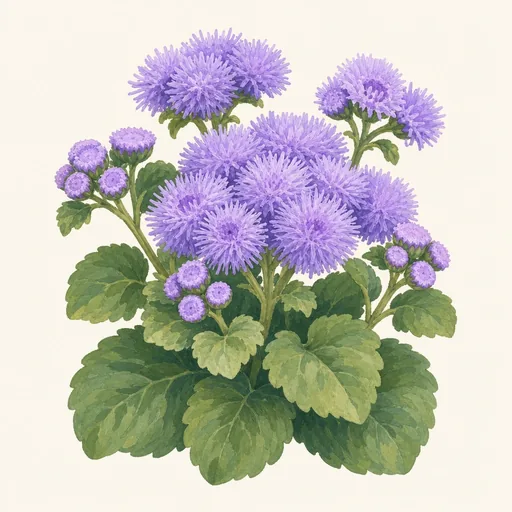
Ageratum
Ageratum houstonianum · Asteraceae
- Start indoors6–8 weeks before the last frostFeb 13 – Mar 5
- Sow outdoors1–2 weeks after the last frostApr 17 – Apr 30
- Plant out1–2 weeks after the last frostApr 17 – Apr 30
- Space15–30 cm (6–12 in) apart
- Bloom45–75 days after plantingJun 1 – Aug 4
Description
Ageratum, commonly grown as Ageratum houstonianum, is a bushy flowering plant in the daisy family (Asteraceae). Often called floss flower, it is prized for clusters of small, fluffy-looking flower heads that create a soft, rounded display. Blue and lavender forms are especially popular, but cultivars also bloom purple, pink, or white. Each flower head contains many tiny tubular florets whose slender, projecting styles give it a fuzzy appearance. The green leaves are oval to heart-shaped, slightly hairy, and toothed along the edges. Plants typically grow 15–60 cm (6–24 in) tall, depending on the cultivar, and form compact mounds.
Native to Mexico and Central America, this species is a short-lived perennial in frost-free climates but is usually grown as an annual where winters are cold. It flowers from late spring or early summer into autumn, often continuing until frost. Its size makes it useful for border edges, containers, and mass plantings; taller varieties can also be cut for arrangements. The blooms attract bees and butterflies.
Grow ageratum in full sun for abundant flowers, providing some afternoon shade in very hot conditions. It prefers well-drained, moderately fertile soil and regular watering, but does not tolerate persistently soggy ground. Removing faded flowers keeps plants tidy, although many modern cultivars bloom freely without deadheading. Seeds can be started indoors before the last frost, or young plants can be set outside after frost danger has passed. In humid conditions, powdery mildew may develop, especially where plants are crowded; good airflow helps reduce the risk. Root rot is more likely in poorly drained soil. Ageratum can self-seed and may naturalize in warm regions, so check local guidance before planting it near sensitive habitats.
Growing Conditions
15–60 cm (6–24 in) tall, 15–45 cm (6–18 in) wide
- Smallest
- Largest
Full sun, 4+ hours
Tolerates part sun, part shade
Moderate
Keep evenly moist, not soggy.
Ideal 18–27 °C (64–81 °F)
Survives down to 0 °C (32 °F).
pH 6–7 · acidic to neutral
Where it Grows
Planting
When to Plant
Plant ageratum outdoors after the last spring frost, when the soil has warmed and nights are reliably mild. Ageratum is frost-tender: even a light frost can damage young plants. If you want earlier flowers, start seeds indoors about 6–8 weeks before your area’s average last frost date. Move seedlings outside only after frost danger has passed, and harden them off first by gradually increasing their time outdoors over 7–10 days. You can also sow seeds directly in the garden after the last frost, although those plants will bloom later than indoor-started seedlings. In frost-free climates, plant during a mild season when seedlings will not face extreme heat. Check the forecast rather than relying solely on a calendar date; an unusually cold spring can delay safe planting. Nursery-grown plants are ready to set out under the same frost-free conditions, preferably on an overcast day or in the evening to reduce transplant stress.
How to Plant
Choose a site with well-drained soil and at least six hours of direct sun each day. In very hot climates, a little afternoon shade can help plants cope with the heat. Loosen the soil and mix in compost if it is compacted or low in organic matter, but avoid a soggy spot: ageratum does not thrive with waterlogged roots.
To start from seed, press the tiny seeds onto moist seed-starting mix without burying them; they need light to germinate. Keep the mix evenly moist and warm, around 70–75°F (21–24°C). Seedlings usually appear in about 1–2 weeks. Once they have true leaves, thin or pot them up so they have room to grow. If sowing directly outdoors, prepare a fine, level seedbed, press the seeds onto the surface, and water gently so they are not washed away.
Set hardened-off seedlings or nursery plants at the same depth they grew in their containers. Space compact varieties about 6–10 inches apart and larger varieties about 10–12 inches apart, or follow the seed packet for your cultivar. Water thoroughly after planting, then keep the soil moderately moist while roots establish. Add a light layer of mulch, keeping it clear of the stems.
Growth Timeline
- Germination 7–14 days
- Seedlings indoors 5–9 weeks
- Growing in the garden 45–75 days
- In bloom 12–20 weeks
Planting Calendar
- Start seeds indoors: 6–8 weeks before the last frost
- Sow outdoors: 1–2 weeks after the last frost
- Plant outdoors: 1–2 weeks after the last frost
- Germination: 7–14 days
- Start indoors: Feb 13 – Mar 5
- Sow outdoors: Apr 17 – Apr 30
- Plant out: Apr 17 – Apr 30
- Bloom: Jun 1 – Aug 4
Care
Care Calendar
- Pinch out · Apr 17 – May 14
Pinch young plants above a pair of leaves to encourage branching. - Mulch · Apr 17 – May 7
Apply a thin layer of mulch after planting to help retain soil moisture. - Deadhead · May 22 – Sep 3
Remove faded flower clusters to keep plants tidy and encourage more blooms. - Prune · Jun 19 – Jul 23
Shear back leggy plants lightly in midsummer to encourage fresh growth.
Watering
Water ornamental ageratum when the top inch (2–3 cm) of soil feels dry. Soak the soil around the roots, then let excess water drain; consistently soggy soil can cause root rot. Newly planted seedlings need more frequent checks while their roots establish. Established plants generally need about 1 inch (2.5 cm) of water per week from rain and irrigation combined, but hot weather, sandy soil, and containers may require more frequent watering. Check container plants daily during heat waves rather than following a fixed schedule. Water at the base in the morning when possible, keeping foliage dry to reduce fungal disease. If plants wilt, check the soil before watering: dry soil calls for water, while wet soil may indicate poor drainage. Reduce watering as growth slows in cool weather.
Pruning
Pinch the tips of young ageratum plants once they have several sets of leaves to encourage branching and a fuller shape. Snip just above a pair of leaves with clean fingers or pruners. Remove faded flower clusters regularly if the variety does not shed them neatly; deadheading improves appearance and can encourage continued flowering. If plants become leggy or bloom less heavily in midsummer, trim stems back by roughly one-third, leaving healthy leaves on each stem. Water after trimming and allow time for new growth and buds to develop. Remove broken, yellowing, or diseased stems whenever you notice them. Do not put visibly diseased material in a home compost pile unless the pile reliably reaches temperatures high enough to kill pathogens. Avoid severe pruning late in the season, when plants may not have time to recover before frost.
Weeding
Keep the area around young ageratum plants free of weeds, which compete for moisture, nutrients, and light while the plants are establishing. Pull weeds when the soil is slightly moist so their roots come out more easily. Work by hand close to ageratum stems: shallow cultivation can disturb the plant’s roots. Remove weeds before they flower or set seed, and check the bed regularly after rain, when new seedlings often appear. In containers, remove volunteer plants rather than letting them share the limited growing space. Once ageratum fills in, its foliage helps shade the soil and suppress some weeds, but continue checking between plants. A thin layer of organic mulch can reduce germination of new weeds. Avoid applying broad-spectrum herbicides near ageratum; spray drift or contact with foliage can damage or kill it.
Mulching
Spread about 1–2 inches (2–5 cm) of fine organic mulch, such as shredded leaves or fine bark, over the soil after planting. Mulch helps slow evaporation, limits weed growth, and reduces soil splashing onto the foliage during rain. Leave a small gap around each stem so the mulch does not hold moisture against it. Apply mulch after the soil has warmed in spring, particularly in cooler climates where a thick early layer can delay warming. Keep the layer modest: ageratum needs well-drained soil, and excessive mulch combined with frequent watering can leave the root zone too wet. As organic mulch breaks down or shifts, top it up only enough to maintain a thin, even covering. Containers may need little or no mulch, but a light layer can help potting mix dry more slowly during hot weather.
Fertilizing
Ageratum generally flowers well with modest feeding. Before planting in a bed, mix a small amount of compost into the soil if it is poor; avoid adding so much that drainage suffers. In reasonably fertile garden soil, additional fertilizer may not be necessary. If growth is pale or weak, apply a balanced fertilizer at the label rate and water it in. Container plants lose nutrients more quickly through regular watering and may benefit from a dilute, balanced liquid fertilizer every few weeks during active growth. Follow the product label, and stop or reduce feeding if plants become lush and leafy with fewer flowers. Too much nitrogen encourages foliage at the expense of blooms. Do not fertilize dry, stressed roots heavily, and do not assume that yellow leaves always signal a nutrient deficiency—overwatering and poor drainage can cause similar symptoms.
Pest Management
Inspect leaves, stems, and flower buds regularly, especially their undersides. Aphids, whiteflies, and spider mites can occur on ageratum; early infestations may be controlled by removing affected growth or washing pests off with a gentle stream of water. For persistent infestations, use an insecticidal soap labeled for the pest and plant, following its directions and testing a small area first. Avoid spraying open flowers when pollinators are visiting. Good spacing and watering at soil level improve airflow and help limit powdery mildew and gray mold. Remove badly affected leaves and discard them; avoid handling wet foliage unnecessarily. Prevent root rot by planting in well-drained soil and never leaving containers standing in water. If a plant is badly diseased, removing it may protect its neighbors. Identify a problem before applying a pesticide, since treatment will not correct heat stress or watering problems.
Harvesting
Ornamental ageratum is grown for flowers, not food; do not eat any part of the plant. For small cut-flower arrangements, cut stems when the flower clusters are fully colored and freshly open. Harvest in the cool of morning with clean snips, then place the stems promptly in clean water. Remove leaves that would sit below the waterline, and change the vase water regularly. Cutting a few stems can also encourage new branching, but leave enough foliage for the plant to keep growing and flowering. To save seed, let selected flower heads dry on the plant, then collect them before the seed scatters. Dry the seed thoroughly and store it in a labeled paper packet in a cool, dry place. Seeds from hybrid varieties may not produce plants that look like the parent.
Growing in Containers
Grows well in a pot of at least 3 litres (0.8 US gallons), with drainage holes. Best kept outdoors.
Propagation
From seed
- Sow seeds indoors 6–8 weeks before the last frost.
- Press seeds onto moist seed-starting mix without covering them; they need light to germinate.
- Keep the mix moist and warm until seedlings emerge.
- Transplant outdoors after frost danger has passed.
From cuttings
- Take a nonflowering stem cutting from a healthy plant.
- Remove the lower leaves.
- Insert the cut end into moist, well-draining potting mix.
- Keep it humid in bright, indirect light until roots form.
- Pot it up once established.
Companion Plants
Good neighbors
- Marigolds: Their warm-colored flowers contrast with ageratum’s blue blooms, and both are commonly grown together in sunny bedding displays.
- Petunias: They are commonly paired with ageratum in summer beds and containers because they share similar light and watering needs.
Common Problems
- Yellowing leaves
- Sticky residue on leaves
- Black sooty coating
- Curled or cupped leaves
Aphids are small, soft-bodied insects that feed by piercing plants and drawing out sap. The group includes many…
- Pale speckles or stippling
- Yellowing leaves
- Brown or crispy leaf edges
- Fine webbing
Spider mites are tiny, plant-feeding arachnids in the family Tetranychidae, not insects. Several species attack garden…
- Yellowing leaves
- Sticky residue on leaves
- Black sooty coating
- Curled or cupped leaves
Whiteflies are a family of tiny, sap-feeding insects that infest vegetables, ornamentals, and greenhouse plants…
- White powdery coating
- Yellowing leaves
- Curled or cupped leaves
- Distorted new growth
Powdery mildew is a group of fungal diseases, not a single species. Different fungi infect different hosts, including…
- Powdery mildew: White, dusty growth on leaves, especially when plants are crowded or air circulation is poor.
- Root rot: Yellowing and wilting can follow prolonged wet soil or poor drainage.
- Aphids, whiteflies, and spider mites: These pests may cause distorted leaves, stippling, or sticky residue.
- Leaf spot: Brown or dark spots can develop in persistently damp conditions.
- Heat or drought stress: Plants may wilt or flower less when soil dries out for too long.
Varieties
A classic, low-growing choice for edging and containers.
- compact
- blue flowers
Its long stems make it suitable for cutting.
- tall
- blue flowers
This compact selection works well at the front of a border.
- dwarf
- blue flowers
Its mounded habit suits beds and pots.
- compact
- blue flowers
This taller selection adds an unusual warm color to bouquets.
- tall
- rose-purple flowers
It produces white flower clusters on stems suited to cutting.
- tall
- white flowers
More about varieties
- ‘Blue Mink’: A compact Ageratum houstonianum cultivar with fluffy blue flowers.
- ‘Blue Horizon’: A taller blue-flowered cultivar often grown for cut flowers.
- ‘Hawaii Blue’: A low-growing blue selection suited to edging and containers.
- ‘White Bouquet’: A white-flowered selection that contrasts well with blue varieties.
- ‘Pink Ball’: A compact selection with soft pink flower heads.
Health Benefits
Ageratum is grown primarily as an ornamental plant, not as a health or wellness herb. One species, Ageratum conyzoides, does have a history of use in traditional medicine in parts of Africa, Asia, and the Americas. Its leaves or preparations have been used on minor wounds and for complaints such as inflammation, fever, and digestive upset. Researchers have investigated extracts for antimicrobial and anti-inflammatory activity, but laboratory findings do not establish that the plant is safe or effective as a treatment for people.
Caution is particularly important because A. conyzoides can contain pyrrolizidine alkaloids, compounds associated with liver damage. Their amounts can vary between plants and preparations, so a traditional recipe is not a reliable guide to safety. Do not ingest Ageratum or apply homemade preparations to broken skin as a substitute for medical care. Pregnant or breastfeeding people, children, and people with liver disease should be especially cautious. The common bedding plant, A. houstonianum, should not be assumed to have the same traditional uses or to be safe for medicinal use. For most gardeners, Ageratum’s practical wellness value is simply the enjoyment of its long-lasting flowers.
Fun Facts
- Ageratum is often called flossflower because its clustered flower heads look soft and fuzzy.
- What looks like one fluffy bloom is a cluster of many tiny tubular flowers.
- Many bedding cultivars belong to Ageratum houstonianum, a species native to Mexico and Central America.
- Its flowers can attract butterflies and other pollinators.
- Ageratum conyzoides is considered an invasive weed in some regions, unlike the tidy bedding cultivars commonly sold for gardens.
Notice an error or have a question about Ageratum? Contact us