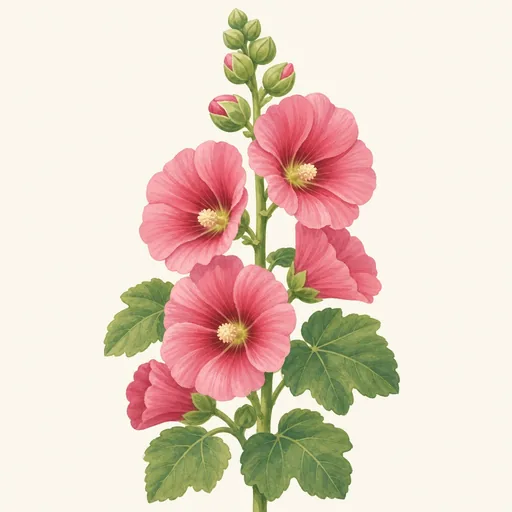
Hollyhock
Alcea rosea · Malvaceae
- Start indoors6–8 weeks before the last frostFeb 13 – Mar 5
- Sow outdoorsFrom the last frost until 2 weeks afterApr 10 – Apr 30
- Plant outFrom the last frost until 2 weeks afterApr 10 – Apr 30
- Plant in autumn6–8 weeks before the first autumn frostAug 30 – Sep 19
- Space45–60 cm (18–24 in) apart
- BloomAfter 2 years
Description
Hollyhock is a tall flowering plant often grown against walls, fences, and at the back of borders. It is usually treated as a biennial or short-lived perennial: in its first year it forms a leafy rosette, then produces a towering flower stalk the following summer. Established plants commonly reach 1.5 to 2.5 metres, although height varies with growing conditions and cultivar. Their large, rough-textured leaves are rounded to heart-shaped, often shallowly lobed, with toothed edges.
Flowers open along the upright stalk from the bottom upward, giving hollyhocks a long, conspicuous display. The blooms may be single, semi-double, or double. Single flowers have five broad petals and a prominent central column of stamens. Colours include white, yellow, pink, red, purple, and nearly black; some cultivars have contrasting centres. Bees visit the open flowers for pollen and nectar, and the seed capsules that follow can provide seed for future plants.
Hollyhocks grow best in full sun and fertile, well-drained soil. Their height makes a sheltered position helpful, and tall stems may need staking in windy gardens. Water young plants during dry spells, but avoid keeping the foliage wet. The plants often self-seed, so seedlings can appear nearby and may differ in colour from their parents. Removing spent flowers limits self-seeding, while leaving some capsules to mature allows seed collection.
A common problem is hollyhock rust, a fungal disease that produces orange-brown spots and pustules, especially on older leaves. Good air circulation and prompt removal of affected foliage can reduce its spread. Although individual plants may not live long, their ability to reseed can keep a planting going for years. Hollyhocks are valued chiefly for their height, old-fashioned appearance, and abundant summer flowers.
Growing Conditions
1.5–2.4 m (5–8 ft) tall, 45–60 cm (18–24 in) wide
- Smallest
- Largest
Full sun, 6+ hours
Tolerates part sun
Moderate
Keep evenly moist, not soggy.
Ideal 15–25 °C (59–77 °F)
Survives down to −40 °C (−40 °F).
pH 6–8 · neutral to alkaline
Where it Grows
Planting
When to Plant
Plant hollyhocks according to when you want them to flower. Most common hollyhocks are biennials or short-lived perennials: they grow leaves in their first season and flower the next summer. For this pattern, sow seeds outdoors in late spring or early summer, after the last frost. In mild climates, you can also sow in late summer or early fall, early enough for young plants to establish before freezing weather. If you want flowers in the first year, choose a variety sold for first-year bloom and start its seeds indoors about six to eight weeks before your last expected frost. Set seedlings or nursery plants outside after frost danger has passed. Watch the site as well as the calendar: wait until the ground is workable, not waterlogged. Hollyhocks develop deep roots and dislike being moved once established, so choose their long-term position before planting.
How to Plant
Choose a permanent spot with at least six hours of direct sun and well-drained soil. Hollyhocks grow tall, so a position sheltered from strong wind is useful; leave room for air to circulate around them, which helps limit hollyhock rust. Loosen the soil and mix in compost if it is poor, but avoid a site where water stands after rain.
Sow seeds directly where the plants will grow, covering them with about ¼ inch (6 mm) of soil. Keep the surface evenly moist, not soggy, until seedlings appear. Thin them to roughly 18–24 inches (45–60 cm) apart; use the wider spacing where rust is common or plants are especially vigorous. If starting seeds indoors, use individual deep pots to disturb the roots as little as possible. Harden seedlings off gradually before planting them outside.
For seedlings or nursery plants, dig a hole wide enough for the root ball and set the plant at the same depth it grew in its pot. Handle the roots gently, fill in the hole, and water thoroughly. Keep new plants watered while they establish, directing water onto the soil rather than the leaves. Stake tall flowering stems if the site is windy.
Growth Timeline
- Establishing 2 years
Planting Calendar
- Start seeds indoors: 6–8 weeks before the last frost
- Sow outdoors: from the last frost until 2 weeks after
- Plant outdoors: from the last frost until 2 weeks after
- Autumn planting: 6–8 weeks before the first autumn frost
- Germination: 10–21 days
- Start indoors: Feb 13 – Mar 5
- Sow outdoors: Apr 10 – Apr 30
- Plant out: Apr 10 – Apr 30
- Autumn planting: Aug 30 – Sep 19
Care
Care Calendar
- Thin · Apr 24 – May 28
Thin young plants to allow good airflow between them. - Stake · May 8 – Jun 11
Tie tall flower stalks loosely to sturdy stakes before they become top-heavy. - Prune · May 22 – Aug 20
Remove rust-spotted leaves as they appear and discard them. - Deadhead · Jun 5 – Aug 20
Remove spent flowers to prolong bloom, leaving some if you want seeds. - Mulch · Oct 25 – Nov 28
Mulch around first-year rosettes to reduce winter frost heaving.
Watering
Water hollyhocks deeply when the top inch or two of soil feels dry, especially while young plants are establishing and during hot, dry spells. Aim for roughly 1 inch of water per week from rain and irrigation combined, adjusting for your soil and weather. Established plants tolerate some dryness, but prolonged drought can reduce flowering. Apply water slowly at the base so it reaches the roots without soaking the foliage; wet leaves favor hollyhock rust. Morning watering gives any splashed leaves time to dry. In containers, check moisture more often because potting mix dries quickly, and water until excess drains from the bottom. Avoid keeping the soil constantly soggy, particularly in poorly drained sites. A layer of mulch helps even out soil moisture, but keep it clear of the plant’s crown.
Pruning
Remove yellowing or rust-spotted leaves as they appear, starting with the lower leaves where hollyhock rust often shows first. Put diseased material in the trash rather than leaving it beneath the plant. You can remove spent flowers to keep the stalk tidy, but leave some blooms in place if you want seeds or self-sown plants. After flowering, cut stalks down near the base once you have collected any seeds you want. In areas with a long growing season, cutting back a finished stalk may encourage some new growth, though another strong display is not guaranteed. At the end of the season, clear away dead foliage to reduce places where disease can persist. Use clean pruners, and avoid handling plants when their leaves are wet, since this can spread rust spores.
Weeding
Keep the area around young hollyhocks free of weeds so seedlings do not have to compete for light, water, and nutrients. Check regularly in spring, when fast-growing weeds can overtake small plants. Pull weeds by hand when the soil is slightly moist, holding nearby soil steady so you do not disturb the hollyhock. For larger patches, hoe only the soil surface and stay clear of the plant’s base. Hollyhocks develop substantial roots and generally do not benefit from deep cultivation around them. Remove weeds before they set seed to make future upkeep easier. As plants mature, their leaves shade some of the soil, but continue to clear crowded growth from around the stalks. Better airflow can help foliage dry after rain and may reduce rust problems. Learn to recognize hollyhock seedlings before pulling them if you want the plants to self-sow.
Mulching
Spread about 2–3 inches of compost, shredded leaves, or another loose organic mulch over the soil around hollyhocks. Apply it after spring planting or once the soil has warmed, and renew it as it breaks down. Mulch helps retain moisture, suppress weeds, and reduce soil splashing onto lower leaves. Leave a gap of a few inches around each stem or crown so the base stays dry and does not rot. Avoid piling mulch against emerging seedlings, which can be smothered. In damp climates, use a thinner layer if needed and keep the planting open to airflow; mulch is not a substitute for removing rust-infected leaves. If you hope to grow self-sown hollyhocks, leave a little exposed soil where fallen seeds can reach the ground, or collect the seeds and sow them yourself.
Fertilizing
Hollyhocks usually need little fertilizer in reasonably fertile garden soil. Before planting, work some finished compost into the bed to improve the soil and provide a modest supply of nutrients. For established plants, a light layer of compost in spring is often enough. If growth is weak and the soil is poor, apply a balanced, slow-release garden fertilizer at the label rate in spring, then water it in. Avoid heavy or repeated applications of nitrogen: they can encourage lush, soft leaves rather than sturdy flowering stalks. Do not put fertilizer against the stems, and do not assume yellow or spotted leaves mean the plant needs feeding; hollyhock rust commonly causes foliage problems. In containers, nutrients wash out faster, so use a balanced fertilizer according to its label during active growth, without exceeding the recommended rate.
Pest Management
Inspect hollyhocks regularly, especially the undersides of leaves and developing buds. Hollyhock rust is a common problem: look for yellow spots above and orange-brown pustules below the leaves. Remove affected leaves promptly, clear fallen debris, space plants for airflow, and water at soil level. Avoid saving seed from badly diseased plants when healthy alternatives are available. Aphids can often be dislodged with a gentle stream of water or controlled by conserving lady beetles and other predators. Hand-pick Japanese beetles and slugs when you find them; check slugs at dusk and beetles in the morning. If buds fail to open or show feeding damage, inspect them for insects before deciding on treatment. Use pesticides only when necessary and follow the label. Avoid spraying open flowers visited by bees and other pollinators.
Harvesting
For cut flowers, choose a sturdy hollyhock stalk when several of its lower flowers have opened and the upper buds are still closed. Cut it in the cool of the morning with clean shears, place it promptly in water, and remove any leaves that would sit below the waterline. Hollyhock flowers open progressively up the stalk, so check the arrangement and remove fading blooms as needed. For seed, leave selected flower stalks standing after bloom. Collect the round seed pods when they have turned brown and papery but before they break apart and shed their seeds. Finish drying them in a well-ventilated place, then separate the seeds from the pods. Store thoroughly dry seed in a labeled paper envelope in a cool, dry place. Leave some pods on the plant if you want hollyhocks to self-sow.
Growing in Containers
Grows well in a pot of at least 40 litres (11 US gallons), with drainage holes. Best kept outdoors.
Propagation
From seed
- Sow seeds outdoors in late spring or early summer, or start them indoors 6–8 weeks before the last frost.
- Cover seeds lightly with soil and keep them evenly moist until they germinate.
- Thin or transplant seedlings to a sunny spot with well-drained soil.
- Space plants for good air circulation and expect most to flower the following year.
Common Problems
- Orange or rust-colored spots
- Spots on leaves
- Yellowing leaves
- Leaves dropping
Rust is a group of plant diseases caused by fungi in the order Pucciniales, not a single species. Different rust fungi…
- Yellowing leaves
- Sticky residue on leaves
- Black sooty coating
- Curled or cupped leaves
Aphids are small, soft-bodied insects that feed by piercing plants and drawing out sap. The group includes many…
- Holes in leaves
- Insects visible on the plant
- Wilting
The Japanese beetle is an introduced scarab beetle that feeds on many garden plants, including roses, grapes, beans…
- White powdery coating
- Yellowing leaves
- Curled or cupped leaves
- Distorted new growth
Powdery mildew is a group of fungal diseases, not a single species. Different fungi infect different hosts, including…
- Holes in leaves
- Slime trails
- Stems chewed or cut through
Slugs and snails are soft-bodied mollusks that feed on many garden plants. Snails carry a visible shell; most slugs…
- Hollyhock rust: Orange-brown pustules develop on leaves, which may yellow and drop. Remove infected foliage, clear fallen leaves, and improve airflow.
- Leaf spots and powdery mildew: Fungal diseases can blemish foliage, especially when plants are crowded or leaves stay damp.
- Aphids and Japanese beetles: Aphids cluster on tender growth; beetles chew holes in leaves and flowers.
- Slugs and snails: These may damage young plants, particularly in damp conditions.
- Wind damage: Tall flower stalks can lean or snap in exposed sites; staking helps.
Varieties
Its densely petaled blooms come in a range of colors and may need staking.
- tall
- double flowers
A shorter choice for small gardens and the backs of low borders.
- compact
- double flowers
Its deep maroon flowers look nearly black.
- dark flowers
- heirloom
Sown early indoors, it can produce purple flowers in its first year.
- compact
- first-year bloom
Apricot-colored petals surround darker, contrasting centers.
- apricot flowers
- contrasting centers
This widely grown mix produces classic single hollyhock flowers in several colors.
- tall
- mixed colors
Its full, ruffled peach blooms make a showy border display.
- peach flowers
- double flowers
Its purple-and-cream flowers vary in pattern from bloom to bloom.
- bicolor flowers
- semi-double flowers
More about varieties
- ‘Chater’s Double’: Tall plants with densely petaled, ruffled flowers in a range of colors.
- ‘Nigra’: A dark-flowered selection with blooms that appear nearly black.
- ‘The Watchman’: Known for deep maroon flowers on tall spires.
- Halo series: Single flowers with contrasting dark centers.
- Queeny series: Compact plants with double flowers, suited to smaller spaces.
Health Benefits
Hollyhock (Alcea rosea) has a history of use in herbal traditions, particularly for soothing a dry throat or mild cough. Its flowers, leaves, and roots contain mucilage, a substance that becomes slippery when mixed with water. Traditionally, people have prepared hollyhock as a tea or infusion, hoping that the mucilage would coat irritated tissues. It has also been used in preparations applied to minor skin irritation.
These are traditional uses, not proven treatments. Research on hollyhock in people is limited, and it should not replace medical care for a persistent cough, breathing difficulty, or a worsening skin problem. Hollyhock is related to marshmallow (Althaea officinalis), another mucilage-rich herb, but findings about marshmallow should not automatically be applied to hollyhock.
Hollyhock flowers are sometimes used as edible garnishes or to color foods and drinks. If using plants from your garden, identify them confidently and use only material that has not been treated with pesticides or other chemicals. Wash it well, and avoid diseased foliage. Anyone who is pregnant, breastfeeding, taking medication, or considering regular medicinal use should ask a qualified healthcare professional first. Stop using it if an allergic reaction occurs.
Fun Facts
- Hollyhock flowers open progressively up their tall spikes, from the bottom toward the top.
- Many hollyhocks grow as biennials, forming leaves in their first year and flowering in their second.
- Hollyhocks can self-seed, so new plants may appear after the original plant has finished flowering.
- Their flowers attract bees and other pollinators.
- Hollyhocks belong to the mallow family, Malvaceae, alongside hibiscus and marshmallow.
Notice an error or have a question about Hollyhock? Contact us