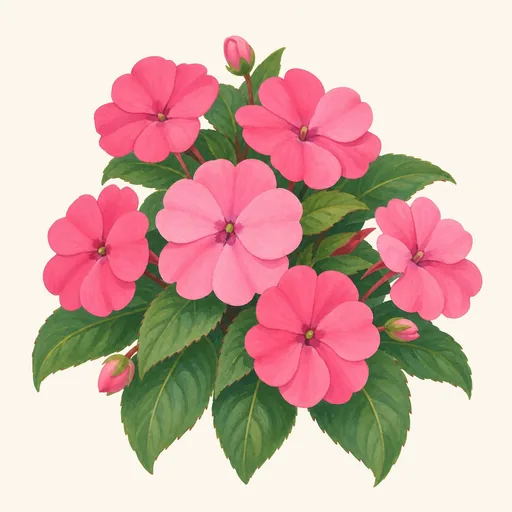
Impatiens
Impatiens walleriana · Balsaminaceae
- Start indoors8–10 weeks before the last frostJan 30 – Feb 19
- Plant out1–2 weeks after the last frostApr 17 – Apr 30
- Space20–30 cm (8–12 in) apart
- Bloom0–30 days after plantingApr 17 – Jun 20
Description
Impatiens, also known as busy Lizzie or balsam, is a popular flowering plant belonging to the family Balsaminaceae. This shade-loving annual is widely cultivated for its vibrant blooms and lush green foliage, making it a favorite among home gardeners and landscape designers. Impatiens are native to tropical regions, particularly in Africa and Asia, and thrive in warm, humid conditions.
The plant typically grows between 12 to 24 inches tall and features upright, succulent stems that can become quite bushy with proper care. The leaves are oval-shaped, glossy, and dark green, providing a beautiful backdrop to the colorful flowers that bloom throughout the growing season. Impatiens flowers come in various colors, including pink, red, white, purple, and even bi-color varieties, and they usually measure about 1 to 3 inches in diameter.
Impatiens are particularly valued for their ability to perform well in shaded areas, making them ideal for spots that receive limited sunlight, such as under trees or alongside buildings. While they can survive in full sun in cooler climates, they thrive best in partial shade. They prefer consistently moist, well-draining soil and benefit from regular watering and fertilization to promote blooming.
However, gardeners should be cautious of potential pests and diseases, such as downy mildew, which can affect their growth. Overall, with thoughtful care, Impatiens can provide a long-lasting and colorful display that enhances any garden or outdoor space, making them a staple choice for amateur gardeners.
Growing Conditions
15–45 cm (6–18 in) tall, 20–45 cm (8–18 in) wide
- Smallest
- Largest
Part shade
Tolerates part sun, full shade
Moderate
Keep evenly moist, not soggy.
Ideal 18–26 °C (64–79 °F)
Survives down to 0 °C (32 °F).
pH 6–7 · acidic to neutral
Where it Grows
Planting
When to Plant
When it comes to planting Impatiens, timing is a critical factor for successful growth and vibrant blooms. Impatiens (Impatiens walleriana) are popular annuals known for their ability to thrive in shade and partial shade, making them perfect for enhancing garden beds, borders, and container arrangements.
Optimal Planting Time
-
Frost-Free Period: Impatiens are sensitive to frost, so it's essential to wait until any danger of frost has passed. This usually means waiting until late spring. In many regions, this occurs around late April to mid-May, but planting times can vary based on your USDA hardiness zone.
-
Soil Temperature: Ideally, the soil temperature should be consistently above 60°F (15°C). You can test this with a soil thermometer or by simply ensuring that nighttime temperatures are above 50°F (10°C), which indicates that nighttime frost is unlikely.
-
Local Climate Considerations: If you live in a warmer climate, you can likely plant earlier in spring, whereas cooler regions may require waiting until early summer. Always consult local gardening calendars or extension services for the best timing specific to your area.
Indoor Seed Starting
If you plan to grow Impatiens from seeds, you can start them indoors approximately 8-10 weeks before the last expected frost date. This advance planting allows you to transplant strong seedlings outdoors at the appropriate time.
-
Seed Germination: Seeds should be sown in a moist seed starting mix and kept in a warm place (about 70°F or 21°C) to encourage germination. Keep the soil consistently moist but not soggy, and once seedlings appear, ensure they receive adequate light.
-
Transplanting Outdoors: Harden off seedlings by slowly acclimatizing them to outdoor conditions. Begin by placing them outside for a few hours a day in a sheltered location and gradually increasing their exposure over a week.
Conclusion
In summary, the best time to plant Impatiens outdoors is once all risk of frost has passed and the soil temperatures are warm. Check local climate guidelines for the most accurate timing in your region. For those starting from seed, begin indoors and allow for a careful transition to outdoor planting. By timing your planting correctly, you can ensure that your Impatiens flourish and produce a vibrant display throughout the growing season.
How to Plant
Planting Impatiens: A Step-by-Step Guide
Impatiens, known for their vibrant blooms and ability to thrive in shady areas, are a popular choice for gardens and containers. Here’s how to ensure successful planting:
-
Choose the Right Time: The best time to plant impatiens is after the last frost, typically in spring when the soil temperature is consistently warm.
-
Select the Location: Impatiens prefer partial to full shade. Choose a spot that receives filtered sunlight or light morning sun to prevent wilting and stress.
-
Prepare the Soil: Use well-draining, loamy soil rich in organic matter. Amend the soil with compost to enhance nutrients and moisture retention. Aim for a pH between 6.0 and 7.0.
-
Spacing: When planting, give each impatiens plant enough space to grow—about 8 to 12 inches apart for optimal airflow and growth.
-
Planting: Dig a hole slightly larger than the root ball. Gently remove the plant from its container and place it in the hole, ensuring that the crown of the plant is level with the soil surface. Backfill the hole with soil and firm it gently.
-
Watering: Water the plants thoroughly after planting. Maintain consistent moisture, but avoid overwatering, to keep the plants healthy.
With proper attention, impatiens will reward you with a stunning display of colorful blooms throughout the growing season.
Growth Timeline
- Germination 10–21 days
- Seedlings indoors 6–10 weeks
- Growing in the garden 0–30 days
- In bloom 12–20 weeks
Planting Calendar
- Start seeds indoors: 8–10 weeks before the last frost
- Plant outdoors: 1–2 weeks after the last frost
- Germination: 10–21 days
- Start indoors: Jan 30 – Feb 19
- Plant out: Apr 17 – Apr 30
- Bloom: Apr 17 – Jun 20
Care
Care Calendar
- Mulch · Apr 17 – May 7
Add a thin layer of mulch to keep the soil evenly moist. - Feed · Apr 24 – Aug 6
Feed container plants every two to four weeks with diluted balanced fertilizer. - Prune · Jun 5 – Jul 23
Cut back leggy stems by about one-third to encourage fresh growth.
Watering
Watering Impatiens effectively is crucial for their health and vibrant blooms. The best strategy is to establish a consistent watering routine that caters to their needs. Start by checking the top inch of the soil; if it feels dry, it’s time to water. Impatiens thrive in evenly moist soil without waterlogging, so aim for a thorough watering that saturates the pot, allowing excess water to drain out.
Early morning is the ideal time for watering, as it reduces evaporation and helps prevent fungal diseases. In hotter weather, you may need to water daily, but be cautious not to overwater, which can lead to root rot. Misting the leaves can also help maintain humidity, especially if they’re grown indoors. Adjust your watering frequency based on the season, temperature, and humidity levels for optimal growth and blossom development.
Pruning
Pruning Impatiens is essential for maintaining their health and encouraging robust growth. The best strategy involves timing and technique. Start by pruning in early spring, just as new growth begins to emerge, or after the summer bloom to promote a fuller plant growth. Use sharp, sterile pruning shears to make clean cuts.
Begin by removing any dead, damaged, or yellowing leaves to improve airflow and reduce the risk of disease. Thin out overcrowded areas by cutting back a few stems to their base, which helps the plant focus energy on remaining branches. If your Impatiens are leggy, trim them back by one-third to encourage bushier growth and more blooms. Always prune above a leaf node, as this encourages new growth from that point. Regularly deadhead spent flowers to promote continuous blooming and maintain a tidy appearance.
Weeding
Weeding around Impatiens plants requires a careful approach to avoid disturbing the delicate root systems or damaging the foliage. The best strategy starts with regular monitoring of the garden bed to identify weeds early before they establish.
-
Hand Weeding: Use your hands to gently pull out weeds, especially those with shallow roots. Be careful not to disturb the Impatiens’ roots.
-
Mulching: Apply a layer of organic mulch, such as shredded bark or wood chips, around the base of the plants. This not only suppresses weed growth but also retains soil moisture and improves soil quality as it breaks down.
-
Soil Cultivation: Lightly cultivate the soil with a hand trowel or hoe to break up the top layer and uproot smaller weeds while being mindful of the Impatiens’ shallow root systems, typically located within the top few inches of soil.
These methods will help maintain a healthy environment for your Impatiens to thrive while keeping weeds at bay.
Mulching
Mulching around Impatiens plants is an effective strategy to promote healthier growth and enhance visual appeal. The best practice involves applying a layer of organic mulch, such as shredded bark, wood chips, or straw. Begin by clearing the area around the plants of weeds or debris. Then, apply a 2-3 inch layer of mulch, starting a few inches away from the plant’s base to prevent rot. This distance allows for air circulation and reduces the risk of fungal diseases.
Mulching serves several purposes: it helps retain soil moisture, suppresses weed growth, and regulates soil temperature. As the organic mulch decomposes, it enriches the soil with nutrients. Be cautious during the hottest months, as too thick a layer can retain excessive heat. Regularly monitor the garden bed, replenishing mulch as needed to maintain its effectiveness throughout the growing season. Proper mulching can significantly enhance the beauty and vitality of Impatiens.
Fertilizing
Fertilizing Impatiens effectively is crucial for promoting healthy growth and abundant blooms. A balanced fertilizer, such as a 10-10-10 (N-P-K) or a 20-20-20, is ideal. Start by applying a slow-release fertilizer at planting time to provide nutrients gradually throughout the growing season. This ensures a steady supply of nutrients as the plant establishes itself.
During the active growing season, typically from spring to early fall, use a water-soluble fertilizer every four to six weeks to boost flower production. It’s essential to dilute the fertilizer to half-strength to avoid leaf burn. Impatiens thrive in partially shaded areas, making consistent moisture and moderate feeding vital. Watch for symptoms of nutrient deficiency, such as yellowing leaves, and adjust your fertilization schedule as needed. With proper care and fertilization, Impatiens can flourish, creating vibrant displays in your garden or containers.
Growing in Containers
Grows well in a pot of at least 1 litres (0.3 US gallons), with drainage holes. Can be grown indoors as a houseplant.
Propagation
From seed
- Sow seeds indoors on the surface of moist seed-starting mix 8–10 weeks before the last frost.
- Press the seeds gently into the mix; do not bury them.
- Keep the mix moist and warm in bright, indirect light.
- Transplant seedlings after frost danger has passed.
From cuttings
- Take a healthy, nonflowering stem cutting about 3–4 inches long.
- Remove the leaves from the lower half.
- Place the stem in water or moist potting mix.
- Keep it warm and out of direct sun until roots form.
- Pot it up when the roots are established.
Companion Plants
Good neighbors
- Hostas: Hostas and impatiens are commonly planted together in shaded beds with moist, well-drained soil.
- Ferns: Ferns are commonly paired with impatiens in moist, shaded plantings.
- Coleus: Coleus and impatiens are often combined in shade containers for contrasting foliage and flowers.
Common Problems
- Yellowing leaves
- Spots on leaves
- Fuzzy gray mold
- Wilting
Downy mildew is a group of plant diseases caused by several species of oomycetes, or water molds, rather than one…
- Yellowing leaves
- Sticky residue on leaves
- Black sooty coating
- Curled or cupped leaves
Aphids are small, soft-bodied insects that feed by piercing plants and drawing out sap. The group includes many…
- Pale speckles or stippling
- Yellowing leaves
- Brown or crispy leaf edges
- Fine webbing
Spider mites are tiny, plant-feeding arachnids in the family Tetranychidae, not insects. Several species attack garden…
- Fuzzy gray mold
- Spots on leaves
- Wilting
- Soft or rotting stems
Gray mold, also called Botrytis blight, is a fungal disease caused most commonly by Botrytis cinerea. It affects many…
- Yellowing leaves
- Wilting
- Stunted growth
- Leaves dropping
Root rot is a general name for the decay of plant roots, not a single disease with one scientific name. It can result…
Varieties
A series of compact, colorful plants bred for resistance to impatiens downy mildew.
- shade tolerant
- downy mildew resistant
This series offers a range of flower colors and strong resistance to impatiens downy mildew.
- shade tolerant
- downy mildew resistant
A widely sold bedding series that is susceptible to impatiens downy mildew.
- compact
- shade tolerant
Its rose-like double blooms suit shaded containers and hanging baskets.
- double flowers
- shade tolerant
It grows in sun or part shade when its soil stays moist.
- sun tolerant
- compact
This series bears large flowers above colorful foliage and grows well in containers.
- large flowers
- part-shade tolerant
More about varieties
Impatiens, popularly known for their vibrant blooms and suitability for shady gardens, are a favorite among amateur gardeners. Here are some of the most common varieties of Impatiens:
1. Impatiens walleriana This is the classic garden variety, often referred to as the busy Lizzie or garden balsam. It features bright, colorful flowers that bloom throughout the growing season, typically from spring through fall. These plants are often used in bedding displays and container arrangements. They thrive in partial to full shade and prefer well-draining, moist soil.
2. Impatiens balsamina Also known as the touch-me-not, this species produces larger, more showy flowers that can come in various colors, including pink, red, and white. Unlike its cousins, I. balsamina is more tolerant of sunlight, although it will still prefer partial shade in hotter climates. This variety grows taller and can reach up to 24 inches, making it ideal for borders or mixed flower beds.
3. Impatiens hawkeri Commonly known as New Guinea impatiens, this variety is recognized for its large, glossy leaves and robust growth. New Guinea impatiens can tolerate more sun than traditional varieties, thriving best in partial shade to full sun, depending on the climate. It features a wider range of flower colors and patterns, often used as a landscaping plant in gardens to add height and drama.
4. Impatiens 'Fusion' Series This is a hybrid variety that showcases unique flower patterns and a wide array of colors, including some bi-colored options. The Fusion series offers improved resistance to downy mildew, a common issue for traditional impatiens. These plants are versatile and perform well in mixed containers and garden beds.
5. Impatiens 'SunPatiens' These hybrids are noted for their ability to thrive in full sun to partial shade conditions. SunPatiens are vigorous growers and offer a bold splash of color, making them perfect for sun-drenched areas where traditional impatiens may struggle. They are also more resistant to diseases, ensuring a longer blooming period.
6. Impatiens 'Celebration' Series This series showcases vibrant and eye-catching colors while being bred for disease resistance, particularly against downy mildew. These plants are compact, making them ideal for containers or smaller garden spaces.
Conclusion When selecting an Impatiens variety for your garden, consider factors such as sunlight exposure, location, and space for growth. With a rich palette of colors and forms, Impatiens can enhance any garden setting, providing not only visual interest but also a reliable source of blooms throughout the growing season. With proper care and attention to their light and nutrient needs, these plants can flourish beautifully in a variety of garden settings.
Health Benefits
Impatiens, particularly the common garden variety (Impatiens walleriana), are primarily known for their ornamental qualities, but they also hold some applications in health and wellness that are worth noting. Although not widely compared to medicinal plants, certain parts of the Impatiens plant have been used in traditional practices for their potential health benefits.
One application comes from the leaves, which are sometimes utilized in folk medicine for their anti-inflammatory properties. They may be used in poultices for minor skin irritations or to soothe insect bites. However, scientific studies validating these claims are limited, and the safety of using these plants for health purposes should be approached with caution.
Furthermore, the vibrant blooms of Impatiens are thought to have psychological benefits. The colorful flowers can enhance mood and reduce stress, promoting a therapeutic gardening experience. Engaging with nature and nurturing plants has well-documented benefits for mental well-being, aiding in relaxation and mindfulness.
While Impatiens isn’t a primary focus for health applications, their presence in gardens contributes both aesthetically and psychologically, illustrating the intertwined relationship between nature and wellness. Always consult with a healthcare professional before considering any plant for medicinal use.
Fun Facts
-
Diverse Colors: Impatiens come in a wide array of colors, including vibrant shades of pink, purple, red, white, and even bi-color varieties, making them a popular choice for adding brightness to shaded garden areas.
-
Shade Lovers: Unlike many flowering plants, Impatiens thrive in shady or partially shaded conditions, making them ideal for brightening up dim corners of the garden where sunlight is limited.
-
Quick Growth: Impatiens are known for their rapid growth rate. Many varieties can grow from seed to flowering in a matter of months, allowing gardeners to enjoy their blooms relatively quickly.
-
Resilient Blooms: These plants can produce flowers from spring until frost in most climates, ensuring a long blooming season that can significantly enhance the garden’s aesthetics throughout the warmer months.
-
Historical Use: Named after the Latin word “impatiens,” which means "impatient," due to their seed pods that burst open when touched, Impatiens have a rich history and have been cultivated since the 19th century for ornamental purposes.
Notice an error or have a question about Impatiens? Contact us