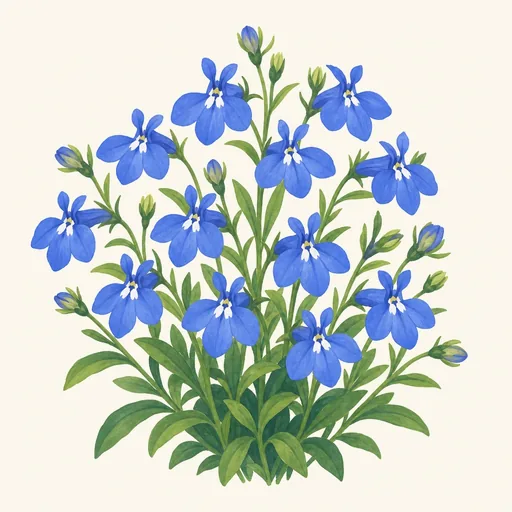
Lobelia
Lobelia erinus · Campanulaceae
- Start indoors8–12 weeks before the last frostJan 16 – Feb 19
- Plant out1–3 weeks after the last frostApr 17 – May 7
- Space10–20 cm (4–8 in) apart
- Bloom30–60 days after plantingMay 17 – Jul 27
Description
Lobelia erinus is the garden lobelia commonly sold for its masses of small, vividly colored flowers. It is native to southern Africa and is grown widely as an ornamental. Compact varieties form low, rounded mounds, while trailing varieties spill over the edges of hanging baskets, window boxes, and containers. Plants typically stand about 10–20 cm tall; trailing stems can extend farther.
The flowers are usually blue or violet-blue, but cultivated varieties also bloom in purple, pink, and white. Each flower has two smaller upper lobes and three broader lower lobes, giving it a delicate, fanlike appearance. Fine stems carry small green leaves, and a healthy plant can be nearly covered in flowers. Lobelia is especially useful for edging paths, filling gaps between larger plants, and softening the sides of pots.
In temperate gardens, it is usually treated as an annual, although it is a short-lived perennial where winters are mild. It flowers best in cool to moderate weather, often from spring into autumn if conditions remain favorable. Prolonged summer heat may slow blooming, particularly in warmer regions.
Grow garden lobelia in well-drained soil that stays evenly moist rather than soggy. Full sun suits it in cool climates; in hot climates, morning sun and afternoon shade help protect it from heat stress. Container plants need regular watering because their soil dries quickly. A light trim after a flush of flowers can encourage fresh growth and more blooms. Avoid letting plants dry out completely or sit in waterlogged soil. Its flowers attract visiting insects, including bees, but the plant is ornamental rather than edible.
Growing Conditions
10–20 cm (4–8 in) tall, 15–30 cm (6–12 in) wide
- Smallest
- Largest
Part sun, 4+ hours
Tolerates full sun, part shade
Moderate
Keep evenly moist, not soggy.
Ideal 12–22 °C (54–72 °F)
Survives down to −1 °C (30 °F).
pH 5.5–7 · acidic to neutral
Where it Grows
Planting
When to Plant
First check which lobelia you have: planting time differs between the low-growing annual bedding lobelia (usually Lobelia erinus) and hardy perennial species such as cardinal flower (Lobelia cardinalis). Set out annual bedding plants in spring after the last expected frost, once nights are reliably above freezing. If starting them from seed, sow indoors about 8–12 weeks before that frost date; the tiny seedlings grow slowly. Harden off indoor-grown plants for about a week before planting them outside. In cool climates, annual lobelia often flowers best from late spring into summer. Where summers are very hot, planting in early spring gives it time to establish before heat arrives; in frost-free areas, autumn planting may work well for winter and spring flowers. Plant perennial lobelias in spring or early autumn, when mild weather helps roots establish. Avoid planting either type into frozen ground or during a spell of intense heat or drought.
How to Plant
Choose a site suited to the species. Annual bedding lobelia grows well in containers, edging, or hanging baskets with fertile, well-drained soil that stays evenly moist. Give it sun in cool areas and some afternoon shade where summers are hot. Perennial cardinal flower prefers consistently moist, compost-enriched soil and can thrive beside a pond or in a rain garden; it tolerates sun when its roots stay damp. Check the label if you have another perennial species, as moisture needs vary.
To start annual lobelia from seed, scatter the fine seed over damp seed-starting mix and press it gently onto the surface. Do not bury it: light helps it germinate. Keep the mix moist, not waterlogged, until seedlings emerge. Before planting out, loosen the soil and mix in compost if needed. Dig holes just wide enough for the root balls, remove plants gently from their pots, and set them at the same depth they were growing before. Space annual bedding plants about 10–15 cm (4–6 inches) apart; give larger perennial lobelias about 30–45 cm (12–18 inches). Water thoroughly after planting, then keep the soil consistently moist while roots establish. In pots, use containers with drainage holes and water whenever the surface begins to dry.
Growth Timeline
- Germination 10–21 days
- Seedlings indoors 6–13 weeks
- Growing in the garden 30–60 days
- In bloom 12–20 weeks
Planting Calendar
- Start seeds indoors: 8–12 weeks before the last frost
- Plant outdoors: 1–3 weeks after the last frost
- Germination: 10–21 days
- Start indoors: Jan 16 – Feb 19
- Plant out: Apr 17 – May 7
- Bloom: May 17 – Jul 27
Care
Care Calendar
- Feed · May 8 – Aug 20
Feed container plants with diluted balanced fertilizer every few weeks. - Prune · Jun 19 – Aug 6
Trim leggy plants back by about one-third to encourage fresh growth and blooms.
Watering
Water according to the kind of lobelia you are growing. Bedding lobelia (Lobelia erinus) performs best in evenly moist, well-drained soil. Water when the surface begins to dry, soaking the root zone rather than giving frequent light sprinkles. Containers and hanging baskets dry out quickly and may need daily checks in hot weather. If bedding plants wilt repeatedly or stop flowering during summer heat, move containers to afternoon shade and water thoroughly. Perennial species such as cardinal flower (Lobelia cardinalis) prefer consistently moist soil and can grow at pond edges; do not let their roots dry out. Even moisture-loving lobelias need appropriate drainage unless they are planted in a setting suited to wet soil. Direct water toward the soil to limit leaf wetness, especially where plants are crowded. Reduce watering as growth slows, but check newly planted lobelias regularly until they are established.
Pruning
Pinch the tips of young bedding lobelia if you want a fuller, more branching plant. As flowers fade, trim back straggly stems with clean shears; a light overall haircut can encourage fresh growth and another flush of blooms. Avoid cutting a heat-stressed plant severely, and water it well afterward. You generally do not need to remove individual spent flowers from compact bedding varieties. For perennial lobelias, remove spent flower spikes if you want a tidier appearance, or leave some in place to produce seed. Cut dead stems down near the base after they have dried, or leave them over winter and remove them in early spring. Take care not to damage the basal rosette on species that maintain one. Pruning will not make a perennial lobelia flower continuously, but removing damaged or diseased growth promptly helps keep the plant healthy.
Weeding
Keep the area around young lobelias free of weeds, which compete for water, nutrients, and light. Hand-pull weeds when the soil is slightly damp so their roots come out more easily. Work carefully near lobelia: bedding plants are small and can be overwhelmed quickly, while established perennials may have shallow roots or young seedlings nearby. If using a hand tool, loosen only the soil surface rather than digging close to the crown. Remove weeds before they flower and set seed, and check container plants for volunteer weeds as well as garden beds. A light mulch can reduce new weed growth, but it will not eliminate the need to inspect the planting regularly. Avoid spraying herbicides near lobelia, where drift can damage foliage. If you are allowing perennial lobelia to self-seed, learn to recognize its seedlings before clearing the bed.
Mulching
Spread a thin layer of organic mulch, such as fine bark or leaf mold, around lobelias to suppress weeds and slow moisture loss. About 2–5 cm (1–2 in) is generally sufficient; keep it slightly back from stems and crowns so they do not stay wet and rot. Mulch is especially useful around perennial lobelias that need consistently moist soil, including cardinal flower. Renew it as it breaks down, rather than piling fresh material on top year after year. In containers, a shallow layer may help the surface dry more slowly, but it is no substitute for checking the potting mix and watering when needed. In cold areas, mulch may help moderate winter soil temperatures around hardy perennials. Wait until the soil has cooled before applying winter mulch, and pull any material away from emerging shoots in spring.
Fertilizing
Lobelias usually need modest feeding rather than heavy applications of fertilizer. Before planting in a garden bed, mix in compost if the soil is poor; established plants growing in reasonably fertile soil may need no additional fertilizer. Bedding lobelia in containers uses up nutrients more quickly. Feed it with a balanced, diluted liquid fertilizer according to the label during active growth, or use a suitable slow-release fertilizer at planting time. Check whether the potting mix already contains fertilizer before adding more. Excess feeding, especially with nitrogen, can produce lush leaves at the expense of flowers and may leave growth weak. For perennial lobelias, a spring top-dressing of compost is often enough. Avoid fertilizing late in the growing season if it encourages tender new growth just before frost. Water dry soil before applying liquid feed to reduce the risk of root damage.
Pest Management
Inspect leaves, stems, and the soil around lobelia regularly, particularly when plants are young. Slugs and snails may chew seedlings and tender perennial shoots; remove them by hand, reduce hiding places, or use a bait labeled for garden use. Aphids can cluster on new growth and flower spikes. A firm spray of water often dislodges them; if needed, use insecticidal soap according to its label, covering affected areas and avoiding open flowers where pollinators are visiting. Spider mites may become troublesome on hot, dry, stressed plants, especially in containers. Check leaf undersides, remove badly affected growth, and correct watering problems. Good spacing and watering at soil level help limit fungal problems. Remove diseased debris, and avoid keeping bedding lobelia waterlogged. Identify a pest before treating: occasional insects or minor leaf damage rarely justify spraying.
Harvesting
Lobelia is grown for its flowers, not as a food crop, but you can harvest seeds for propagation. Leave a few healthy flower stems on the plant after blooming. When the small seed capsules turn brown and begin to dry, clip the stems into a paper bag before the tiny seeds spill. Let the capsules finish drying in a ventilated place, then shake out the seeds and store them in a labeled paper envelope somewhere cool and dry. Seed from named cultivars may not produce plants identical to the parent. Sowing requirements vary by species; many lobelia seeds are surface-sown because they need light to germinate, while some perennial species benefit from a period of cold stratification. Check the requirements for your particular species before sowing. Do not harvest lobelia for eating or home remedies: lobelia plants can be toxic if ingested.
Growing in Containers
Grows well in a pot of at least 1 litres (0.3 US gallons), with drainage holes. Best kept outdoors.
Propagation
From seed
- Sow seeds indoors 8–12 weeks before the last frost.
- Press the seeds onto moist seed-starting mix without covering them.
- Keep the mix moist and provide bright light.
- Transplant seedlings after frost danger has passed.
From cuttings
- Take short, nonflowering stem cuttings in spring or summer.
- Remove the lower leaves.
- Insert the stems into moist, free-draining potting mix.
- Keep them humid and in bright, indirect light until rooted.
By division
- Divide established perennial lobelias in early spring.
- Lift the clump and separate rooted sections.
- Replant each section at its original depth.
- Water thoroughly and keep the soil moist while the divisions establish.
Companion Plants
Good neighbors
- Petunias: They are commonly paired with trailing lobelia in sunny containers, where their larger blooms contrast with lobelia’s small flowers.
- Fuchsias: They are often grown with trailing lobelia in hanging baskets that receive partial shade and regular watering.
Common Problems
- Yellowing leaves
- Sticky residue on leaves
- Black sooty coating
- Curled or cupped leaves
Aphids are small, soft-bodied insects that feed by piercing plants and drawing out sap. The group includes many…
- Holes in leaves
- Slime trails
- Stems chewed or cut through
Slugs and snails are soft-bodied mollusks that feed on many garden plants. Snails carry a visible shell; most slugs…
- Seedlings collapse at soil level
- Soft or rotting stems
- Brown, mushy roots
- Wilting
Damping off is a disease of seeds and young seedlings, not a single organism with one scientific name. It can be…
- Yellowing leaves
- Wilting
- Stunted growth
- Leaves dropping
Root rot is a general name for the decay of plant roots, not a single disease with one scientific name. It can result…
- Poor flowering in hot weather: Annual bedding lobelia (Lobelia erinus) often slows or stops blooming during summer heat.
- Root rot: Soggy, poorly drained soil can damage roots, especially in bedding types.
- Damping-off: Seedlings may collapse when kept too wet or crowded.
- Aphids, spider mites, and slugs: Aphids and mites can damage foliage; slugs may eat tender new growth.
Varieties
A classic bedding variety for borders and pots.
- compact
- deep blue flowers
- bronze foliage
Its soft blue flowers suit edging and containers.
- compact
- pale blue flowers
This white-flowered variety brightens borders and mixed planters.
- compact
- white flowers
Its stems spill over hanging baskets and container edges.
- trailing
- blue flowers
- white eye
This early-flowering selection is suited to baskets and window boxes.
- trailing
- deep blue flowers
A mounding variety with blue flowers marked by white centers.
- compact
- early flowering
- white eye
More about varieties
- Trailing lobelia (Lobelia erinus ‘Sapphire’): A cascading bedding variety with blue flowers and white centers, popular in hanging baskets.
- Edging lobelia (Lobelia erinus ‘Crystal Palace’): A compact variety with deep blue flowers and dark foliage.
- Cardinal flower (Lobelia cardinalis): A tall perennial with vivid red flowers that attracts hummingbirds.
- Great blue lobelia (Lobelia siphilitica): A North American perennial with upright spikes of blue flowers.
Health Benefits
Indian tobacco (Lobelia inflata) has a history of herbal use for respiratory complaints, including coughs and asthma. Its main alkaloid, lobeline, has also been investigated as an aid to smoking cessation because it interacts with some of the same biological pathways as nicotine. Neither use is supported well enough to recommend lobelia as a treatment. Research has not established that it reliably helps people quit smoking, and it should not replace proven treatments for asthma or other breathing problems.
Safety is a significant concern. Lobelia inflata can cause nausea and vomiting; larger amounts may cause serious effects, including breathing difficulties or seizures. The amount of active compounds in herbal products can vary, making a safe dose difficult to judge. People who are pregnant or breastfeeding, and children, should avoid medicinal lobelia. Anyone considering a lobelia supplement should first speak with a qualified healthcare professional, particularly if they take medication or have an existing health condition.
These historical uses concern L. inflata, not the ornamental lobelias commonly grown in containers and borders. Do not eat garden lobelias or use them to make home remedies.
Fun Facts
- The genus Lobelia includes both tiny trailing bedding plants and tall, upright perennials.
- Cardinal flower’s red, tubular blooms are especially attractive to hummingbirds.
- Annual bedding lobelia is commonly grown in blue, a flower color gardeners often seek out.
- Despite its common name, Indian tobacco (Lobelia inflata) is not a true tobacco plant.
Notice an error or have a question about Lobelia? Contact us