Coleus
Coleus scutellarioides · Lamiaceae
- Start indoors8–10 weeks before the last frostJan 30 – Feb 19
- Plant out1–3 weeks after the last frostApr 17 – May 7
- Space25–45 cm (10–18 in) apart
Description
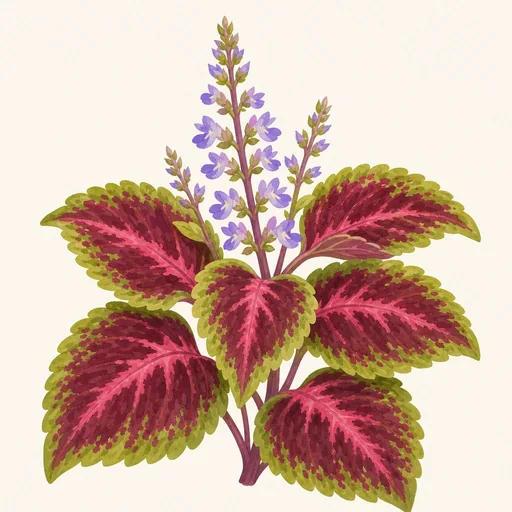
Coleus is a tender perennial best known for its vividly colored leaves, but it also produces flowers. Slender spikes rise above the foliage and carry many small, tubular, two-lipped blossoms, usually in shades of blue or lavender, sometimes white or pink. The flowers open gradually along the spike and can attract bees and other small pollinators. They are modest compared with the leaves, which may combine green, burgundy, purple, red, orange, yellow, or cream in striking patterns.
Gardeners often grow coleus as an annual in beds and containers, although it can live for several years where temperatures stay warm. Plants vary from compact mounds to upright forms over a meter tall, depending on the cultivar. Flowering is most noticeable in summer and autumn, but timing varies with climate, day length, and variety. Pinching off flower spikes is optional: it keeps attention on the foliage and can encourage a bushier shape, while leaving them in place provides a delicate floral accent.
Coleus grows best in fertile, well-drained soil that stays evenly moist without becoming waterlogged. Many cultivars favor bright, indirect light or partial shade, though some tolerate more direct sun if adequately watered. Leaf color and scorching risk both depend on the variety and local conditions. The plant is sensitive to frost and can be overwintered indoors in a bright spot. Pinching stem tips encourages branching, and soft stem cuttings root readily in water or potting mix.
Native to parts of tropical Asia and the western Pacific, coleus is now widely cultivated in warm regions and as a seasonal garden or houseplant in cooler countries. Its flowers are typical of the mint family, whose members often bear small blossoms clustered along upright stems.
Growing Conditions
30–90 cm (1–3 ft) tall, 30–60 cm (12–24 in) wide
- Smallest
- Largest
Part shade
Tolerates full sun, part sun, bright indirect light
Moderate
Keep evenly moist, not soggy.
Ideal 18–30 °C (64–86 °F)
Survives down to 0 °C (32 °F).
pH 6–7 · acidic to neutral
Where it Grows
Planting
When to Plant
Plant coleus outdoors after the last spring frost, once the soil has warmed and nighttime temperatures consistently stay above 50°F (10°C). In many places, this is a week or two later than the usual date for planting frost-tolerant annuals. Coleus is sensitive to cold: a frost can kill it, and chilly nights can slow growth or damage its leaves. If a late frost is forecast after planting, bring containers indoors or cover plants overnight.
If you are starting coleus from seed, sow it indoors about 8–12 weeks before your expected last frost. Plants bought from a greenhouse should spend 7–10 days gradually adjusting to outdoor light and temperatures before they go into the garden. In frost-free climates, coleus can be planted during mild weather, though it establishes best when conditions are warm rather than cool or intensely hot. Wait until the weather is suitable before putting rooted cuttings outside, too.
How to Plant
Choose a spot with well-drained soil and light suited to your variety. Most coleus does well with morning sun and afternoon shade; varieties sold as sun-tolerant can take more direct light if kept adequately watered. In containers, use a quality potting mix and a pot with drainage holes. For garden beds, loosen the soil and mix in compost if it is poor or compacted.
Dig a hole about twice as wide as the root ball but no deeper. Slip the plant from its pot, gently loosen any tightly circling roots, and set it at the same depth it grew in the container. Fill around the roots, firm the soil lightly, and water thoroughly. Space plants according to their mature size: about 12–18 inches (30–45 cm) apart works for many varieties, while large ones may need more room. Add a thin layer of mulch in beds, keeping it away from the stems. Keep the soil evenly moist while plants establish, but do not leave it waterlogged. Pinch growing tips if you want a bushier plant.
To grow coleus from seed, press seeds onto moist seed-starting mix without covering them: they need light to germinate. Transplant seedlings outdoors only after the weather has warmed and they have been hardened off.
Planting Calendar
- Start seeds indoors: 8–10 weeks before the last frost
- Plant outdoors: 1–3 weeks after the last frost
- Germination: 10–20 days
- Start indoors: Jan 30 – Feb 19
- Plant out: Apr 17 – May 7
Care
Care Calendar
- Pinch out · Apr 24 – Jun 11
Pinch young shoot tips for bushier growth, but stop if you want flowers. - Feed · Apr 24 – Aug 6
Feed container plants lightly every few weeks during active growth. - Protect · Oct 11 – Oct 31
Bring potted plants indoors before frost if you want to keep them.
Watering
Keep coleus soil evenly moist, but not waterlogged. Check it with a finger: water when the top inch feels dry, then soak the root zone until excess water drains away. Empty saucers beneath pots so roots do not sit in water. Outdoor plants may need more frequent watering during hot, windy weather; containers dry out faster than garden beds. Check newly planted coleus often while its roots establish. Water at the base, preferably in the morning, to limit prolonged wetness on the leaves. Wilting can signal dry soil, but it can also occur in saturated soil with damaged roots, so check before watering again. Reduce watering when growth slows in cool weather or indoors under lower light. Good drainage is essential.
Pruning
Pinch out the growing tips of young coleus just above a pair of leaves to encourage branching and a fuller plant. Repeat as stems lengthen, rather than removing a large amount of growth at once. Trim leggy stems back to a leaf node; new shoots can grow from the remaining nodes. Remove damaged or discolored leaves as needed. Many gardeners pinch off flower spikes to keep the plant focused on leafy growth, though you can leave them if you enjoy the flowers or want to offer visiting insects a food source. Use clean scissors or pruners, particularly when moving between plants. Healthy stem tips removed during pruning can be rooted as cuttings. If an outdoor plant is threatened by frost, take cuttings beforehand to keep it growing indoors.
Weeding
Keep the soil immediately around garden-grown coleus free of weeds, especially while plants are small. Weeds compete for water and nutrients and can crowd the lower leaves, reducing airflow. Pull them by hand when the soil is slightly moist, taking care not to disturb coleus roots. Remove weeds before they set seed, and check again after rain or watering brings new seedlings up. If you use a hoe between plants, work shallowly and keep it away from the stems. Inspect pots, too: stray weeds can establish quickly in moist potting mix. Do not use lawn weed killers near coleus; spray drift can injure its foliage. Once the plants have filled out, their shade may suppress some weed seedlings, but occasional hand-weeding is still useful.
Mulching
For coleus in garden beds, spread a 1–2-inch layer of organic mulch, such as shredded leaves or fine bark, over the soil. Mulch helps retain moisture, moderates soil temperature, and slows weed growth. Leave a small gap around each stem rather than piling mulch against it; constant moisture at the crown can encourage rot. Apply mulch after planting and watering, and top it up if it thins during the growing season. Check the soil beneath it before watering instead of assuming the surface reflects conditions around the roots. A thin layer can also help large outdoor containers, but it is optional; avoid covering the stem bases or blocking your view of the potting mix when checking moisture.
Fertilizing
Coleus benefits from modest feeding during active growth, particularly in containers, where nutrients wash out with watering. At planting time, you can mix a balanced, slow-release fertilizer into the soil or potting mix according to its label. Alternatively, use a balanced liquid fertilizer at a dilute, label-approved rate about once a month in spring and summer. Rich garden soil may need little additional feeding. Avoid applying more than the label recommends: excess fertilizer can produce soft, stretched growth and may reduce the vividness of the foliage. Water dry soil before applying liquid feed, and keep fertilizer off the leaves. Pause or reduce feeding when growth slows in cool weather or low indoor light. If foliage looks pale, first check watering, drainage, and light, since fertilizer will not correct those problems.
Pest Management
Inspect coleus regularly, including the undersides of leaves and tender shoot tips. Aphids, whiteflies, mealybugs, and spider mites can occur, especially on indoor plants; slugs and snails may chew outdoor foliage. Isolate a newly infested potted plant and remove pests with a gentle stream of water or by wiping affected leaves. For persistent infestations, use an insecticidal soap labeled for the pest and follow its directions carefully. Test it on a small area first, as coleus foliage can be sensitive to sprays; avoid treating plants in strong sun or heat. Hand-pick slugs and snails and remove nearby hiding places. Good spacing and drainage also help limit disease. Discard badly diseased leaves, clean tools, and avoid keeping the foliage wet for long periods.
Growing in Containers
Grows well in a pot of at least 3 litres (0.8 US gallons), with drainage holes. Can be grown indoors as a houseplant.
Propagation
From cuttings
- Cut a healthy, nonflowering stem just below a leaf node.
- Remove the leaves from the lower part of the stem.
- Place the stem in water or moist potting mix.
- Keep it warm and in bright, indirect light.
- Pot up the cutting once roots have formed.
From seed
- Sow seeds on the surface of moist seed-starting mix.
- Press them gently into the mix without covering them.
- Keep the mix warm and evenly moist in bright light.
- Transplant seedlings after they develop true leaves.
Companion Plants
Good neighbors
- Impatiens: Both are commonly grown together in moist, partly shaded beds and containers.
- Begonias: Shade-tolerant begonias are commonly paired with coleus for contrasting flowers and foliage in containers.
Common Problems
- Yellowing leaves
- Sticky residue on leaves
- Black sooty coating
- Curled or cupped leaves
Aphids are small, soft-bodied insects that feed by piercing plants and drawing out sap. The group includes many…
- Yellowing leaves
- Spots on leaves
- Fuzzy gray mold
- Wilting
Downy mildew is a group of plant diseases caused by several species of oomycetes, or water molds, rather than one…
- Yellowing leaves
- Sticky residue on leaves
- Black sooty coating
- Curled or cupped leaves
Mealybugs are small, sap-feeding insects in the family Pseudococcidae. They occur on many houseplants, ornamentals…
- Yellowing leaves
- Wilting
- Stunted growth
- Leaves dropping
Root rot is a general name for the decay of plant roots, not a single disease with one scientific name. It can result…
- Pale speckles or stippling
- Yellowing leaves
- Brown or crispy leaf edges
- Fine webbing
Spider mites are tiny, plant-feeding arachnids in the family Tetranychidae, not insects. Several species attack garden…
- Wilting or root rot: Often caused by soggy soil or poor drainage.
- Leggy growth: Too little light or a lack of pinching can leave stems long and sparse.
- Scorched or faded leaves: Harsh afternoon sun can damage varieties that prefer shade.
- Pests: Aphids, whiteflies, spider mites, and mealybugs may feed on the foliage.
- Downy mildew: Can cause spotting, leaf drop, and fuzzy growth beneath leaves, especially in humid conditions.
Varieties
Its broad leaves have rosy centers edged in green.
- large leaves
- shade tolerant
Creamy white leaf centers contrast with green edges.
- compact
- shade tolerant
Deep burgundy leaves have dark, scalloped edges.
- compact
- ruffled leaves
Bright green leaves are traced with dark purple veins.
- bold veining
- upright
Its ruffled, lime-green leaves brighten containers and borders.
- chartreuse foliage
- sun tolerant
Broad red leaves provide color throughout the growing season.
- red foliage
- sun tolerant
More about varieties
- ‘Kong Red’: Large leaves with red centers and green edges; best with shade from strong afternoon sun.
- ‘Black Dragon’: Ruffled, deep burgundy foliage on a compact plant.
- ‘Fishnet Stockings’: Bright green leaves traced with dark purple veins.
- ‘Wasabi’: Vivid chartreuse, serrated leaves that brighten mixed plantings.
- ‘Main Street Beale Street’: Rich red foliage that holds its color well in sun or partial shade.
Fun Facts
- Coleus is grown mainly for its colorful leaves rather than its small flowers.
- Stem cuttings often root readily in water.
- Pinching stem tips encourages a bushier plant.
- It is a tender perennial but is commonly grown as an annual where winters are cold.
- Ornamental coleus has also been called Solenostemon scutellarioides; its current scientific name is Coleus scutellarioides.
Notice an error or have a question about Coleus? Contact us