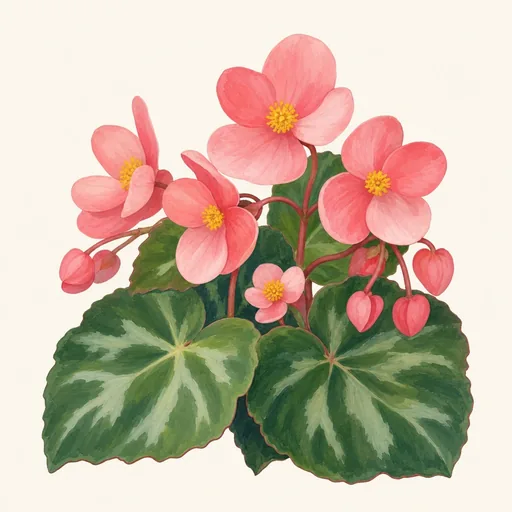
Begonia
Begonia · Begoniaceae
- Plant out1–3 weeks after the last frostApr 17 – May 7
- Space20–30 cm (8–12 in) apart
Description
Begonia is a large genus of flowering plants grown for its colorful blooms, striking leaves, or both. Its species and cultivated varieties range from compact bedding plants to trailing basket plants and upright shrubs. Leaves are often lopsided, with one side larger than the other, and may be glossy, hairy, patterned, or deeply colored. Flowers usually have four or more petal-like parts and appear in shades of white, pink, red, orange, and yellow. A plant can bear separate male and female flowers; the female flowers develop distinctive winged seed capsules.
Gardeners commonly group begonias by their growth habits. Wax begonias are dependable bedding plants that flower over a long season. Tuberous begonias produce especially large, showy flowers and typically rest during a cool or dry season. Cane begonias have tall, jointed stems, while rhizomatous and rex begonias are grown mainly for ornamental foliage. These are practical gardening groups rather than a complete botanical classification.
Most begonias prefer bright, indirect light or partial shade, although light needs vary among varieties. They generally grow best in loose, well-drained soil that stays lightly moist without becoming waterlogged. Letting the surface dry slightly between waterings helps protect the roots. Good air circulation discourages powdery mildew, and protection from harsh afternoon sun helps prevent leaf scorch. Many begonias are sensitive to frost, so gardeners in cold climates grow them as houseplants or bring them indoors for winter. Some can be propagated from stem or leaf cuttings; tuberous types may also be started from dormant tubers. Begonias contain soluble calcium oxalates and should be kept away from pets that might chew them, particularly the tubers. In suitable climates, they can brighten shaded beds, containers, and sheltered patios.
Growing Conditions
15–45 cm (6–18 in) tall, 20–45 cm (8–18 in) wide
- Smallest
- Largest
Part shade, 2+ hours
Tolerates part sun, bright indirect light
Moderate
Keep evenly moist, not soggy.
Ideal 16–24 °C (61–75 °F)
Survives down to 0 °C (32 °F).
pH 5.5–6.5 · acidic
Where it Grows
Planting
When to Plant
Plant begonias outdoors after the last spring frost, once nights are consistently mild and the soil has warmed to about 60°F (16°C). They are frost-tender, so a warm afternoon is not enough: check your local frost forecast before putting them in the ground or leaving containers outside. In cooler climates, start tuberous begonias indoors about 6–8 weeks before the expected last frost to give them a head start. Move them outdoors gradually over several days after frost danger has passed. Fibrous-rooted bedding begonias can be planted as established young plants at the same frost-free point. If you are growing begonias indoors, you can pot them at any time of year, though spring’s increasing light helps new plants establish. In hot regions, spring planting lets outdoor begonias establish before intense summer heat. Wait if the planting site is still cold or waterlogged: cool, wet soil increases the risk of rot.
How to Plant
Choose a sheltered spot with bright, indirect light or morning sun and afternoon shade. Most begonias scorch in strong midday sun, although some bedding varieties tolerate more light. Use a pot with drainage holes or a garden bed that drains freely. Mix compost into garden soil if needed, or fill containers with a loose, well-draining potting mix. Avoid heavy, soggy soil.
For fibrous-rooted begonias, dig a hole just wide enough for the root ball and set the plant at the same depth it grew in its pot. Gently firm the soil around it. Space small bedding varieties about 8–12 inches (20–30 cm) apart; allow more room for larger varieties. For tuberous begonias, set each tuber with its hollow side facing up. Start it in barely moist potting mix, leaving the top exposed or only lightly covered; add more mix as shoots grow, without burying the emerging stems deeply. Keep rhizomatous begonias near the soil surface rather than burying their stems.
Water newly planted begonias to settle the soil, then let the surface dry slightly before watering again. Keep water off the leaves when practical, and never leave a container standing in water. If planting outdoors, acclimate indoor-grown plants gradually to outdoor light and temperatures.
Planting Calendar
- Plant outdoors: 1–3 weeks after the last frost
- Plant out: Apr 17 – May 7
Care
Care Calendar
- Feed · Apr 24 – Aug 6
Feed container plants with diluted balanced fertilizer every few weeks during active growth. - Deadhead · May 8 – Aug 20
Remove spent flowers from tuberous types to encourage more blooms; wax begonias usually need no deadheading. - Protect · Oct 11 – Oct 31
Bring potted begonias indoors or protect them before freezing weather. - Lift and store · Oct 25 – Nov 7
After frost damages the foliage, lift tuberous begonias and dry and store their tubers frost-free.
Watering
Keep begonia soil evenly moist during active growth, but never waterlogged. Check the top 1–2 cm (about ½ inch) of potting mix; water when it feels dry, then let excess drain away. Water the soil rather than the leaves, especially on fuzzy-leaved types, to reduce spotting and fungal disease. Pots need drainage holes, and plants in hot, windy locations may need water more often than those in shade. Reduce watering when growth slows in winter. Tuberous begonias need a more pronounced dry rest after their foliage naturally dies back; keep stored tubers barely dry rather than continuing a regular watering schedule. Rex and other rhizomatous begonias dislike both prolonged dryness and soggy roots. If indoor air is dry, raise humidity with a humidifier or by grouping plants, while maintaining airflow. Wilting can signal either dry soil or root rot, so check the mix before watering.
Pruning
Remove yellow, damaged, or diseased leaves promptly, using clean scissors and cutting close to the stem without injuring healthy tissue. Snip off spent flowers on flowering begonias to keep plants tidy and, where applicable, encourage further blooms. Pinch the growing tips of young wax or cane begonias if you want a bushier shape; make cuts just above a leaf node. Thin crowded stems sparingly to improve airflow, particularly where damp foliage has encouraged fungal problems. Avoid stripping off too much foliage at once, since leaves fuel growth and, in tuberous types, replenish the tuber. For tuberous begonias entering dormancy, allow stems and leaves to yellow and die back naturally before removing them. Rex and other foliage begonias generally need only light grooming rather than routine hard pruning. Disinfect tools after working on a plant with signs of disease, and discard infected material rather than composting it.
Weeding
For begonias grown outdoors, remove weeds while they are small so they do not compete for water, nutrients, and light. Pull by hand after watering or rain, when the soil loosens, and take care around the begonia’s shallow roots and, in tuberous varieties, the tuber. Weed regularly near the crown, but avoid digging or hoeing deeply enough to damage roots. Remove the whole weed, including its roots where practical, before it flowers or sets seed. Dispose of persistent weeds that can regrow from fragments rather than leaving them on the soil. A light mulch can suppress new seedlings, provided it is kept away from begonia stems. In containers, pull stray seedlings as soon as they appear; crowded pots dry unevenly and offer pests shelter. Indoor begonias normally have no weeding needs beyond removing an occasional volunteer seedling from the potting mix.
Mulching
For outdoor begonias, spread a thin layer of fine organic mulch, such as shredded leaves or fine bark, over the soil to slow evaporation and limit weeds. About 2–5 cm (1–2 inches) is usually enough; leave a gap around stems, crowns, and exposed tubers so they do not stay damp and rot. Apply mulch after the soil has warmed and been watered, rather than over very dry soil. Check beneath it occasionally: if the ground remains soggy or slugs gather there, pull the mulch back or reduce its depth. In cool, wet conditions, a heavy layer can do more harm than good. Container-grown and indoor begonias usually do not need mulch, since it can make soil moisture harder to judge and keep the crown too wet. For tuberous begonias grown outdoors, follow local guidance on lifting tubers before frost rather than relying on mulch to protect them.
Fertilizing
Feed actively growing begonias with a balanced, water-soluble fertilizer diluted according to the label, often at half strength, about every two to four weeks. Begin after new growth is established in spring and stop or reduce feeding when growth slows in autumn or winter. Flowering types can benefit from regular light feeding during their bloom period; foliage types also need nutrients, but too much fertilizer may damage their roots or cause weak growth. Water first if the potting mix is dry, and do not exceed the label rate. Fresh potting mix may already contain fertilizer, so check its packaging before adding more. Pale leaves can have several causes, including poor light or unhealthy roots, and are not always a sign that more fertilizer is needed. If white salts collect on the soil surface or pot rim, flush the mix with water and allow it to drain, then feed less often.
Pest Management
Inspect new plants and check leaf undersides and growing tips regularly. Aphids, mealybugs, thrips, and spider mites can affect begonias; outdoors, slugs and snails may chew leaves. Isolate an infested pot, remove pests by hand or with a gentle stream of water, and prune badly affected growth. Insecticidal soap may help with soft-bodied pests, but test it on a small area first: some begonia leaves are sensitive, and sprays should be used only as directed on the label. Remove fallen debris, avoid overcrowding, and provide airflow to discourage gray mold and powdery mildew. Water the soil rather than wetting leaves, and let excess water drain to reduce root rot. Fungus gnats in pots often indicate persistently damp mix; letting the surface dry appropriately can help. Identify the problem before treating it, since leaf spots or wilting may reflect watering conditions rather than insects.
Growing in Containers
Grows well in a pot of at least 2 litres (0.5 US gallons), with drainage holes. Can be grown indoors as a houseplant.
Propagation
From seed
- Sow the tiny seeds on the surface of moist seed-starting mix.
- Press them gently into the mix without covering them.
- Keep the tray warm, humid, and in bright indirect light.
- Transplant seedlings after they develop several true leaves.
From cuttings
- Cut a healthy stem just below a node.
- Remove the lower leaves.
- Insert the stem into moist, free-draining potting mix.
- Keep it warm and in bright indirect light until roots form.
From tubers
- Select a healthy tuberous begonia tuber with more than one bud.
- Cut the tuber so each piece has at least one bud.
- Let the cut surfaces dry before planting.
- Plant each piece shallowly with its bud facing upward.
- Keep the mix lightly moist until growth begins.
Companion Plants
Good neighbors
- Coleus: Its colorful foliage complements begonia flowers, and both are commonly grown together in partially shaded containers.
- Impatiens: Both are commonly planted in partially shaded beds with evenly moist soil for continuous summer color.
- Ferns: Their fine-textured foliage contrasts with begonias in shaded, moist planting areas.
Common Problems
- White powdery coating
- Yellowing leaves
- Curled or cupped leaves
- Distorted new growth
Powdery mildew is a group of fungal diseases, not a single species. Different fungi infect different hosts, including…
- Fuzzy gray mold
- Spots on leaves
- Wilting
- Soft or rotting stems
Gray mold, also called Botrytis blight, is a fungal disease caused most commonly by Botrytis cinerea. It affects many…
- Spots on leaves
- Yellowing leaves
- Holes in leaves
- Leaves dropping
Bacterial leaf spot is a name for leaf diseases caused by several bacteria, commonly species of Xanthomonas or…
- Yellowing leaves
- Wilting
- Stunted growth
- Leaves dropping
Root rot is a general name for the decay of plant roots, not a single disease with one scientific name. It can result…
- Yellowing leaves
- Sticky residue on leaves
- Black sooty coating
- Curled or cupped leaves
Mealybugs are small, sap-feeding insects in the family Pseudococcidae. They occur on many houseplants, ornamentals…
- Root rot from soggy soil or poor drainage
- Powdery mildew and gray mold, especially with poor airflow
- Bacterial leaf spot, which can cause water-soaked or dark patches
- Brown, crispy leaf edges from dry air, underwatering, or harsh sun
- Mealybugs, aphids, thrips, and spider mites
Varieties
A widely grown choice for large containers and hanging baskets.
- red flowers
- vigorous
- self-cleaning
Its arching stems carry flowers through the warm season.
- pink flowers
- vigorous
- self-cleaning
This series needs good drainage and winter storage where winters freeze.
- yellow flowers
- large blooms
- shade tolerant
Its cascading stems suit hanging baskets in bright shade.
- trailing
- apricot flowers
- large blooms
This bedding begonia flowers steadily with little deadheading.
- red flowers
- bronze foliage
- compact
A large bedding begonia suited to containers and mass planting.
- red flowers
- bronze foliage
- vigorous
More about varieties
- Wax begonias (Begonia Semperflorens-Cultorum Group): Compact bedding plants with glossy leaves and frequent flowers.
- Tuberous begonias (Begonia × tuberhybrida): Grown for large, showy blooms; their tubers usually rest during a dormant period.
- Rex begonias (Begonia Rex Cultorum Group): Prized for boldly colored, patterned foliage rather than flowers.
- Polka dot begonia (Begonia maculata): A cane begonia with silver-spotted leaves and reddish undersides.
- Hardy begonia (Begonia grandis): A perennial species that can survive winter outdoors in some temperate gardens.
Health Benefits
Begonias are grown mainly as ornamentals, not as medicinal plants. Their colorful leaves and flowers can make indoor spaces and gardens more pleasant, and tending them can be an enjoyable, calming hobby. Those are potential benefits of gardening and living with plants in general; there is no good evidence that begonias themselves provide a distinctive health benefit.
Some Begonia species have been used in local food traditions and folk medicine, but uses vary by species. That history should not be taken as proof that a begonia can prevent or treat an illness. An ornamental plant bought without a confirmed species identification is not a safe substitute for food or medicine.
Begonias contain calcium oxalates, particularly in their underground parts. Eating parts of the plant may irritate the mouth or digestive tract, and begonias are toxic to cats and dogs. Keep them away from pets and young children who might chew them. If you want an edible flower or herb, choose a plant specifically identified and grown for that purpose rather than sampling a houseplant begonia.
Fun Facts
- Begonia leaves are often asymmetrical, with one side of the leaf blade larger than the other.
- The genus was named in honor of Michel Bégon, a French official and plant collector.
- The genus contains more than 2,000 described species.
- A begonia can bear separate male and female flowers on the same plant.
- Begonia seeds are extremely tiny and are often described as dust-like.
Notice an error or have a question about Begonia? Contact us