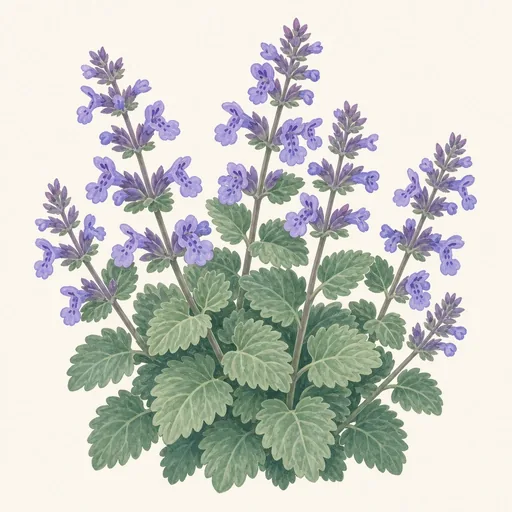
Catmint
Nepeta × faassenii · Lamiaceae
- Start indoors6–8 weeks before the last frostFeb 13 – Mar 5
- Sow outdoorsFrom the last frost until 2 weeks afterApr 10 – Apr 30
- Plant outFrom the last frost until 2 weeks afterApr 10 – Apr 30
- Plant in autumn6–8 weeks before the first autumn frostAug 30 – Sep 19
- Space30–60 cm (12–24 in) apart
- Bloom60–90 days after plantingJun 9 – Aug 19
Description
Catmint is a low-growing, spreading perennial grown for its lavender-blue flowers and aromatic foliage. Its branching stems form soft mounds, usually about 30–60 cm tall and often wider than they are high. The small, gray-green leaves have scalloped edges and release a minty scent when brushed or crushed. From late spring into summer, slender flowering stems rise above the leaves, carrying clusters of small, tubular, two-lipped flowers. Bees and other pollinators visit them readily. In favorable conditions, flowering may continue into autumn, especially if spent stems are cut back after the first flush.
This ornamental catmint is a garden hybrid, distinct from catnip (Nepeta cataria), though the two are often confused. It is commonly planted along paths, at the front of borders, in rock gardens, and beneath roses, where its loose shape can soften harder edges. Cultivars vary in height, spread, and flower color, but most have a similar airy appearance. The foliage remains attractive between flowering periods and can provide a gentle contrast to plants with larger or darker leaves.
Catmint grows best in full sun and well-drained soil. Once established, it tolerates dry spells and generally needs little fertilizer; overly rich soil can encourage floppy growth. It may flower less freely in shade and can struggle in persistently wet ground. Cutting stems back after bloom encourages tidier growth and often a second display of flowers. In cold climates, the aboveground growth dies back in winter and returns from the base in spring. Although some cats respond to its scent, this ornamental hybrid is not the plant most often used as catnip. Its long flowering season and modest care needs make it a familiar choice in temperate gardens.
Growing Conditions
30–90 cm (1–3 ft) tall, 45–90 cm (1–3 ft) wide
- Smallest
- Largest
Full sun, 4+ hours
Tolerates part sun
Low
Let the soil dry out between waterings.
Ideal 15–27 °C (59–81 °F)
Survives down to −40 °C (−40 °F).
pH 6–8 · neutral to alkaline
Where it Grows
Planting
When to Plant
Plant catmint in spring, after the last expected frost, when the soil is workable and no longer waterlogged. This gives young plants a full growing season to develop roots. In areas with mild winters, early fall is also a good choice: plant at least four to six weeks before the ground typically freezes so roots can establish. Fall planting can be especially helpful where summers are hot.
Container-grown catmint can be planted later in the growing season, but avoid setting it out during a heat wave unless you can water it regularly while it establishes. If starting from seed, sow indoors about six to eight weeks before the last expected frost, or sow outdoors after frost danger has passed. Check the seed packet for any variety-specific instructions. Wait until seedlings are sturdy enough to handle before transplanting them. Avoid planting into cold, saturated soil, which can cause roots to rot.
How to Plant
Choose a spot with full sun—ideally at least six hours of direct light—and soil that drains well. Catmint tolerates average, relatively poor soil; rich soil and heavy feeding can encourage floppy growth. In heavy clay, improve drainage by planting in a raised bed or on a slight mound. Give each plant room to spread: about 18 to 24 inches between plants suits many varieties, but check the mature width of your particular cultivar.
Dig a hole about twice as wide as the root ball and no deeper. Slip the plant from its pot, gently loosen any tightly circling roots, and place it so the top of the root ball is level with the surrounding soil. Backfill with the soil you removed, firm it lightly, and water thoroughly. Keep soil lightly moist while the plant establishes, letting the surface dry somewhat between waterings; do not leave it soggy. Once established, catmint usually needs little supplemental water except during prolonged drought. A thin layer of mulch can help retain moisture, but keep it away from the crown to reduce the risk of rot.
For seeds, follow the packet’s sowing-depth directions and keep the seed-starting mix consistently moist, not saturated, until seedlings emerge.
Growth Timeline
- Germination 10–21 days
- Seedlings indoors 3–8 weeks
- Growing in the garden 60–90 days
- In bloom 12–20 weeks
Planting Calendar
- Start seeds indoors: 6–8 weeks before the last frost
- Sow outdoors: from the last frost until 2 weeks after
- Plant outdoors: from the last frost until 2 weeks after
- Autumn planting: 6–8 weeks before the first autumn frost
- Germination: 10–21 days
- Start indoors: Feb 13 – Mar 5
- Sow outdoors: Apr 10 – Apr 30
- Plant out: Apr 10 – Apr 30
- Autumn planting: Aug 30 – Sep 19
- Bloom: Jun 9 – Aug 19
Care
Care Calendar
- Prune · Mar 13 – Apr 16
Cut old stems back to a few inches above the ground before new growth takes off. - Divide · Mar 27 – May 14
Divide crowded clumps every few years as new growth begins. - Deadhead · May 22 – Jul 9
Shear off spent flower spikes after the first flush to encourage rebloom.
Watering
Water newly planted catmint thoroughly, then check the soil regularly during its first growing season. Water when the top 1–2 inches feel dry, soaking the root zone rather than giving frequent light sprinkles. Once established, catmint is drought-tolerant in the ground and usually needs extra water only during prolonged dry spells or intense heat. Let the soil dry somewhat between waterings; constantly wet soil can cause root rot. Water at the base of the plant to keep foliage dry and reduce disease risk. Catmint in containers dries out faster, so check pots more often, especially in summer, and water until excess drains from the bottom. Always use a pot with drainage holes. Wilting during the hottest part of the day does not necessarily mean the plant needs water: check the soil first, and water if it is dry.
Pruning
In early spring, cut back dead stems before new growth gets underway. During the growing season, remove damaged or untidy stems as needed. After the first major flush of flowers fades, shear the plant back by about one-third to one-half. This often encourages fresh foliage and a second, lighter round of bloom while keeping sprawling varieties compact. Make cuts above healthy leaves rather than into the woody base. You can also snip off spent flower spikes individually if the plant needs only light tidying. Pruning before seeds mature helps limit self-seeding in fertile varieties, although some named cultivars produce little or no viable seed. Avoid heavy cutting immediately before frost, when tender new growth may be damaged. Leaving the final stems standing over winter can provide some habitat and mark the plant’s location; clear them in spring.
Weeding
Keep the area around young catmint free of weeds so its roots do not have to compete for water, light, and nutrients while the plant establishes. Pull weeds by hand when the soil is slightly moist, taking care to remove their roots without disturbing the catmint’s crown. A hand fork can help with deep-rooted weeds, but work shallowly near the plant to avoid injuring its roots. Check especially in spring, before catmint’s new growth spreads and hides small seedlings. Established clumps often shade out some weeds, but grasses and persistent perennials can still push through. Remove these promptly, before they spread or set seed. If a fertile catmint variety self-sows more than you want, pull unwanted seedlings while they are small. A modest layer of mulch can reduce new weeds, but leave a gap around the plant’s crown.
Mulching
A thin layer of mulch can suppress weeds and help newly planted catmint retain moisture, especially during its first season. Spread roughly 1–2 inches of mulch over the surrounding soil, leaving a few inches clear around the crown and stems. Keeping the crown uncovered is important: catmint prefers well-drained conditions and may rot if damp mulch is piled against it. Fine gravel can suit dry, sunny plantings and will not hold moisture against the plant as readily as a thick layer of organic mulch. Shredded bark or compost can also be used sparingly where the soil drains well. Established catmint often needs little mulch beyond what is useful for weed control. Check the layer each spring, pull any weeds growing through it, and replenish only as needed. Do not use mulch to compensate for poorly drained soil; improve the site or choose another planting spot instead.
Fertilizing
Catmint generally grows and flowers well without routine fertilizer, particularly in average garden soil. In early spring, a light top-dressing of finished compost is usually enough if the soil is poor. Keep compost away from the crown, and avoid building up a thick, moisture-holding layer. Too much fertilizer, especially nitrogen, can produce soft, floppy growth with fewer flowers. If an established plant looks weak, first check that it receives plenty of sun and that the soil drains well; watering problems or excessive shade are not solved by feeding. A soil test can help identify an actual nutrient deficiency before you add fertilizer. Container-grown catmint has access to fewer nutrients and may benefit from a dilute, balanced fertilizer during active growth, following the product label. Stop feeding if growth becomes lush and sprawling. There is no need to fertilize as the plant enters winter dormancy.
Pest Management
Catmint usually has few serious pest problems. Inspect leaves and stems occasionally, particularly on young or stressed plants, for aphids, spider mites, or chewing damage. A firm spray of water can dislodge small aphid colonies; repeat as necessary, aiming the spray away from open flowers and visiting pollinators. If pests persist, use an insecticidal soap labeled for the problem, following its directions and avoiding applications when bees are active. Slugs may nibble tender new growth; hand-pick them in the evening or use an appropriate slug bait if damage is substantial. Some cats are strongly attracted to catmint and may roll on or flatten small plants. A temporary wire cage can protect new transplants until they are sturdy. Good spacing, sun, and well-drained soil help prevent problems such as powdery mildew and root rot. Remove badly affected foliage and avoid keeping the crown wet.
Harvesting
If you want catmint for dried flowers or foliage, gather stems when the plant is healthy and flowers are beginning to open, preferably after dew has dried. Use clean scissors to cut leafy, flowering stems above a pair of leaves, leaving enough growth for the plant to recover. Harvesting a modest portion during the first bloom can double as the seasonal trim that encourages fresh growth. For drying, tie small bundles loosely and hang them in a dark, dry, well-ventilated place, or spread stems in a single layer on a screen. Store fully dry material in an airtight container away from light. Fresh flower spikes can also be cut for informal arrangements; leave some on the plant for bees and other pollinators. Identify the exact Nepeta species or cultivar before using any harvest in food or tea, and avoid consuming plants treated with products not labeled for edible crops.
Growing in Containers
Grows well in a pot of at least 10 litres (2.6 US gallons), with drainage holes. Best kept outdoors.
Propagation
By division
- Lift an established clump in spring or early fall.
- Separate it into sections with roots and shoots.
- Replant the sections at their original depth.
- Water them in and keep the soil lightly moist until established.
From cuttings
- Take short, nonflowering stem cuttings in late spring or early summer.
- Remove the leaves from the lower half of each stem.
- Insert the stems into moist, free-draining propagation mix.
- Keep them in bright, indirect light until rooted.
- Pot up the rooted cuttings.
From seed
- Sow species catmint seeds in spring; named cultivars may not grow true from seed.
- Press the seeds onto moist seed-starting mix.
- Keep the mix lightly moist until seedlings emerge.
- Transplant seedlings outdoors after the last frost.
Companion Plants
Good neighbors
- Roses: Catmint is commonly planted at the edge of rose beds, where its long flowering season complements roses and its mounded growth softens bare lower stems.
- Peonies: Catmint’s low, spreading growth helps cover the base of peonies and provides flowers after their spring bloom.
- Lavender: Both thrive in full sun and well-drained soil, making them a common pairing in dry, informal borders.
Common Problems
- White powdery coating
- Yellowing leaves
- Curled or cupped leaves
- Distorted new growth
Powdery mildew is a group of fungal diseases, not a single species. Different fungi infect different hosts, including…
- Yellowing leaves
- Wilting
- Stunted growth
- Leaves dropping
Root rot is a general name for the decay of plant roots, not a single disease with one scientific name. It can result…
- Root rot: Wet, poorly drained soil can cause yellowing and dieback.
- Powdery mildew: A whitish coating may develop on leaves in humid conditions, especially where air circulation is poor.
- Flopping: Excess fertilizer, rich soil, or too little sun can leave stems sprawling.
- Occasional pests: Aphids and spider mites may appear, though serious infestations are uncommon.
Varieties
Its arching stems make a broad, flower-covered mound for sunny borders.
- violet-blue flowers
- long blooming
- spreading
Give this large, billowing cultivar room to spread.
- tall
- violet-blue flowers
- vigorous
Its tidy habit suits the front of a border or a container.
- compact
- indigo-blue flowers
- early blooming
This mounding cultivar stays relatively neat while producing many flower spikes.
- compact
- blue flowers
- dense
It offers a smaller-growing alternative to Walker's Low.
- compact
- blue flowers
- long blooming
Use this small cultivar along paths or at the front of a sunny bed.
- low-growing
- deep blue flowers
- compact
More about varieties
- ‘Walker’s Low’: A popular, long-blooming cultivar with lavender-blue flowers; despite its name, it can grow quite wide.
- ‘Six Hills Giant’: A larger selection suited to generous borders.
- ‘Cat’s Pajamas’: A compact cultivar with blue flowers and dark purple calyces.
- ‘Purrsian Blue’: A tidy, mounded selection with abundant blue-purple blooms.
- ‘Junior Walker’: A smaller selection with a habit similar to ‘Walker’s Low’.
Health Benefits
Garden catmint is grown mainly for its flowers, scent, and appeal to pollinators. There are no well-established medical benefits for common ornamental catmint cultivars, and they should not be assumed to have the same uses as catnip.
Catnip (Nepeta cataria) is a related species in the same genus. Its leaves have traditionally been brewed as tea for relaxation and mild digestive discomfort. These are traditional uses, not proven treatments: human research is limited, and a soothing effect from a warm tea does not establish that catnip treats anxiety, insomnia, or digestive disease. Some Nepeta plants contain aromatic compounds studied for insect-repelling properties, but that does not make a garden plant a reliable substitute for a tested repellent.
If you want to try an herbal tea, first identify the species and use plant material grown without unsuitable pesticides. Avoid medicinal use during pregnancy or breastfeeding, when safety information is inadequate. Check with a healthcare professional before using it alongside medicines or for a persistent symptom. Do not ingest essential oils: concentrated oils are not equivalent to a mild tea. For most gardeners, catmint’s dependable wellness contribution is simply the enjoyment of its fragrance, flowers, and visiting bees.
Fun Facts
- Catmint and catnip belong to the same genus, Nepeta, but they are not necessarily the same species.
- Many catmint flowers attract bees and other pollinators.
- Catmint is in the mint family, whose members typically have square stems.
- ‘Walker’s Low’ was named for a place, not for its height.
- Crushing the leaves releases their distinctive minty fragrance.
Notice an error or have a question about Catmint? Contact us