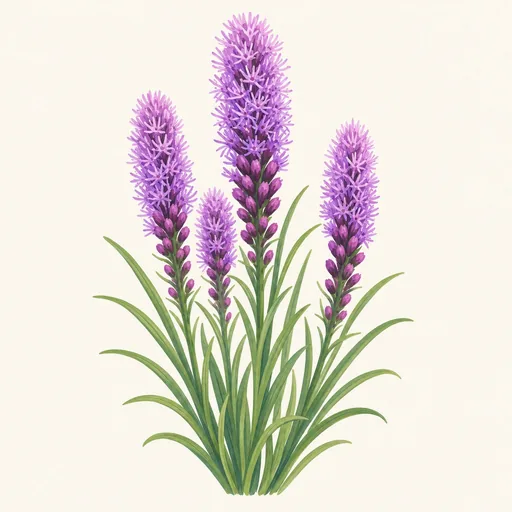
Liatris
Liatris · Asteraceae
- Plant in autumn4–8 weeks before the first autumn frostAug 30 – Oct 3
- Space30–45 cm (12–18 in) apart
- Bloom90–120 days after planting
Description
Liatris is a genus of perennial flowering plants in the daisy family, Asteraceae. Often called blazing stars or gayfeathers, these plants are known for upright stems topped with dense spikes or rounded clusters of small, feathery flower heads. Most have purple to pink blooms, although some species flower white. Unlike many flowering spikes, those of several familiar garden species open from the top downward. The flowers attract bees, butterflies, and other pollinators, and their seeds can provide food for birds.
Leaves are generally narrow and grasslike, growing along the stems and sometimes forming a tuft near the base. Depending on the species, plants may reach from under 30 cm to well over 1 m tall. They grow back each year from underground structures such as corms or thickened roots. Flowering usually takes place in summer or early autumn, with timing varying by species and climate.
Liatris species occur naturally in North America, especially in prairies, meadows, open woods, and other sunny habitats. Their preferred conditions differ: some flourish in dry, sandy ground, while others favor consistently moist soil. For garden cultivation, choose a species suited to the site rather than assuming all liatris have the same water needs. Most perform best in full sun and soil that drains well enough to avoid prolonged waterlogging.
Gardeners value liatris for its vertical shape, wildlife appeal, and suitability for naturalistic plantings. The flower spikes also work well as cut flowers and can be dried. Established plants usually need little maintenance, though tall stems may benefit from support in exposed locations. Propagation is possible from seed or by dividing established clumps; seed-grown plants may take more than one season to reach flowering size. Leaving some spent flower heads in place provides seed for wildlife and allows plants to self-sow where conditions are suitable.
Growing Conditions
0.6–1.2 m (2–4 ft) tall, 30–45 cm (12–18 in) wide
- Smallest
- Largest
Full sun, 6+ hours
Tolerates part sun
Moderate
Keep evenly moist, not soggy.
Ideal 15–27 °C (59–81 °F)
Survives down to −40 °C (−40 °F).
acidic to neutral
Where it Grows
Planting
When to Plant
Plant Liatris corms in spring, once the soil has thawed and is workable. You do not need to wait for the last frost: established Liatris is cold-hardy, and the corms will begin growing as the soil warms. Spring planting is especially reliable in places with cold, wet winters. In regions with mild winters, you can also plant corms in fall, several weeks before the ground freezes, so they have time to settle in.
If you are growing Liatris from seed, sow outdoors in fall and let winter provide the cold period many species need to germinate. For spring sowing, check the seed packet: seeds commonly benefit from four to six weeks of moist chilling in a refrigerator first. Start them indoors in late winter or sow outside after the last frost. Seed-grown plants may take a year or two to flower. Divide established clumps in early spring, as growth begins, or in fall after flowering.
How to Plant
Choose a spot with full sun—at least six hours of direct light—and soil that drains well. Liatris tolerates lean or sandy soil, but its corms can rot if they sit in water, particularly over winter. If your soil is heavy clay, improve drainage or plant in a raised bed. Clear weeds and loosen the soil before planting; there is usually no need for rich compost or heavy fertilizer.
Plant each corm about 2 to 4 inches (5 to 10 cm) deep, with the growing buds facing up and the roots or flatter side facing down. If you cannot tell which side is up, plant it on its side. Space corms roughly 6 to 12 inches (15 to 30 cm) apart, allowing more room for larger varieties and mature clumps. Cover with soil, firm gently, and water to settle it. Keep the soil lightly moist while new growth starts, but never soggy; established plants generally need watering only during prolonged dry spells.
For nursery plants or divided clumps, dig a hole wide enough to spread the roots and set the crown at the same level it grew before. Water after planting. If sowing seeds, follow the packet’s depth guidance, since requirements vary among Liatris species.
Growth Timeline
- Growing in the garden 90–120 days
- In bloom 3–6 weeks
Planting Calendar
- Autumn planting: 4–8 weeks before the first autumn frost
- Autumn planting: Aug 30 – Oct 3
Care
Care Calendar
- Prune · Feb 27 – Apr 16
Cut last year's dry stems to the ground before new shoots emerge. - Divide · Mar 13 – Apr 16
Every few years, divide crowded clumps and replant the corms in well-drained soil. - Stake · May 8 – Jun 11
Support tall varieties early if they grow in an exposed spot.
Watering
Water newly planted Liatris regularly through its first growing season, letting the soil surface dry slightly between waterings. Aim to moisten the root zone rather than sprinkling the leaves, and water in the morning when possible. Once established, most garden Liatris tolerate dry spells and need supplemental water mainly during prolonged drought. Species differ, though: Liatris spicata generally appreciates more consistent moisture than species native to dry prairie soils. Check the soil before watering rather than following a rigid schedule. If it remains wet several inches down, wait. Good drainage matters as much as watering frequency because corms and crowns can rot in soggy soil, especially during winter. Container-grown plants dry faster than those in the ground; water them when the upper inch or two of potting mix feels dry, and empty any saucer that holds standing water.
Pruning
Remove spent flower spikes if you prefer a tidy appearance or want to limit self-seeding. Cut the stalk near its base with clean pruners after flowering; avoid removing healthy leaves while they are still green, since the plant uses them to replenish its underground storage organs. Alternatively, leave the flower heads standing through winter. They provide seed for birds and add structure to the garden. After the foliage has yellowed and died back, cut stems and leaves close to the ground in late fall or early spring. Spring cleanup also lets you see where the dormant plants are before disturbing the soil. If a stem breaks or develops obvious disease, remove it promptly and dispose of diseased material rather than composting it. Liatris does not need routine shaping or pinching to flower well.
Weeding
Keep the planting area relatively free of weeds, particularly while Liatris is becoming established. Young shoots and small plants compete poorly with vigorous grasses and other fast-growing weeds for light, water, and nutrients. Pull weeds after rain or watering, when their roots release more easily, and try to remove perennial weed roots rather than repeatedly cutting off their tops. Work carefully near Liatris shoots and crowns: shallow corms or rhizomes and emerging stems can be damaged by a hoe. In spring, mark the planting spot if needed so you do not mistake slow-to-emerge Liatris shoots for weeds. Once plants are larger, spacing them with compatible garden plants can help shade bare ground and reduce new weed seedlings. Check regularly and remove weeds before they set seed; a few minutes of frequent hand-weeding is usually easier than clearing an overgrown bed.
Mulching
Apply a thin layer of mulch to help suppress weeds and moderate soil temperature, especially around new plantings. About 1–2 inches (2.5–5 cm) of shredded leaves, fine bark, or another loose organic mulch is generally sufficient. Keep it a few inches away from the crowns and emerging shoots rather than piling it against them. A deep, moisture-holding layer can keep the crown too wet and increase the risk of rot. In heavy soil or a rainy climate, use mulch sparingly and prioritize drainage. In dry, sandy beds, a light layer can reduce evaporation while plants establish. Check the bed in spring and pull mulch back if it covers new growth. Renew it only as it breaks down; there is no need to add another full layer every year. Leave seed heads accessible if you want birds to feed on them.
Fertilizing
Liatris usually needs little fertilizer in ordinary garden soil. Many species grow naturally in relatively lean ground, and heavy feeding can encourage weak, leafy growth instead of sturdy flower spikes. At planting time, improve very poor soil with a modest amount of finished compost, mixed into the surrounding soil without burying the crown too deeply. Established plants can receive a light top-dressing of compost in spring if growth is weak or the soil is depleted. Avoid placing compost directly against emerging stems. Do not apply fertilizer simply because flowering has finished; the plant normally stores energy from its leaves for the following year. If plants repeatedly grow poorly, check sunlight, drainage, and competition from nearby roots before feeding. A soil test can identify an actual nutrient deficiency. Follow its recommendations rather than routinely using a high-nitrogen lawn fertilizer.
Pest Management
Start with healthy growing conditions: give Liatris sun, well-drained soil, and enough space for air to move around the stems. Check young shoots for slug or snail damage and remove the pests by hand or use an appropriate iron-phosphate bait if needed. Aphids or other small sap-feeding insects can often be dislodged with a firm spray of water. Avoid broad-spectrum insecticides during flowering, when Liatris attracts bees, butterflies, and other pollinators. Watch for leaf spotting or powdery mildew, particularly where plants are crowded; remove badly affected foliage and water at soil level rather than wetting the leaves. Yellowing or collapse in persistently wet soil may indicate crown or corm rot. Remove severely affected plants and correct the drainage before replanting. Occasional chewed leaves rarely require treatment if the plants are otherwise vigorous.
Harvesting
For cut flowers, harvest Liatris spikes when the upper flowers have begun to open and lower buds remain closed. Unlike many flower spikes, Liatris blooms from the top downward. Cut stems in the cool of morning with clean shears, place them promptly in water, and remove any leaves that would sit below the waterline. Leave enough foliage on each plant to support next year’s growth. For seed, allow flower heads to dry on the plant until they turn brown and the seeds come away readily. Clip the heads into a paper bag before the seeds scatter, then dry them thoroughly in an airy place. Store cleaned seed in a cool, dry location until sowing; Liatris seed generally benefits from a period of cold, moist conditions before germination. If you want birds to use the seeds, leave some heads standing rather than collecting them all.
Growing in Containers
Grows well in a pot of at least 10 litres (2.6 US gallons), with drainage holes. Best kept outdoors.
Propagation
From seed
- Collect mature seeds after the flower heads dry.
- Chill the seeds in moist medium for several weeks, or sow them outdoors in fall.
- Sow shallowly in well-drained seed-starting mix.
- Keep the mix lightly moist until seedlings establish.
- Transplant seedlings after the risk of frost has passed.
By division
- Lift established clumps in early spring.
- Gently separate the corms, keeping a growing bud on each division.
- Discard soft or damaged corms.
- Replant the divisions in sunny, well-drained soil.
- Water them in, then avoid waterlogging.
Companion Plants
Good neighbors
- Purple coneflower: Both are commonly grown in sunny, well-drained prairie-style plantings and attract pollinators.
- Black-eyed Susan: It shares liatris’s preference for full sun and provides contrasting yellow flowers.
- Butterfly weed: Both suit sunny, well-drained pollinator gardens.
- Little bluestem: This prairie grass grows well alongside liatris in sunny, well-drained plantings.
Common Problems
- White powdery coating
- Yellowing leaves
- Curled or cupped leaves
- Distorted new growth
Powdery mildew is a group of fungal diseases, not a single species. Different fungi infect different hosts, including…
- Orange or rust-colored spots
- Spots on leaves
- Yellowing leaves
- Leaves dropping
Rust is a group of plant diseases caused by fungi in the order Pucciniales, not a single species. Different rust fungi…
- Yellowing leaves
- Wilting
- Stunted growth
- Leaves dropping
Root rot is a general name for the decay of plant roots, not a single disease with one scientific name. It can result…
- Corm rot: Poorly drained or persistently wet soil can cause corms to decay.
- Powdery mildew and leaf spots: More likely where plants are crowded and air circulation is poor.
- Slugs and rabbits: May damage tender new growth, especially in spring.
- Flopping stems: Tall plants may lean in rich soil or partial shade; full sun usually produces sturdier growth.
Varieties
Its shorter flower spikes suit borders and small gardens.
- compact
- purple flowers
Its white spikes add height to sunny borders.
- white flowers
- tall
Its long violet spikes make good cut flowers.
- violet flowers
- tall
This white-flowered form provides a pale alternative to the usual purple liatris.
- white flowers
More about varieties
- Liatris spicata (dense blazing star): A widely grown species with closely packed purple flower spikes.
- Liatris spicata ‘Kobold’: A compact cultivar suited to smaller borders.
- Liatris spicata ‘Floristan White’: A white-flowered cultivar that contrasts well with purple forms.
- Liatris pycnostachya (prairie blazing star): A tall prairie species with dense, rosy-purple spikes.
- Liatris ligulistylis (meadow blazing star): Noted for its appeal to monarch butterflies.
- Liatris aspera (rough blazing star): Has more widely spaced flower clusters along its stems.
Health Benefits
Liatris is grown chiefly as an ornamental, not as a medicinal herb. Some species have a history of use in traditional remedies, including preparations made from their underground parts, but those uses have not been established as safe or effective treatments in clinical studies. Because Liatris is a genus rather than a single species, accounts of traditional use should not be assumed to apply to every plant sold as blazing star. There is no established dose or standard home preparation. Do not use it to treat an illness or replace medical care without advice from a qualified healthcare professional.
Its clearest wellness value is in the garden. The upright flower spikes provide color and make long-lasting cut flowers, while the blooms offer nectar to butterflies and other pollinators. Growing Liatris in a sunny, well-drained space can be a rewarding way to spend time outdoors and observe wildlife. Those are benefits of gardening and enjoying the plant, rather than evidence that consuming Liatris improves health. Leave flowers on some stems if you want visiting pollinators to benefit, and choose a species suited to your local conditions.
Fun Facts
- Liatris flower spikes usually open from the top downward, unlike many other spike-flowering plants.
- Many garden Liatris grow from swollen underground structures commonly called corms.
- Blazing stars are native to North America.
- The plants are often called gayfeather because of their feathery-looking blooms.
- The flower spikes can be used fresh or dried in arrangements.
Notice an error or have a question about Liatris? Contact us