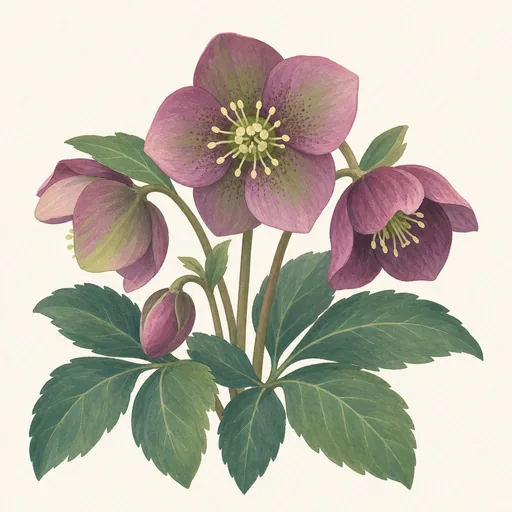
Hellebore
Helleborus · Ranunculaceae
- Plant outFrom 4 weeks before to 2 weeks after the last frostMar 13 – Apr 30
- Plant in autumn4–8 weeks before the first autumn frostAug 30 – Oct 3
- Space35–45 cm (14–18 in) apart
Description
Hellebore is the common name for plants in the genus Helleborus, a group of long-lived perennials in the buttercup family. They are valued for flowers that appear from winter into spring, often when little else is blooming. Depending on the species or hybrid, the nodding flowers may be white, green, pink, purple, or nearly black; many are spotted or edged in a contrasting color. What look like petals are actually sepals, which can remain attractive long after pollination. The small, modified true petals form nectar-producing structures near the center of the flower.
Most hellebores form low clumps of leathery, divided leaves. Some retain their foliage through winter, while others shed it or produce fresh leaves as flowering begins. Christmas rose (Helleborus niger) and Lenten roses, commonly H. orientalis and its hybrids, are familiar garden types; despite their names, they are not roses. Mature plants generally grow about 20–60 cm tall, although size varies by type.
Hellebores do best in partial shade, such as beneath deciduous trees, where they receive winter light and protection from strong summer sun. They prefer fertile, well-drained soil with consistent moisture during establishment. Once settled, many tolerate periods of dry shade, but waterlogged ground can cause root problems. A layer of compost or leaf mold helps maintain the soil. Removing damaged older leaves before flowering can make the blooms easier to see and improve air circulation.
Established clumps need little disturbance and may self-seed, though seedlings of hybrids seldom resemble their parents exactly. All parts of the plant are poisonous if eaten, and sap can irritate skin, so wear gloves when cutting leaves or dividing plants. Hellebores are best admired in the garden rather than handled by children or pets.
Growing Conditions
30–60 cm (12–24 in) tall, 40–60 cm (16–24 in) wide
- Smallest
- Largest
Part shade, 2+ hours
Tolerates part sun, full shade
Moderate
Keep evenly moist, not soggy.
Ideal 5–20 °C (41–68 °F)
Survives down to −34 °C (−29 °F).
pH 6.5–8 · neutral to alkaline
Where it Grows
Planting
When to Plant
Plant hellebores in early autumn, while the soil is still warm but the hottest weather has passed. This gives their roots time to establish before winter and helps them cope with the following summer. Early spring is another good choice, especially where winters are severe. A potted hellebore can be planted whenever the ground is workable, but avoid frozen or waterlogged soil, heatwaves, and periods when you cannot water it regularly.
If you are choosing a plant in bloom, late winter or early spring is a useful time to shop: you can see its actual flower colour, which may vary between seedlings. Plant it promptly if conditions are suitable, or keep the pot watered in a sheltered spot until they improve. Hellebores are long-lived and generally prefer not to be moved once established, so choose a permanent site rather than planning to transplant them later.
How to Plant
Choose a spot with partial or dappled shade, such as beneath deciduous shrubs or trees. Hellebores tolerate some sun where the soil stays moist, but strong afternoon sun can stress them. They do best in fertile, well-drained soil that retains some moisture; avoid sites that stay soggy. Mix compost or leaf mould into poor soil before planting. Leave roughly 30–45 cm (12–18 in) between smaller plants, and more room for vigorous varieties.
Water the plant in its pot, then dig a hole about twice as wide as the root ball and no deeper. Slip the plant out carefully, loosening any tightly circling roots without tearing the root ball apart. Set it at the same depth it grew in the pot, with the crown—the point where leaves emerge—not buried. Backfill, firm the soil gently, and water thoroughly. Add a thin layer of leaf mould or other organic mulch to conserve moisture, keeping it clear of the crown.
Keep the soil evenly moist during the first growing season, especially through dry spells, but do not leave it waterlogged. Wear gloves when handling hellebores: their sap can irritate skin, and all parts are poisonous if eaten.
Planting Calendar
- Plant outdoors: from 4 weeks before to 2 weeks after the last frost
- Autumn planting: 4–8 weeks before the first autumn frost
- Plant out: Mar 13 – Apr 30
- Autumn planting: Aug 30 – Oct 3
Care
Care Calendar
- Prune · Jan 30 – Mar 19
Cut away tattered or diseased old leaves before new flower buds emerge. - Feed · Feb 13 – Apr 2
Top-dress lightly with compost around the plant. - Deadhead · Apr 24 – Jun 25
Cut spent flower stalks at the base unless you want seedlings. - Mulch · Oct 11 – Nov 14
Apply a thin layer of leaf mold or compost, keeping the crown uncovered.
Watering
Keep the soil evenly moist while a hellebore establishes, especially during its first growing season. Check the soil a few centimetres below the surface and water when it begins to dry, rather than following a fixed schedule. Water deeply at the base of the plant so moisture reaches the roots, then let excess water drain away. Established hellebores usually need extra water only during prolonged dry spells, although plants beneath trees may need more because tree roots compete for moisture. Pay particular attention during summer drought: even when a hellebore is not flowering, its roots need enough moisture to support the following season’s growth. Avoid persistently soggy soil, which can encourage root problems. A layer of mulch helps the soil retain moisture, but keep it clear of the crown. Container-grown hellebores dry out faster than garden plants, so check their potting mix more often.
Pruning
Remove dead, damaged or diseased leaves with clean secateurs. On many hybrid hellebores, older leaves can be cut back in late winter, just before the new flower stems emerge. This makes the flowers easier to see and removes foliage that may carry leaf-spot disease. Cut each old leaf close to its base without nicking emerging buds or the crown. Not every hellebore needs this treatment: species with leafy flowering stems, such as Helleborus foetidus, are generally best left intact except for damaged growth. After flowering, you can remove spent flower stems if you do not want seedlings; leave them in place if you plan to collect seed. Do not remove healthy new foliage simply to tidy the plant, as it feeds the roots. Wear gloves when pruning, because hellebores are poisonous and their sap may irritate skin.
Weeding
Keep the area around a hellebore free of weeds, particularly while the plant is young. Weeds compete for water and nutrients, and vigorous ground-cover weeds can crowd the crown or hide emerging shoots. Pull small weeds by hand when the soil is slightly moist, taking care not to disturb the hellebore’s roots. For deep-rooted weeds, loosen the soil gently with a hand tool rather than digging heavily beside the plant. Check beneath the leaves and around the edge of any mulch, where seedlings can be easy to miss. Remove weeds before they flower and set seed to reduce future work. A modest layer of organic mulch can suppress new weeds, but it will not stop established perennial weeds; remove those before mulching. If you notice small hellebore seedlings, distinguish them from weeds before pulling them—they can be left to grow or moved when large enough to handle.
Mulching
Spread a thin layer of compost, leaf mould or other well-rotted organic material over the soil around a hellebore in spring or autumn. Roughly 3–5 cm is enough to help retain moisture, moderate soil temperature and suppress annual weeds. Keep the mulch a few centimetres away from the crown and the bases of stems; burying them can encourage rot, especially in wet weather. If fallen leaves collect naturally around plants growing beneath deciduous trees, they can serve as mulch, provided they do not smother new shoots. Top up the layer as it breaks down, rather than piling fresh material onto an already thick covering. Avoid uncomposted manure and thick, water-holding layers in poorly drained soil. Before mulching, pull weeds and remove any hellebore leaves affected by leaf spot. Mulch is particularly useful where tree roots compete with the plant for summer moisture.
Fertilizing
Hellebores generally need little fertilizer in reasonably fertile garden soil. A yearly top-dressing of well-rotted compost or leaf mould is often sufficient: spread it around the plant without covering the crown. If growth is weak and the soil is poor, apply a balanced, slow-release garden fertilizer in early spring at the rate on the label, then water it in. Avoid heavy applications, especially of high-nitrogen fertilizer, which can encourage soft leafy growth without improving flowering. Do not assume fertilizer will solve every problem: poor drainage, deep shade, drought or competition from tree roots may be the real cause of weak growth. Container-grown hellebores have a limited supply of nutrients and may benefit from a modest spring feed or renewal of their potting mix. If a plant is growing and flowering well, skip additional fertilizer rather than feeding it routinely.
Pest Management
Inspect new shoots, leaves and flower buds regularly. Aphids may gather on tender growth; small infestations can be washed off with water or removed by hand. Slugs and snails can damage young shoots and seedlings, especially in damp weather. Check around pots and dense mulch for hiding places, and use a locally approved slug control if damage is persistent. Good spacing and watering at soil level help foliage dry, reducing conditions that favour leaf-spot disease. Remove affected old leaves and dispose of them rather than leaving them around the plant. If a hellebore develops severe black streaking and distorted growth, hellebore black death, a viral disease, is a possibility; there is no cure, so remove and dispose of a badly affected plant rather than dividing it. Disinfect tools after working on suspect plants. Identify the problem before using any pesticide.
Harvesting
Hellebore flowers can be cut for arrangements, though newly opened blooms often wilt quickly in a vase. For longer-lasting stems, wait until the central seed pods have begun to develop and the flower-like sepals feel firmer. Cut stems with clean secateurs, place them promptly in water and keep the arrangement out of direct sun. To collect seed instead, watch the developing pods in late spring or early summer and gather them as they begin to open, before the seeds scatter. Sow fresh seed promptly; hellebore seed can lose viability in storage and often germinates after a period of seasonal temperature changes. Seed-grown plants may differ from their parent, particularly with hybrids. Wear gloves when handling cut stems and seed pods, and wash your hands afterwards. All parts of a hellebore are poisonous: harvest it only for ornamental use, never for food or herbal preparations.
Growing in Containers
Grows well in a pot of at least 10 litres (2.6 US gallons), with drainage holes. Best kept outdoors.
Propagation
From seed
- Collect seeds as soon as the pods ripen.
- Sow the fresh seeds in a pot of moist, well-draining seed compost.
- Keep the pot outdoors in a sheltered spot through the seasons.
- Keep the compost lightly moist while the seeds germinate.
- Pot up seedlings once they are large enough to handle.
By division
- Choose a mature clump in early autumn or just after flowering.
- Lift the clump carefully, keeping as many roots intact as possible.
- Separate it into sections, each with buds and roots.
- Replant the sections promptly at their original depth.
- Water them in and keep the soil lightly moist while they establish.
Companion Plants
Good neighbors
- Snowdrops: They bloom alongside hellebores in late winter and thrive in similar woodland conditions.
- Daffodils: They provide spring flowers among hellebores and suit the same well-drained, partly shaded beds.
- Ferns: They share the preference for woodland shade and provide foliage after hellebore flowers fade.
- Hostas: Their emerging leaves fill space around hellebores later in spring without hiding the winter flowers.
Common Problems
- Yellowing leaves
- Sticky residue on leaves
- Black sooty coating
- Curled or cupped leaves
Aphids are small, soft-bodied insects that feed by piercing plants and drawing out sap. The group includes many…
- Spots on leaves
- Yellowing leaves
- Leaves dropping
Fungal leaf spot is a general name for diseases caused by many different fungi, not a single species. These fungi…
- Holes in leaves
- Slime trails
- Stems chewed or cut through
Slugs and snails are soft-bodied mollusks that feed on many garden plants. Snails carry a visible shell; most slugs…
- Fuzzy gray mold
- Spots on leaves
- Wilting
- Soft or rotting stems
Gray mold, also called Botrytis blight, is a fungal disease caused most commonly by Botrytis cinerea. It affects many…
- Leaf spot: Dark patches on leaves and stems, especially in damp conditions. Remove affected foliage and avoid overhead watering.
- Hellebore black death: A viral disease that causes black streaks, distorted growth, and decline. Remove and discard affected plants; there is no cure.
- Crown or root rot: Poorly drained soil can cause wilting and rotting at the base of the plant.
- Aphids: These insects cluster on new growth and can spread viruses.
- Slugs and snails: They may chew young leaves and flower buds.
Varieties
Its outward-facing, deep red flowers stand above attractive marbled leaves.
- deep red flowers
- mottled foliage
It bears pink flowers above foliage marked with pale veins.
- pink flowers
- mottled foliage
Its cream-colored flowers age to pink and green on compact plants.
- cream flowers
- compact
Its rose-pink flowers often begin opening in winter.
- pink flowers
- winter blooming
This Helleborus niger cultivar produces large white flowers in winter.
- white flowers
- early blooming
Its layered flowers have pale petals edged in contrasting pink or purple.
- double flowers
- picotee edges
This Winter Jewels cultivar bears dark purple, nearly black double flowers.
- double flowers
- near-black flowers
More about varieties
- Christmas rose (Helleborus niger): A compact species with white flowers that can bloom in winter.
- Lenten rose (Helleborus × hybridus): Widely grown hybrids with flowers in white, pink, purple, and near-black shades.
- Stinking hellebore (Helleborus foetidus): An evergreen species with finely divided leaves and clusters of green, bell-shaped flowers.
- Corsican hellebore (Helleborus argutifolius): A robust evergreen species with toothed leaves and pale green flowers.
Fun Facts
- Hellebores belong to the buttercup family, not the rose family.
- The colorful parts that look like petals are sepals; they often remain attractive long after pollination.
- Despite its name, the Christmas rose may flower at different times depending on the climate.
- Seed-grown Lenten roses can produce flowers unlike those of their parent plants.
- All parts of hellebores are poisonous if eaten.
Notice an error or have a question about Hellebore? Contact us