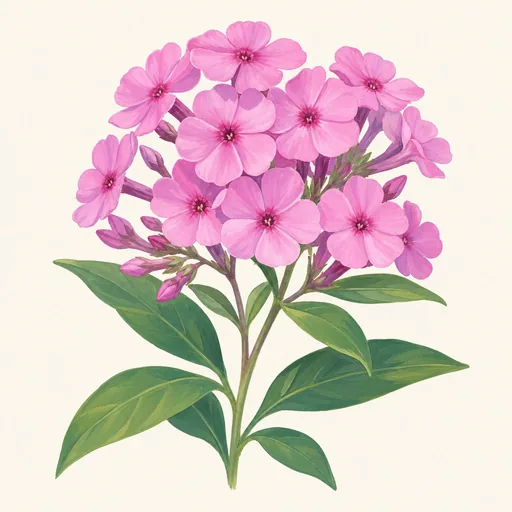
Phlox
Phlox · Polemoniaceae
- Plant outFrom the last frost until 4 weeks afterApr 10 – May 14
- Plant in autumn6–8 weeks before the first autumn frostAug 30 – Sep 19
- Space45–60 cm (18–24 in) apart
Description
Phlox is a genus of flowering plants valued for its bright, often fragrant blooms. Most species are native to North America, though one occurs naturally in northeastern Asia. Garden phlox ranges from low mats that spread over rocks and borders to upright plants that can reach about 1.2 metres tall. Some species are annuals, but many are herbaceous perennials that return each spring.
The flowers typically have five petals joined at the base into a slender tube. They appear singly or in clusters, depending on the species, and may be pink, purple, white, red, or blue. Many have a contrasting centre. Bloom time varies: creeping phlox often flowers in spring, while tall garden phlox provides colour in summer. The leaves are generally simple and arranged opposite each other along the stems.
Different kinds suit different places. Creeping phlox (Phlox subulata) forms a low, evergreen or semi-evergreen carpet and grows well in sunny, well-drained sites. Woodland phlox (Phlox divaricata) prefers partial shade and soil that stays moderately moist. Tall garden phlox (Phlox paniculata) grows best in fertile soil with consistent moisture and good air circulation. Most garden varieties flower more freely with adequate light, although their needs vary by species.
Phlox is useful in borders, rock gardens, and naturalistic plantings. Its flowers attract butterflies and other pollinators, and removing faded blooms can encourage further flowering in some varieties. Tall phlox may develop powdery mildew, especially where plants are crowded or foliage stays damp. Spacing plants well and choosing resistant cultivars can help. Propagation methods include division for many perennials, stem cuttings, and seed; named cultivars should be propagated vegetatively if their particular flower colour or growth habit is to be preserved.
Growing Conditions
0.6–1.2 m (2–4 ft) tall, 45–90 cm (1–3 ft) wide
- Smallest
- Largest
Full sun, 4+ hours
Tolerates part sun
Moderate
Keep evenly moist, not soggy.
Ideal 15–27 °C (59–81 °F)
Survives down to −34 °C (−29 °F).
pH 6–7 · acidic to neutral
Where it Grows
Planting
When to Plant
The right planting time depends on which phlox you have. Plant perennial garden phlox and creeping phlox in spring, once the soil is workable, or in early autumn, at least four to six weeks before the ground usually freezes. Spring planting gives roots a full growing season to establish; early-autumn planting works well where summers are hot, provided the plants have time to root before winter. Avoid planting during a heat wave or in frozen or waterlogged soil. If you are buying potted plants, you can generally plant them during the growing season when conditions are mild, but they will need more careful watering in summer. Annual phlox, usually Phlox drummondii, should go outdoors after your last expected spring frost. To get an earlier start, sow annual phlox indoors about six to eight weeks before that frost date, or sow it directly in the garden after frost danger has passed.
How to Plant
Choose a spot with good airflow and well-drained soil. Most phlox flowers best in full sun, though garden phlox appreciates some afternoon shade in very hot climates. Creeping phlox needs particularly sharp drainage; tall garden phlox prefers soil that stays evenly moist but never soggy. Loosen the soil around the planting area and mix in compost if it is poor or compacted. If water tends to stand there after rain, choose another site or improve drainage before planting.
For potted perennials, dig a hole about as deep as the root ball and wider than it. Gently tease apart tightly circling roots, set the plant at the same depth it grew in its pot, and firm soil around it. Do not bury the crown, where the stems meet the roots. Space tall garden phlox about 18–24 inches (45–60 cm) apart for airflow; allow roughly 12–18 inches (30–45 cm) between creeping phlox plants so they can spread. Water thoroughly after planting. Add a thin layer of mulch around tall phlox to conserve moisture, keeping it clear of the stems. Water regularly while roots establish, especially in dry weather. For annual phlox, follow the seed packet’s sowing depth and spacing instructions.
Planting Calendar
- Plant outdoors: from the last frost until 4 weeks after
- Autumn planting: 6–8 weeks before the first autumn frost
- Plant out: Apr 10 – May 14
- Autumn planting: Aug 30 – Sep 19
Care
Care Calendar
- Divide · Mar 27 – May 7
Divide crowded clumps every few years and replant promptly. - Thin · Apr 10 – May 14
Remove some crowded shoots from upright phlox to improve airflow. - Mulch · Apr 10 – May 14
Apply a thin layer of compost or mulch, keeping it clear of the crowns. - Deadhead · Apr 24 – Aug 20
Remove spent flower clusters to keep plants tidy and encourage further bloom. - Prune · Oct 25 – Nov 28
Cut dead stems of upright phlox to the ground, especially if they had mildew.
Watering
Water newly planted phlox regularly until its roots are established, keeping the soil evenly moist but not soggy. Established tall garden phlox generally needs about 1 inch (2.5 cm) of water per week from rain or irrigation, with more during hot, dry spells. Check the soil before watering: if the upper inch is dry, water deeply enough to moisten the root zone. Creeping phlox usually needs less water once established, but benefits from a deep drink during prolonged drought. Apply water at the soil surface, preferably in the morning, rather than wetting the leaves. Good air circulation and dry foliage help limit powdery mildew, a common problem on tall phlox. Containers dry out faster than garden beds and may need more frequent checks. If the soil stays wet for days, reduce watering and check drainage; phlox does not thrive with waterlogged roots.
Pruning
For tall garden phlox, remove spent flower clusters to keep the plant tidy and, in some varieties, encourage a smaller second flush of bloom. Cut flower stems back to a pair of healthy leaves rather than leaving bare stalks. In late spring, you can shorten some stems by about one-third to one-half to encourage branching and stagger flowering; this may delay blooms on those stems. Thin crowded shoots near the base if needed to improve airflow. After frost has killed the foliage, cut tall phlox stems down and remove diseased debris from the garden. Creeping phlox needs a different approach: after its spring flowers fade, lightly shear or trim straggly growth to maintain a compact mat. Avoid cutting deeply into old, bare, woody stems, which may not fill in readily. Clean pruning tools when moving between plants that show signs of disease.
Weeding
Keep weeds out of phlox beds, especially while new plants are establishing. Weeds compete for moisture and nutrients and can crowd stems, reducing the airflow that helps tall phlox resist powdery mildew. Pull or hoe young weeds when the soil is slightly moist, taking care not to damage phlox’s relatively shallow roots or emerging shoots. Hand-weeding is particularly useful around creeping phlox: its low mat can conceal weed seedlings, and a hoe can tear up its stems. Remove perennial weeds, including their roots, before planting if possible. Check along the edges of creeping phlox regularly, where grass and other vigorous plants can grow into the mat. A thin layer of mulch in open spaces can suppress new weeds, but keep it off the crowns and do not bury the foliage. Remove weeds before they set seed to reduce work in later seasons.
Mulching
Apply a 2–3-inch (5–8 cm) layer of shredded leaves, compost, or another loose organic mulch around tall garden phlox. Mulch helps conserve moisture, moderates soil temperature, and reduces weed growth. Leave a small gap around the crown and stems so they are not kept constantly damp. Refresh the layer as it breaks down, rather than piling new mulch on top indefinitely. In climates with freezing winters, mulch can also help limit repeated freezing and thawing around newly planted roots. Creeping phlox usually needs much less mulch once its foliage covers the ground. Mulch the open soil around young plants, but avoid covering their low stems and leaves; trapped moisture can encourage rot. If using compost as mulch, spread it thinly near the crown. Check that irrigation still reaches the soil beneath the mulch rather than merely dampening its surface.
Fertilizing
Before planting, improve poor soil with compost and ensure it drains well. In established beds, a light top-dressing of compost in spring is often sufficient for phlox growing in reasonably fertile soil. If growth is weak and the soil is low in nutrients, apply a balanced, slow-release fertilizer in spring at the label rate, then water it in. Avoid placing fertilizer directly against stems or crowns. More is not necessarily better: excess nitrogen can produce lush, weak growth and may increase disease problems without improving flowers. Creeping phlox generally needs little fertilizer, particularly in a fertile bed; overfeeding can encourage foliage at the expense of its compact habit. Tall garden phlox may benefit from modest feeding where soil is lean, but avoid repeated heavy applications. If a plant consistently performs poorly, a soil test can help identify a nutrient or pH problem before you add more fertilizer.
Pest Management
Inspect phlox regularly, including the undersides of leaves and the growing tips. Aphids and spider mites may appear, especially on stressed plants; a firm spray of water can dislodge small aphid populations, while keeping plants adequately watered can help limit mite outbreaks. Slugs and snails may feed on tender growth; remove hiding places, hand-pick them in the evening, or use a bait labeled for garden use. Phlox plant bugs can distort leaves and flower buds; remove affected plant debris and check for the insects early in the season. Powdery mildew is a disease rather than an insect pest, but it is a frequent concern with tall phlox. Space plants for airflow, avoid wetting foliage, and remove badly affected leaves or stems. Choose mildew-resistant varieties where available. Identify the problem before using a pesticide, and follow the label carefully; beneficial insects often help keep minor pest populations in check.
Harvesting
Phlox flowers can be cut for indoor arrangements. For tall garden phlox, choose stems whose flower clusters have begun opening but still have plenty of unopened buds. Cut in the cool of the morning with clean, sharp snips, and place the stems promptly in clean water. Make cuts above a healthy set of leaves so the plant retains foliage. Remove any leaves that would sit below the waterline, change the vase water regularly, and keep the arrangement out of direct sun and heat. Take only a modest number of stems from each plant if you want the garden display to continue. Creeping phlox has short stems and is not commonly harvested as a cut flower. If you want to collect seed, leave a few flower heads on the plant until their seed capsules mature and dry; seed-grown plants may differ from named varieties.
Growing in Containers
Grows well in a pot of at least 20 litres (5.3 US gallons), with drainage holes. Best kept outdoors.
Propagation
By division
- Dig up an established perennial clump in early spring or autumn.
- Separate it into sections with healthy roots and shoots.
- Replant the sections promptly at their original depth.
- Water thoroughly.
From cuttings
- Take nonflowering stem cuttings in late spring or early summer.
- Remove the lower leaves.
- Insert the stems into moist, free-draining potting mix.
- Keep them humid and out of direct sun until rooted.
- Pot up the rooted cuttings.
From seed
- Collect ripe seed or buy seed of the species or annual phlox you want.
- Sow according to the seed packet's depth and timing instructions.
- Keep the seed-starting mix lightly moist.
- Transplant seedlings after they have developed several true leaves.
Companion Plants
Good neighbors
- Coneflower: Garden phlox and coneflowers are commonly grown together because both thrive in sunny perennial borders and flower in summer.
- Black-eyed Susan: Black-eyed Susans are a common border companion for garden phlox, sharing its preference for sun and providing contrasting summer blooms.
Common Problems
- White powdery coating
- Yellowing leaves
- Curled or cupped leaves
- Distorted new growth
Powdery mildew is a group of fungal diseases, not a single species. Different fungi infect different hosts, including…
- Pale speckles or stippling
- Yellowing leaves
- Brown or crispy leaf edges
- Fine webbing
Spider mites are tiny, plant-feeding arachnids in the family Tetranychidae, not insects. Several species attack garden…
- Spots on leaves
- Yellowing leaves
- Leaves dropping
Fungal leaf spot is a general name for diseases caused by many different fungi, not a single species. These fungi…
- Powdery mildew, especially on garden phlox where air circulation is poor.
- Spider mites and aphids, which can damage leaves and new growth.
- Leaf spot, which causes discolored patches on foliage.
- Root rot in poorly drained or consistently waterlogged soil.
- Slugs and snails, which may feed on tender young plants.
Varieties
A widely grown white-flowered cultivar valued for its resistance to powdery mildew.
- white flowers
- mildew resistant
- tall
Its many small pink flowers attract butterflies.
- pink flowers
- mildew resistant
- tall
Its pale pink blooms have a distinct darker center.
- pale pink flowers
- dark pink eye
This upright cultivar bears purple flowers with white centers.
- purple flowers
- white eye
Its flowers shift between violet and a bluer hue with the light.
- blue-violet flowers
- tall
This mat-forming cultivar produces striped flowers in spring.
- low-growing
- pink-and-white flowers
- spring bloom
It forms a spreading mat covered in flowers in spring.
- low-growing
- blue-lavender flowers
- spring bloom
More about varieties
- Garden phlox (Phlox paniculata): A tall summer-flowering perennial; ‘David’ has white flowers and good powdery mildew resistance.
- Creeping phlox (Phlox subulata): A low, spreading perennial that forms a carpet of spring flowers; ‘Emerald Blue’ has lavender-blue blooms.
- Woodland phlox (Phlox divaricata): A spring-flowering species suited to partial shade; ‘Blue Moon’ has lavender-blue flowers.
- Annual phlox (Phlox drummondii): Grown from seed for colorful flowers over a long season.
Fun Facts
- The name Phlox comes from a Greek word meaning “flame.”
- Most phlox species are native to North America.
- Different species bloom at different times, from spring-flowering creeping phlox to summer-flowering garden phlox.
- Phlox flowers attract butterflies and other pollinators.
Notice an error or have a question about Phlox? Contact us