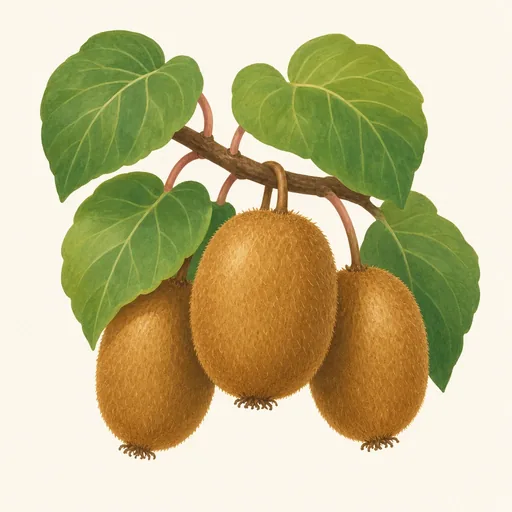
Kiwi
Actinidia deliciosa · Actinidiaceae
- Plant outFrom the last frost until 4 weeks afterApr 10 – May 14
- Space3–4.5 m (10–15 ft) apart
- HarvestAfter 3–5 years
Description
Kiwi, or kiwifruit, is the fruit of a vigorous, deciduous climbing vine native to China. The familiar green kiwifruit is oval, with thin, brown, fuzzy skin and bright green flesh surrounding a pale center and many small, edible black seeds. Its flavor balances sweetness and tartness. The fruit is a botanical berry and provides vitamin C, fiber, and potassium.
The vine has large, rounded leaves and needs a sturdy trellis or pergola to support its long, woody stems. In late spring, it produces cream-colored flowers that attract pollinating insects. Most vines bear either male or female flowers, so growers plant a compatible male vine near female vines to obtain fruit. A male vine can pollinate several females, provided their flowering periods overlap. Fruit develops through summer and is usually harvested in autumn, often while still firm.
Kiwifruit grows best in temperate regions with adequate winter chill, warm growing seasons, and protection from strong winds and late spring frosts. Give the vine full sun, fertile, well-drained soil, and consistent moisture, particularly while fruit is developing. Waterlogged soil can damage its roots. Regular pruning keeps growth manageable and encourages productive fruiting wood; vines may take several years to bear substantial crops. Cultivars differ in vigor, cold tolerance, and harvest timing, so choosing one suited to local conditions matters. In commercial orchards, growers train vines overhead to make pruning, pollination, and harvesting easier.
After harvest, firm kiwifruit can be kept cool and allowed to soften at room temperature before eating. Ethylene released by apples or bananas speeds ripening. The flesh is eaten fresh, spooned from a halved fruit, or added to desserts and salads. Bacterial canker and root diseases can affect vines, making healthy planting material, drainage, and careful orchard hygiene important.
Growing Conditions
5–9 m (16–30 ft) tall, 3–6 m (10–20 ft) wide
- Smallest
- Largest
Full sun, 6+ hours
Tolerates part sun
High
Keep the soil consistently moist.
Ideal 18–27 °C (64–81 °F)
Survives down to −18 °C (0 °F).
pH 5.5–6.5 · acidic
Where it Grows
Planting
When to Plant
Plant kiwi while it is dormant or just before active growth begins. For bare-root vines, the best time is late winter to early spring, once the soil can be worked but before the buds open. In regions with cold winters, spring planting gives young vines a full growing season to establish before freezing weather. In mild climates, autumn planting can also work if the vine has several weeks to develop roots before the ground becomes cold. Container-grown kiwi can be planted through much of the growing season, but avoid periods of extreme heat, drought, or frost.
Check your local last-frost date and the vine’s hardiness before choosing a date: fuzzy kiwi and hardy kiwi tolerate different levels of winter cold. Newly emerging shoots are vulnerable to late frost even on hardy plants, so be ready to protect a young vine if temperatures drop after budbreak. Plant when the soil is moist but not waterlogged.
How to Plant
Choose a sunny, sheltered site with fertile, well-drained soil and room for a strong trellis or pergola. Install the support before planting: mature kiwi vines become large and heavy. Most varieties need a separate male vine nearby to pollinate female vines, although some cultivars are self-fertile. Check the variety label for its pollination requirements and mature spacing; allow generous room between vines, commonly 10–20 feet (3–6 m), depending on the type and training system.
Dig a hole about twice as wide as the root ball, but no deeper. For a bare-root vine, spread the roots over a small mound of soil in the hole. Set the vine at the depth it grew previously, keeping the crown at soil level and any graft union above it. Backfill with the original soil, gently firm it, and water thoroughly. Do not put concentrated fertilizer directly against the roots.
Apply a 2–3-inch (5–8 cm) layer of mulch around the vine, leaving a gap around the stem to discourage rot. Keep the soil evenly moist, not soggy, during establishment. Tie the main shoot loosely to a stake leading to the support, and protect the young vine from strong wind, browsing animals, and late frost if needed.
Growth Timeline
- Establishing 3 years
- First harvest possible years 3–5
Planting Calendar
- Plant outdoors: from the last frost until 4 weeks after
- Plant out: Apr 10 – May 14
Care
Care Calendar
- Prune · Jan 30 – Mar 12
While dormant, remove tangled growth and shorten fruiting laterals before sap begins to flow. - Prune · May 22 – Jul 23
Trim vigorous summer shoots to keep the trellis open to light and air. - Feed · Mar 27 – Apr 30
Apply a balanced fertilizer in spring, keeping it away from the trunk. - Protect · Mar 27 – Apr 30
Cover tender new shoots when a late frost is forecast. - Mulch · Apr 10 – May 14
Spread mulch over moist soil, leaving a gap around the trunk. - Stake · Apr 10 – Jun 11
Tie new growth loosely to a sturdy trellis and check that supports remain secure.
Watering
Keep the root zone evenly moist, especially while a young vine establishes and while fruit is enlarging. Kiwi has shallow, spreading roots, so deep, regular watering is better than frequent light sprinkling. As a starting point, provide about 1–2 inches (2.5–5 cm) of water per week from rain and irrigation during the growing season, adjusting for heat, soil type, and plant size. Check the soil a few inches down: water when it begins to dry, but do not leave it saturated. Drip irrigation or a soaker hose wets the roots without routinely wetting the foliage. Water more often in sandy soil and less often in heavy soil that retains moisture. Good drainage is essential because waterlogged roots are vulnerable to rot. Continue watering during dry spells after harvest, then reduce watering as growth slows in autumn. Keep irrigation away from the trunk to avoid persistently damp bark.
Pruning
Train kiwi on a sturdy trellis, with a permanent trunk and one or two main horizontal arms. Prune established female vines in winter while dormant, removing dead, tangled, and weak growth and replacing old fruiting canes with vigorous younger ones. Fruit grows on new shoots arising from canes formed the previous season, so do not remove all of last year's growth. Space retained canes along the support to admit light and air. In summer, shorten excessively long, nonfruiting shoots and remove growth that blocks paths or overwhelms the trellis; avoid stripping away so many leaves that fruit becomes exposed to sunscald. Male vines can be pruned after flowering to control their size without sacrificing the season's pollen. Disinfect tools when cutting diseased wood. Young vines need mainly training rather than heavy pruning. Because vines grow vigorously, plan to inspect and tidy them more than once each season.
Weeding
Keep a weed-free area around the base of each vine, particularly during establishment. Grasses and broadleaf weeds compete with kiwi's shallow roots for water and nutrients, and dense growth can make it difficult to see irrigation problems or damage near the trunk. Pull weeds by hand when soil is moist, or cut them off at the surface. Cultivate only very shallowly: digging and hoeing can injure roots close to the soil surface. A layer of organic mulch helps prevent new weeds, but leave a gap around the trunk. Check the edges of the mulched area regularly, as spreading grasses can grow through it. If using an herbicide nearby, follow its label precisely and shield the vine; spray drift or contact with green bark and leaves can cause serious injury. Groundcover or grass between rows is fine if it is kept from encroaching on the vine's root zone.
Mulching
Spread 2–4 inches (5–10 cm) of wood chips, shredded leaves, or another coarse organic mulch over the root zone. Mulch conserves moisture, moderates soil temperature, and suppresses weeds, all useful for kiwi's relatively shallow roots. Extend it outward as the vine grows rather than piling it deeply in a small circle. Keep mulch several inches away from the trunk so bark can dry and rodents have less cover against it. Replenish the layer as it decomposes, but do not keep adding material until it forms a thick mound. Water before mulching if the soil is dry, and check moisture beneath the mulch rather than assuming the surface reflects conditions around the roots. In poorly drained soil, mulch does not replace drainage improvements; soggy conditions can still encourage root rot. If rodents are common, inspect beneath mulch and keep the area immediately around the trunk especially clear.
Fertilizing
Base fertilizer choices on a soil test where possible. Kiwi grows best in fertile, well-drained soil, but too much nitrogen produces vigorous leafy shoots at the expense of manageable growth and fruit. In the first year, avoid heavy feeding while roots establish. For established vines, apply a modest amount of balanced fertilizer or compost in spring as growth begins; where soil tests or pale, weak growth indicate a need, additional nitrogen can be given in a split application in late spring. Follow the product label and local extension guidance for amounts, since vine size, soil, and fertilizer strength vary. Spread fertilizer over the root zone, away from the trunk, then water it in. Do not put concentrated fertilizer into planting holes or against stems. Avoid late-summer nitrogen, which can encourage tender growth susceptible to winter injury. Correct potassium, phosphorus, or soil-pH problems according to test results rather than adding supplements routinely.
Pest Management
Inspect leaves, shoots, fruit, and the trunk regularly so problems are caught early. Scale insects, mites, and leaf-feeding insects may occur; identify the pest before treating, and tolerate minor damage that does not affect the vine. A firm water spray can dislodge some small pests, while pruning crowded growth improves inspection and airflow. Protect ripening fruit from birds where needed with properly secured netting. Prevent root rot by planting in well-drained soil and avoiding overwatering. Remove diseased or dead wood promptly, disinfecting pruning tools between suspect vines. Bacterial canker is a serious kiwi disease in some regions; dark, oozing wounds or widespread shoot dieback warrant advice from a local extension service or plant-health authority. Buy healthy planting stock and avoid moving potentially infected material. If a pesticide is necessary, choose one labeled for kiwi and the identified problem, follow all label directions, and avoid spraying when pollinators are visiting flowers.
Harvesting
Harvest timing depends on the type of kiwi. Fuzzy kiwi is usually picked in autumn while still firm, once it is mature enough to ripen off the vine. Fruit should be full-sized, with seeds that have turned black; an immature fruit may soften without developing good flavor. Harvest before a damaging hard freeze, and handle fruit gently to prevent bruising. Let firm fruit ripen at room temperature until it yields slightly to pressure. Placing it in a bag with an apple can speed ripening; refrigerate ripe fruit. Unripe but mature fuzzy kiwi can be kept refrigerated for longer, away from ethylene-producing fruit until you want it to ripen. Hardy kiwi, the small smooth-skinned type, is generally harvested when fruit softens and sweetens, often over several pickings because it ripens unevenly. Pick promptly as it becomes ripe to limit dropping or bird damage. Only female vines produce fruit, and most varieties require a compatible male pollinator.
Growing in Containers
Grows well in a pot of at least 75 litres (20 US gallons), with drainage holes. Best kept outdoors.
Propagation
From cuttings
- Take a healthy softwood cutting in early summer.
- Remove the lower leaves and dip the base in rooting hormone.
- Insert it into a moist, free-draining rooting mix.
- Keep it humid in bright, indirect light.
- Pot it up after roots develop.
By layering
- Bend a flexible shoot to the ground in spring.
- Lightly wound the underside where it will touch the soil.
- Pin and cover that section with soil, leaving the tip exposed.
- Keep the soil moist.
- Detach and transplant the shoot after it roots.
From seed
- Remove and rinse seeds from a ripe kiwi.
- Chill the seeds in a moist medium for several weeks.
- Sow them shallowly in moist seed-starting mix.
- Keep them warm and transplant the seedlings after they develop true leaves.
Companion Plants
Good neighbors
- Male kiwi vine: A compatible male kiwi vine supplies pollen needed for female vines to produce fruit.
Common Problems
- Wilting
- Leaves dropping
- Stunted growth
- Soft or rotting stems
Canker is a general name for a localized area of dead bark and underlying tissue on a woody stem or branch, not a…
- Yellowing leaves
- Wilting
- Stunted growth
- Leaves dropping
Root rot is a general name for the decay of plant roots, not a single disease with one scientific name. It can result…
- Yellowing leaves
- Sticky residue on leaves
- Black sooty coating
- Stunted growth
Scale insects are small, sap-feeding insects that settle on garden and houseplants. Adults often look like bumps on…
- Brown or crispy leaf edges
- Wilting
- Bleached or scorched patches
- Leaves dropping
Frost damage is an injury caused when plant tissues become cold enough for ice to form or for cells to lose water to…
- Flowers or buds dropping
- Distorted new growth
Poor pollination occurs when too little viable pollen reaches a flower’s receptive stigma, or when pollen fails to…
- Poor fruit set: Most kiwi vines need a compatible male vine flowering at the same time as the female, plus pollinating insects.
- Bacterial canker: Can cause leaf spots, dieback, and oozing cankers; it is especially serious in some growing regions.
- Root rot: Poor drainage encourages diseases such as Phytophthora root rot.
- Frost and wind damage: Late frosts can kill new shoots and flowers, while strong winds can damage vines.
- Iron chlorosis: In alkaline soil, leaves may turn yellow while their veins remain green.
Varieties
A common supermarket-type kiwi that needs a compatible male vine and a long growing season.
- large fruit
- classic green flesh
Plant this male vine to pollinate compatible fuzzy kiwis such as 'Hayward'; it does not bear fruit.
- pollinator
- vigorous
This vine can fruit without a separate male, though a compatible pollinator may improve yields.
- self-fertile
- small fruit
Also sold as 'Ananasnaya', this productive vine needs a compatible male hardy kiwi.
- cold hardy
- smooth skin
- sweet
A relatively compact choice for small gardens, although a compatible male may improve fruit set.
- self-fertile
- compact
- smooth skin
This vine bears small reddish fruit and needs a compatible male hardy kiwi.
- red-fleshed
- smooth skin
- cold hardy
This male vine pollinates compatible female hardy kiwis but does not bear fruit.
- pollinator
- cold hardy
More about varieties
- ‘Hayward’: The familiar large, fuzzy, green-fleshed kiwifruit; a female cultivar of Actinidia deliciosa.
- ‘Bruno’: A green-fleshed cultivar with elongated fruit; generally ripens earlier than ‘Hayward’.
- ‘Monty’: A productive green-fleshed cultivar whose fruit is typically smaller than ‘Hayward’.
- ‘Zesy002’ (SunGold): A smooth-skinned, yellow-fleshed cultivar of Actinidia chinensis with a sweet flavor.
- ‘Ananasnaya’: A cultivar of hardy kiwi (Actinidia arguta) that bears small, smooth-skinned fruit.
Health Benefits
Kiwifruit is best known as a source of vitamin C, which supports normal immune function, collagen formation, and wound healing. It also supplies dietary fiber, particularly when the edible skin is eaten. Fiber can help support regular bowel movements. Studies have found that eating kiwifruit may improve stool frequency and comfort in some people with constipation, though it is not a substitute for medical care when symptoms persist.
Kiwifruit contains potassium, which helps maintain normal muscle and nerve function and contributes to healthy blood pressure as part of an overall balanced diet. It also provides vitamin K, needed for normal blood clotting, and smaller amounts of vitamin E and folate. Its high water content makes it a refreshing snack.
Green kiwifruit contains actinidin, an enzyme that breaks down proteins. This is why fresh kiwi can tenderize meat and may help with the digestion of protein-rich meals, although evidence for a meaningful digestive benefit is still limited. Kiwifruit is a food, not a treatment for illness. It can trigger allergic reactions, sometimes severe, particularly in people with related fruit or latex allergies. Anyone taking warfarin should keep their vitamin K intake consistent and ask a clinician before making major dietary changes.
Fun Facts
- Kiwifruit is native to China; its familiar commercial name refers to New Zealand’s kiwi bird.
- Botanically, a kiwifruit is a berry.
- Most kiwi plants have male or female flowers on separate vines, so a female usually needs a nearby male to produce fruit.
- The protein-breaking enzyme actinidin can stop fresh kiwi from setting properly in gelatin desserts.
- Hardy kiwi produces grape-sized fruit with smooth, edible skin.
Notice an error or have a question about Kiwi? Contact us