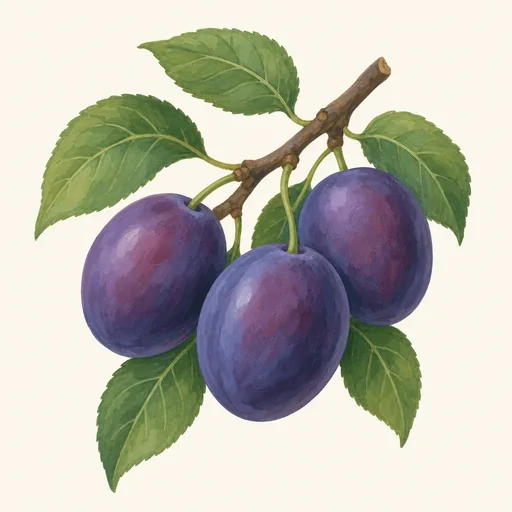
Plum
Prunus domestica · Rosaceae
- Plant outFrom 4 weeks before the last frost until the last frostMar 13 – Apr 16
- Plant in autumn4–6 weeks before the first autumn frostSep 13 – Oct 3
- Space3–6 m (10–20 ft) apart
- HarvestAfter 2–5 years
Description
Plum is a deciduous fruit tree in the rose family, grown for its smooth-skinned, juicy stone fruits. The name usually refers to the European plum, Prunus domestica, although fruits sold as plums also come from other species, especially the Japanese plum, Prunus salicina. European plum trees commonly reach 4–10 metres tall if left unpruned. They have oval, finely toothed leaves and clusters of small white flowers that open in spring, often before the leaves are fully grown.
The fruit varies widely by cultivar: it may be round or oval, with green, yellow, red, purple, or nearly black skin. Its flesh can be sweet or tart and is typically yellow or reddish. A single hard stone encloses the seed. Plums are eaten fresh, baked into pies, cooked into preserves, and dried; dried plums are commonly called prunes. Some European plum cultivars have flesh that separates readily from the stone, making them particularly useful for drying and cooking.
Plum trees grow best in full sun and fertile, well-drained soil. They need regular water while fruit is developing, but poorly drained ground can damage their roots. Most cultivars require a period of winter cold to flower and fruit well, so suitability depends on local climate. Pollination requirements vary: some European plums are self-fertile, while others crop better with a compatible tree nearby. Late frosts can destroy blossoms and sharply reduce the harvest. Gardeners generally prune established European plum trees in summer, when cuts are less vulnerable to certain diseases than during cool, wet winter weather. Fruit is usually picked when fully coloured and slightly soft for fresh eating; firmer fruit may be harvested for transport or cooking. Birds, aphids, and fungal diseases can affect the crop.
Growing Conditions
2.5–6 m (8–20 ft) tall, 2.5–6 m (8–20 ft) wide
- Smallest
- Largest
Full sun, 6+ hours
Moderate
Keep evenly moist, not soggy.
Ideal 18–27 °C (64–81 °F)
Survives down to −34 °C (−29 °F).
pH 6–7 · acidic to neutral
Where it Grows
Planting
When to Plant
Plant a plum tree while it is dormant, before new growth begins. Bare-root trees are usually planted from late autumn through early spring, when the ground is not frozen or waterlogged. In areas with mild winters, autumn planting lets roots begin to establish before summer heat. Where winters are severe, early spring is safer: plant as soon as the soil can be worked, before buds open.
Container-grown plums can be planted in spring or autumn, provided you can water them as they establish. Avoid planting during a heatwave, drought, or period of saturated soil. If planting in autumn, allow several weeks for roots to settle before the ground freezes. Choose a day when the soil is moist but crumbly rather than sticky. Local weather matters more than a calendar date: a tree planted into workable soil and watered consistently has a better start than one planted simply because the season seems right.
How to Plant
Choose a sunny site with well-drained soil and room for the tree’s mature size. Check the variety’s pollination requirements before buying: some plums need a compatible plum nearby to produce fruit. Keep the site clear of competing grass and weeds.
Dig a hole about twice as wide as the roots or container, but no deeper than the root system. For a bare-root tree, soak the roots in water for an hour or two before planting and spread them gently over a small mound of soil. For a container tree, slide off the pot and gently loosen any circling roots. Set the tree at the depth it grew in the nursery, with the graft union clearly above ground. Backfill with the original soil, firming it lightly to remove large air pockets; do not put fertilizer in the hole.
Water thoroughly after planting. Add a 5–8 cm (2–3 in) layer of mulch over the root area, leaving a gap around the trunk. Water regularly through the first growing season, especially during dry spells, without keeping the soil soggy. Stake only if the tree cannot stand securely, and remove the stake once established. Protect the trunk from browsing animals if needed.
Growth Timeline
- Establishing 2 years
- First harvest possible years 2–5
Planting Calendar
- Plant outdoors: from 4 weeks before the last frost until the last frost
- Autumn planting: 4–6 weeks before the first autumn frost
- Plant out: Mar 13 – Apr 16
- Autumn planting: Sep 13 – Oct 3
Care
Care Calendar
- Prune · Feb 27 – Apr 2
On a dry day, remove dead and crossing branches and open the canopy; prune in summer instead where silver leaf is a concern. - Feed · Mar 13 – Apr 16
Apply a modest amount of balanced fertilizer in early spring if growth is weak. - Mulch · Apr 10 – May 14
Spread organic mulch over the root zone, keeping it clear of the trunk. - Thin · May 15 – Jun 25
After natural fruit drop, space remaining plums about 2 to 4 inches apart to limit branch breakage and improve fruit size. - Protect · Jul 19 – Oct 3
Net ripening fruit against birds, securing the net so wildlife cannot become trapped.
Watering
Water newly planted plum trees deeply after planting, then keep the root zone evenly moist through their first growing season. Check the soil before watering: if the upper few inches are dry, soak slowly rather than giving a light daily sprinkle. Established trees generally need about 1–2 inches of water per week during active growth, including rainfall, though needs vary with heat, soil, and tree size. Water is especially important from flowering through fruit development; drought can reduce fruit size or cause fruit to drop. Apply water over the area beneath and just beyond the canopy, preferably with drip irrigation or a soaker hose. Avoid constantly soggy soil, which can damage roots, and avoid wetting foliage late in the day. As harvest approaches, keep watering reasonably consistent rather than alternating severe dryness with heavy soaking, which can contribute to fruit cracking.
Pruning
Prune a young plum tree to establish a sturdy framework with well-spaced branches and an open canopy. Japanese plums are commonly trained to an open center; European plums may be trained to an open center or modified central leader. Once established, remove dead, broken, crossing, or crowded wood and any shoots arising from below the graft union. Thin selectively so light and air reach the fruit, but avoid removing a large share of healthy growth at once. Timing matters: in areas where silver leaf disease or bacterial canker is a concern, prune during dry weather after harvest or in summer rather than during cool, wet winter conditions. Elsewhere, follow local guidance for the safest pruning season. Use clean, sharp tools and cut back to a branch collar or suitable side branch without leaving a stub. Thin excess young fruit separately if branches are heavily loaded.
Weeding
Keep grass and weeds away from a plum tree’s trunk, especially while it is young. Competing plants take up water and nutrients from the shallow soil where many feeder roots grow, and tall growth can hide pests or shelter rodents. Maintain a weed-free circle at least 2–3 feet wide around a young tree, expanding it as the tree grows if space allows. Pull weeds by hand, cut them at the soil surface, or smother them with mulch. Work gently: deep hoeing or digging can injure plum roots. If mowing nearby, leave enough clearance to prevent mower or string-trimmer damage to the bark. Check the area regularly in spring and summer, before weeds set seed. A groundcover can be useful farther from the trunk, but it should not crowd a newly planted tree. If using a herbicide, choose one labeled for use around fruit trees and protect the trunk and foliage from spray.
Mulching
Spread 2–4 inches of organic mulch, such as wood chips or shredded leaves, over the soil around the plum tree. Cover at least a 2–3-foot radius around a young tree if practical, and extend the mulched area as it grows. Mulch conserves soil moisture, moderates temperature, and suppresses weeds, reducing the need to cultivate near shallow roots. Keep it several inches away from the trunk; mulch piled against bark can hold moisture there and encourage decay or provide cover for rodents. Replenish the layer as it breaks down, but check its depth before adding more. Water the soil first if it is dry, since mulch can slow light rain from reaching the roots. In damp sites or heavy clay soil, favor a thinner layer and watch for persistently wet conditions. Do not bury the graft union or use fresh manure as mulch.
Fertilizing
Base fertilizing on the tree’s growth and, ideally, a soil test. A plum tree growing steadily, with healthy leaves and a reasonable crop, may need little or no added fertilizer. Before planting, correct any soil deficiencies indicated by a test; after planting, avoid putting fertilizer directly against the roots or trunk. If an established tree needs feeding, apply a fertilizer labeled for fruit trees in early spring, following its directions and spreading it over the root zone rather than in a pile at the trunk. Water it in if the label directs. Avoid heavy nitrogen applications: they can produce soft, vigorous shoots at the expense of fruiting and may increase susceptibility to some pests and diseases. Do not fertilize late in the growing season where new growth could be damaged by winter cold. Compost can improve soil over time, but account for the nutrients it supplies before adding more fertilizer.
Pest Management
Inspect plum trees regularly for damaged leaves, shoots, and fruit so problems are identified early. Common concerns vary by region and include aphids, plum curculio, fruit-boring moth larvae, brown rot, black knot, and bacterial canker. Remove fallen or rotting fruit promptly; take mummified fruit off the tree, and prune out diseased wood when conditions are suitable. Open-canopy pruning improves airflow and makes fruit easier to inspect. For black knot, cut infected branches well below visible swellings and dispose of them; clean tools when moving between diseased and healthy wood. Protect fruit from birds with properly secured netting where needed. Identify a pest before treating it, and use local extension advice to choose an effective, legally registered control and the right application time. Follow the label exactly. Avoid spraying insecticides during bloom, when pollinators are visiting, and observe all preharvest intervals.
Harvesting
Harvest plums when their background color has changed from green to the ripe color expected for the variety and the fruit has begun to soften slightly. Taste a few: sweetness, flavor, and ease of separation from the stem are better guides than color alone, especially for varieties whose ripe skins remain partly green. Fresh-eating plums are generally best picked close to fully ripe. Fruit picked slightly firm may soften indoors, but it will not become much sweeter. Check the tree every few days, because individual plums ripen at different times and ripe fruit can fall or be taken by birds. Lift each plum gently and twist, or clip its stem to avoid bruising the fruit or tearing the branch. Handle the harvest carefully and refrigerate ripe plums promptly if they will not be eaten or processed soon. Discard fruit with rot or insect damage.
Growing in Containers
Grows well in a pot of at least 50 litres (13 US gallons), with drainage holes. Best kept outdoors.
Propagation
By grafting
- Obtain a healthy, compatible plum rootstock.
- Collect dormant scion wood from the cultivar you want to grow.
- Graft the scion onto the rootstock in late winter or early spring.
- Secure and seal the graft, then remove shoots growing below it.
From seed
- Remove and wash the pit from a ripe plum.
- Cold-stratify the pit in a moist medium for about three to four months.
- Sow it in well-drained potting mix and keep it moist.
- Grow the seedling on, recognizing that its fruit may differ from the parent plum.
From cuttings
- Take softwood cuttings from healthy new growth in late spring or early summer.
- Remove the lower leaves and apply rooting hormone to the cut ends.
- Insert the cuttings into a moist, free-draining rooting medium.
- Keep them humid and out of direct sun until roots form.
- Pot up rooted cuttings and protect them through their first winter.
Companion Plants
Good neighbors
- Plum (a compatible cultivar): Many plum cultivars set more fruit when a compatible plum flowers nearby at the same time.
- Sweet alyssum: Its flowers attract hoverflies and other beneficial insects that feed on aphids around fruit trees.
Common Problems
- Yellowing leaves
- Sticky residue on leaves
- Black sooty coating
- Curled or cupped leaves
Aphids are small, soft-bodied insects that feed by piercing plants and drawing out sap. The group includes many…
- Spots on leaves
- Yellowing leaves
- Holes in leaves
- Leaves dropping
Bacterial leaf spot is a name for leaf diseases caused by several bacteria, commonly species of Xanthomonas or…
- Wilting
- Leaves dropping
- Stunted growth
- Soft or rotting stems
Canker is a general name for a localized area of dead bark and underlying tissue on a woody stem or branch, not a…
- Brown or crispy leaf edges
- Wilting
- Bleached or scorched patches
- Leaves dropping
Frost damage is an injury caused when plant tissues become cold enough for ice to form or for cells to lose water to…
- Flowers or buds dropping
- Distorted new growth
Poor pollination occurs when too little viable pollen reaches a flower’s receptive stigma, or when pollen fails to…
- Brown rot causes fruit to rot on the tree, especially in warm, wet weather.
- Black knot produces hard, dark swellings on branches and is particularly troublesome in parts of North America.
- Aphids curl young leaves and leave sticky honeydew behind.
- Plum curculio damages developing fruit in eastern North America.
- Late spring frosts can kill blossoms and sharply reduce the harvest.
- Poor drainage can lead to root rot; bacterial canker can cause sunken, oozing patches on branches.
Varieties
A widely grown prune plum suited to fresh eating, drying and preserves.
- self-fertile
- freestone
- late
Its small, sweet fruit and cold hardiness suit gardens with colder winters.
- self-fertile
- cold-hardy
A familiar garden plum with sweet fruit that can set heavy crops.
- self-fertile
- productive
It bears small, sweet, reddish-purple plums and can also pollinate other compatible Japanese plums.
- self-fertile
- early
Its fragrant, red-skinned fruit sets more reliably with a compatible pollinator.
- partially self-fertile
- aromatic
This yellow plum needs a compatible Japanese plum nearby for reliable crops.
- yellow fruit
- productive
Its dark-red flesh is good for fresh eating, but it needs a compatible pollinator.
- red flesh
- sweet
More about varieties
- ‘Victoria’ — A popular European plum with reddish-purple fruit, often eaten fresh or cooked.
- ‘Stanley’ — A European plum with firm, sweet fruit suitable for fresh eating and drying.
- ‘Santa Rosa’ — A Japanese-type plum valued for its aromatic, red-skinned fruit.
- ‘Methley’ — An early-ripening Japanese-type plum with small, reddish-purple fruit.
- ‘Shiro’ — A Japanese-type plum that bears sweet, yellow fruit.
- ‘Mirabelle de Nancy’ — A small, golden European plum commonly used for preserves and baking.
Health Benefits
Plums are enjoyed mainly as fruit, but they also offer useful nutrients. Fresh plums provide dietary fiber, vitamin C, and potassium. Their red and purple skins contain polyphenols, including anthocyanins, which are being studied for their potential health effects. Eating whole fruit can help people meet general recommendations to eat a variety of fruits and vegetables; it is not a treatment for disease.
Dried plums, or prunes, are especially well known for helping with occasional constipation. They contain fiber and sorbitol, a naturally occurring sugar alcohol that draws water into the bowel. Clinical studies have found that prunes can improve stool frequency and consistency for some people. Start with a modest serving, since larger amounts may cause gas, bloating, or diarrhea.
Prunes have also been studied for bone health, particularly in postmenopausal women. Some studies suggest benefits for maintaining bone mineral density, but the evidence does not establish prunes as a substitute for adequate calcium and vitamin D, exercise, or prescribed care. Dried plums are more concentrated in sugar and calories than fresh plums, so portion size matters. For most people, either form can be part of a balanced diet.
Fun Facts
- Prunes are dried plums; varieties with firm flesh and a high sugar content are particularly well suited to drying.
- Despite its name, the Japanese plum (Prunus salicina) originated in China.
- European plums (Prunus domestica) include familiar groups such as damsons, greengages, and mirabelles.
- Plums and apricots can be crossed to produce hybrids such as pluots.
- Some plum trees need pollen from another compatible variety to set a good crop.
Notice an error or have a question about Plum? Contact us