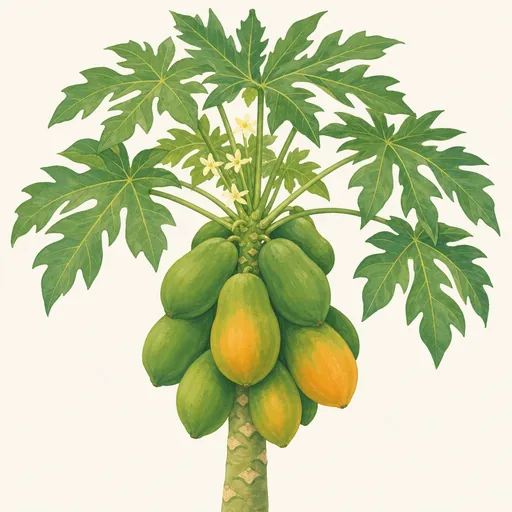
Papaya
Carica papaya · Caricaceae
- Start indoors6–10 weeks before the last frostJan 30 – Mar 5
- Sow outdoors3–6 weeks after the last frostMay 1 – May 28
- Plant out3–6 weeks after the last frostMay 1 – May 28
- Space1.8–3 m (6–10 ft) apart
- Harvest240–365 days after planting
Description
Papaya is a fast-growing, short-lived tropical plant cultivated chiefly for its sweet fruit. Although it looks like a small tree, its usually unbranched, soft-stemmed trunk is not woody in the usual sense. Large, deeply lobed leaves form a crown at the top, and flowers arise near the leaf bases. Plants may bear male, female, or bisexual flowers. Fruits develop along the upper trunk and range from small, pear-shaped types to large, elongated ones.
The skin is green when immature and usually turns yellow or orange as the fruit ripens. Ripe flesh is orange, salmon-colored, or sometimes yellow, with a soft texture and a mildly musky, sweet flavor. Its central cavity holds many round, black seeds coated in a slippery layer; the seeds have a sharp, peppery taste. Ripe papaya is eaten fresh, added to fruit salads, or blended into drinks. Firm green fruit is cooked as a vegetable or shredded for salads. Papaya provides vitamin C and carotenoids. Its milky latex contains papain, a protein-digesting enzyme used to tenderize meat.
Papaya thrives in warm, frost-free climates with plenty of sun, well-drained soil, and regular moisture. It grows quickly from seed and can start fruiting within a year under favorable conditions. Waterlogged soil can cause root problems, while frost can severely damage or kill the plant. Fruits bruise easily and are commonly harvested when they begin to change color, then allowed to finish ripening off the plant. Handle unripe fruit and cut stems carefully: their latex can irritate skin, and people with latex allergies may also react to papaya.
Growing Conditions
2–6 m (7–20 ft) tall, 1.5–3 m (5–10 ft) wide
- Smallest
- Largest
Full sun, 6+ hours
Moderate
Keep evenly moist, not soggy.
Ideal 21–32 °C (70–90 °F)
Survives down to −1 °C (30 °F).
pH 5.5–7 · acidic to neutral
Where it Grows
Planting
When to Plant
Plant papaya when frost is no longer a risk and the soil has warmed to at least 70°F (21°C). It grows best where temperatures stay roughly between 70 and 90°F (21–32°C); prolonged cold, especially nights below about 60°F (16°C), slows growth and can damage young plants. In a frost-free climate, you can plant during a warm spell at almost any time of year. The start of the rainy season can be convenient if the soil drains well, but avoid planting into ground that remains soggy. In cooler regions, wait until late spring or early summer, after both the air and soil have warmed reliably. Papaya needs a long warm season to bear fruit and is usually short-lived where winters are cold, so an early start after the last frost gives it the best chance. Start seeds indoors a few weeks beforehand if needed, and move seedlings outside only once conditions are consistently warm.
How to Plant
Choose a spot with full sun, shelter from strong winds, and loose, well-drained soil. Papaya is particularly prone to root and stem rot in waterlogged ground, so plant on a raised mound or bed if drainage is poor. Allow about 8–10 feet (2.5–3 m) between plants. Mix some compost into the planting area, but avoid burying the trunk or piling rich material against it.
For direct sowing, clean the gelatinous coating from fresh seeds and sow them about ½ inch (1–2 cm) deep. Sow a few seeds per location and keep the soil evenly moist, not saturated. Thin weak seedlings as they grow. If using a nursery plant, choose a young, healthy seedling: older papayas resent root disturbance. Slide it carefully from its pot without breaking the root ball, set it at the same depth it grew in the container, firm the soil gently, and water thoroughly. Add mulch to help retain moisture, leaving a gap around the stem.
If growing from seed, remember that some papayas bear separate male and female flowers. A female needs pollen from a male or hermaphroditic plant to produce fruit. Plant several seedlings until they flower, or choose a self-fertile cultivar.
Growth Timeline
- Germination 10–21 days
- Seedlings indoors 6–14 weeks
- Growing in the garden 240–365 days
- Harvest 26–52 weeks
Planting Calendar
- Start seeds indoors: 6–10 weeks before the last frost
- Sow outdoors: 3–6 weeks after the last frost
- Plant outdoors: 3–6 weeks after the last frost
- Germination: 10–21 days
- Start indoors: Jan 30 – Mar 5
- Sow outdoors: May 1 – May 28
- Plant out: May 1 – May 28
Care
Care Calendar
- Mulch · Apr 10 – May 14
Apply organic mulch, keeping it clear of the trunk. - Feed · Apr 24 – Oct 1
Feed lightly every 4–6 weeks during active growth. - Protect · Oct 4 – Oct 24
Move container plants indoors before frost; protect outdoor plants from brief cold spells.
Watering
Keep papaya soil evenly moist, especially while plants establish and while fruit is developing. Its roots are relatively shallow, so prolonged drought can cause flowers or young fruit to drop, but soggy soil can quickly lead to root and stem rot. Water deeply when the upper few centimeters of soil begin to dry, then let excess water drain away. In hot, dry weather this may mean watering several times a week; rainfall, soil type, and plant size should determine the schedule. Apply water over the root zone rather than against the trunk, and use drip irrigation or a soaker hose if possible. Container-grown papayas dry out faster and need more frequent checks, but their pots must drain freely. Reduce watering during cool or rainy periods. Wilting despite wet soil can indicate damaged roots rather than a need for more water.
Pruning
Papayas usually need little pruning. Unlike many fruit trees, they grow mainly from a single, soft trunk with leaves clustered near the top, so routine shaping or hard cutting back is not recommended. Remove leaves only when they are fully dead, badly diseased, or interfering with access to fruit. Cut their stalks carefully with clean tools, taking care not to injure the trunk or remove many healthy leaves at once; those leaves feed the developing fruit. If a plant produces unwanted side shoots, they can be removed while small. Remove fallen or diseased material from around the plant to reduce pest and disease pressure, and disinfect tools after handling visibly diseased growth. Topping a papaya to control its height can expose the trunk to rot and does not reliably produce a strong new growing point. When a plant becomes too tall to harvest safely, replacing it is often more practical.
Weeding
Keep a weed-free area around young papayas so grasses and broadleaf weeds do not compete with them for water and nutrients. This matters most during establishment, when the plant’s root system is still developing. Papaya roots grow close to the soil surface and are easily damaged, so pull weeds by hand or cut them at ground level rather than digging or hoeing deeply near the trunk. Work when the soil is slightly moist to remove small weeds before they set seed. A layer of organic mulch can suppress new weeds, but leave a clear gap around the trunk. If weeds are persistent, refresh the mulch after removing them rather than piling more material over established weeds. Avoid letting climbing weeds cover the leaves or fruit. If using an herbicide nearby, shield the papaya completely: its green trunk and foliage can be injured by spray drift.
Mulching
Spread an organic mulch, such as shredded leaves, wood chips, or coarse compost, over the soil around the papaya. A layer about 5–8 cm (2–3 in) deep helps conserve moisture, moderates soil temperature, and discourages weeds—useful benefits for a plant with shallow roots. Extend the mulch across the root zone as the plant grows, but keep it at least 15–30 cm (6–12 in) away from the trunk. Mulch touching the trunk can trap moisture against its soft tissue and encourage rot. Apply mulch to soil that has been watered if it is dry, and replenish the layer as it decomposes. Do not bury the trunk or pile fresh grass clippings thickly around it. In a very wet climate or poorly drained site, use a thinner layer and prioritize improving drainage; mulch cannot make waterlogged soil suitable for papaya.
Fertilizing
Papayas grow quickly and fruit heavily, so they benefit from regular feeding in fertile, well-drained soil. Before planting, incorporate finished compost into the planting area, but do not place concentrated fertilizer against the roots or trunk. Once the plant is established and actively growing, apply a balanced fertilizer in small, repeated doses according to its label and the plant’s size; container plants may need a diluted, more frequent feed. Spread fertilizer over the root zone, keep it away from the trunk, and water it in. As flowering and fruiting begin, avoid excessive nitrogen, which can promote leafy growth at the expense of fruit. Papayas also need potassium and other nutrients; yellowing or distorted leaves can have several causes, so a soil test is more reliable than adding supplements at random. Pause or reduce feeding when growth slows in cool weather or when heavy rain risks washing nutrients away.
Pest Management
Inspect leaves, stems, and developing fruit regularly. Aphids, whiteflies, mealybugs, and spider mites may gather on leaf undersides or tender growth; a strong spray of water or an appropriate insecticidal soap can help with small infestations. Follow the product label, and avoid spraying in intense sun. Fruit flies can damage ripening papayas where they occur; collect fallen fruit promptly, use locally recommended traps, and consider bagging fruit after it has set. Good spacing and airflow, careful watering, and well-drained soil help limit fungal diseases and root rot. Papaya ringspot virus causes mottling, leaf distortion, and marked rings on fruit. There is no cure: remove badly affected plants and control weeds that can host pests. Aphids can spread the virus even when infestations are brief, so insect sprays alone may not prevent it. Check local guidance before using pesticides or moving diseased plant material.
Harvesting
Harvest papayas once the fruit has reached its full size and the green skin begins to turn yellow, often called color break. Fruit picked with roughly a quarter of its skin yellow can finish ripening indoors; for eating soon, leave it on the plant until more of the skin is yellow, provided pests and weather permit. Ripeness is also indicated by a slight give when pressed gently and a sweet aroma. Hold the fruit while cutting its short stem with a clean knife or pruners; do not twist or pull it from the plant. Handle it gently to prevent bruising. Milky latex from a cut stem or unripe fruit can irritate skin, so gloves may be helpful. Let mature fruit ripen at room temperature, then refrigerate it briefly once ripe. Green papaya can also be harvested for cooking, but use recipes intended for unripe fruit.
Growing in Containers
Grows well in a pot of at least 60 litres (16 US gallons), with drainage holes. Can be grown indoors as a houseplant.
Propagation
From seed
- Collect seeds from a fully ripe papaya.
- Rub off the gelatinous coating and rinse the seeds.
- Sow about 1 cm deep in moist, well-draining seed-starting mix.
- Keep warm and evenly moist until seedlings emerge.
- Transplant carefully after seedlings develop several true leaves.
Companion Plants
Good neighbors
- Cowpeas: Cowpeas are grown as a low-growing legume intercrop with papaya, covering bare soil and helping suppress weeds.
- Peanuts: Peanuts are a documented papaya intercrop that provides ground cover without heavily shading young trees.
Common Problems
- Spots on leaves
- Brown or crispy leaf edges
- Bleached or scorched patches
- Leaves dropping
Anthracnose is a name for several fungal diseases, not a single species. Depending on the plant, the cause may be a…
- Yellowing leaves
- Sticky residue on leaves
- Black sooty coating
- Curled or cupped leaves
Mealybugs are small, sap-feeding insects in the family Pseudococcidae. They occur on many houseplants, ornamentals…
- Galls or swellings
- Stunted growth
- Yellowing leaves
- Wilting
Root-knot nematodes are microscopic roundworms that live in soil and feed inside plant roots. Several species in the…
- Yellowing leaves
- Wilting
- Stunted growth
- Leaves dropping
Root rot is a general name for the decay of plant roots, not a single disease with one scientific name. It can result…
- Brown or crispy leaf edges
- Wilting
- Bleached or scorched patches
- Leaves dropping
Frost damage is an injury caused when plant tissues become cold enough for ice to form or for cells to lose water to…
- Papaya ringspot virus: causes mottled leaves, distorted growth, and ring-shaped marks on fruit; aphids spread it.
- Root and stem rot: often caused by Phytophthora in poorly drained or waterlogged soil.
- Anthracnose: produces sunken, dark spots on ripening fruit, especially in humid weather.
- Powdery mildew: leaves a white coating on foliage and can reduce vigor.
- Fruit flies, aphids, whiteflies, mealybugs, and spider mites: may damage fruit or foliage or spread disease.
- Cold, strong winds, and poor pollination: can stunt plants, break stems, or reduce fruit set.
Varieties
A Hawaiian selection with small fruits suited to fresh eating.
- red-orange flesh
- sweet
- small fruit
A relatively short-growing Solo selection with sweet fruit.
- red-orange flesh
- compact
- small fruit
Its fruit forms relatively low on the trunk, making harvest easier.
- yellow-orange flesh
- low fruit set
- sweet
A widely grown hybrid valued for its generous crops.
- red flesh
- productive
- early
Its large fruits need more room than those of Solo types.
- large fruit
- red flesh
More about varieties
- Sunrise Solo: A compact-fruited Hawaiian type with reddish-orange flesh.
- Kapoho Solo: A Hawaiian variety with small, sweet fruit and yellow-orange flesh.
- Red Lady: An early-fruiting hybrid with red-orange flesh; commonly grown in tropical regions.
- Maradol: A large-fruited type, often sold as Mexican papaya, with salmon-colored flesh.
- Tainung No. 1: A productive hybrid that bears elongated fruit with reddish flesh.
Health Benefits
Ripe papaya is eaten as a fresh fruit and provides vitamin C, which supports normal immune function and helps the body make collagen. Its orange flesh contains carotenoids, including beta-carotene, which the body can convert to vitamin A. Papaya also supplies fiber, water, and smaller amounts of folate and potassium. As part of a varied diet, its fiber can help support regular bowel movements. These are nutritional benefits, not evidence that papaya treats or prevents a particular disease.
Papaya contains the protein-digesting enzyme papain, especially in the milky latex of unripe fruit. Papain is used commercially to tenderize meat and appears in some digestive supplements, but evidence that supplements improve digestion in otherwise healthy people is limited. Papaya leaf extracts are also promoted for illnesses such as dengue; they should not replace medical care, and their benefits and safety are not well established.
Ripe fruit is generally enjoyed as food. People with latex allergies may react to papaya. Pregnant people should avoid medicinal amounts of unripe papaya or its latex because safety is uncertain. If using papaya extracts or supplements, particularly alongside medicines, ask a healthcare professional first.
Fun Facts
- Papaya looks like a tree, but its trunk is a soft, mostly unbranched stem rather than typical woody timber.
- Botanically, a papaya fruit is a berry.
- Papaya plants may bear male, female, or bisexual flowers; flower type affects whether a plant can set fruit on its own.
- The milky latex in unripe papaya contains papain, an enzyme used to tenderize meat.
- In warm conditions, papayas grow quickly and may begin fruiting within a year of planting.
Notice an error or have a question about Papaya? Contact us