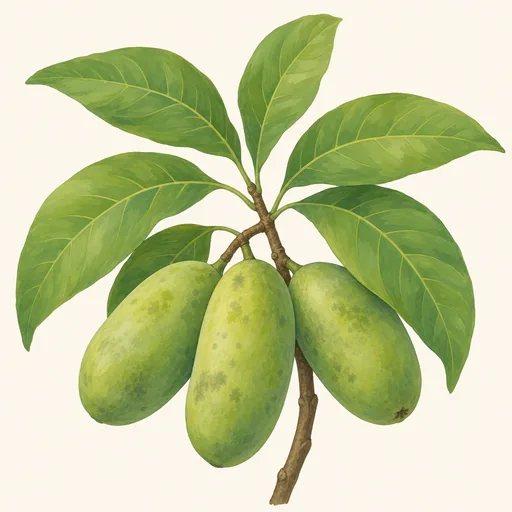
Pawpaw
Asimina triloba · Annonaceae
- Plant outFrom 4 weeks before to 2 weeks after the last frostMar 13 – Apr 30
- Plant in autumn4–8 weeks before the first autumn frostAug 30 – Oct 3
- Space2.5–4.5 m (8–15 ft) apart
- HarvestAfter 3–5 years
Description
Pawpaw is a small, deciduous tree native to eastern North America. It often grows in woodland understories and along streams, forming thickets through root suckers. Its large, drooping leaves give it a tropical appearance, although the tree tolerates cold winters. In spring, it produces dark maroon flowers before or as the leaves emerge. Flies and beetles visit the flowers, and most trees need pollen from a genetically different pawpaw to set fruit reliably.
The fruits are oblong, green to yellowish, and usually several inches long. They have soft, creamy flesh surrounding large, dark seeds. Their sweet flavor is often compared with banana, mango, and custard. Fruit generally ripens in late summer or autumn, depending on location and variety. A ripe pawpaw yields slightly to gentle pressure and has a strong aroma. It bruises easily and keeps only a few days at room temperature, which is one reason it is seldom found in ordinary supermarkets. Eat the flesh fresh or use it in chilled desserts; do not eat the seeds or skin.
For home growing, choose a site with fertile, moist but well-drained soil. Young plants benefit from shade, while established trees usually produce more fruit with ample sunlight. Keep the root zone mulched and water during dry spells, especially while trees become established. Plant two genetically distinct trees or cultivars for better pollination. Grafted trees preserve the fruit qualities of named varieties; seedlings can differ considerably from their parents and may take longer to bear. Pawpaw has relatively few serious pest problems in its native range, and its foliage feeds zebra swallowtail caterpillars. Because pawpaws develop a deep taproot, young container-grown trees are generally easier to establish than plants dug from the wild. Protect newly planted trees from competing grass and avoid disturbing their roots.
Growing Conditions
4.5–9 m (15–30 ft) tall, 3–6 m (10–20 ft) wide
- Smallest
- Largest
Full sun, 6+ hours
Tolerates part sun, part shade
Moderate
Keep evenly moist, not soggy.
Ideal 18–30 °C (64–86 °F)
Survives down to −29 °C (−20 °F).
pH 5.5–7 · acidic to neutral
Where it Grows
Planting
When to Plant
Plant pawpaw while it is dormant, ideally in early spring before its buds begin to swell. This is especially important for bare-root trees, whose delicate roots should go into the ground as soon as the soil is workable and no longer frozen or waterlogged. Container-grown trees can also be planted in spring after the worst hard freezes have passed. Fall planting is possible where winters are mild, provided the tree has several weeks to establish roots before the ground freezes; in colder areas, spring is the safer choice. If you have a choice, plant on a cool, overcast day rather than during hot, dry, or windy weather. Keep the roots moist while preparing the site, and do not leave a potted tree waiting through summer heat if you can plant it in suitable spring conditions. Pawpaw often breaks dormancy later than other fruit trees, so a leafless tree in early spring is not necessarily dead.
How to Plant
Choose a sheltered spot with fertile, well-drained soil that stays reasonably moist. Mature pawpaws fruit best in full sun, but young trees benefit from temporary afternoon shade or shade cloth for their first year or two. For reliable fruit, plant at least two genetically distinct trees for cross-pollination, spacing them roughly 10 to 15 feet (3 to 4.5 m) apart. Two seedlings will usually differ genetically; two copies of the same named cultivar will not.
Pawpaws have easily damaged roots, so start with a small, healthy tree and handle its root ball gently. Dig a hole about twice as wide as the root ball but no deeper. Remove the container carefully, disturbing the roots as little as possible, and set the tree at the same depth it grew in the pot. Keep any graft union above the soil. Backfill with the excavated soil, firm it lightly, and water thoroughly to settle it around the roots. Do not put fertilizer in the planting hole. Add 2 to 3 inches (5 to 8 cm) of mulch over the root area, leaving a gap around the trunk. Water regularly during dry spells while the tree establishes, especially in its first two growing seasons.
Growth Timeline
- Establishing 3 years
- First harvest possible years 3–5
Planting Calendar
- Plant outdoors: from 4 weeks before to 2 weeks after the last frost
- Autumn planting: 4–8 weeks before the first autumn frost
- Plant out: Mar 13 – Apr 30
- Autumn planting: Aug 30 – Oct 3
Care
Care Calendar
- Prune · Feb 13 – Apr 2
Remove dead or crossing branches while the tree is dormant. - Mulch · Apr 10 – May 14
Spread organic mulch over the root zone, keeping it clear of the trunk. - Protect · Apr 10 – Aug 6
Shade young trees during their first one or two growing seasons.
Watering
Keep the soil around young pawpaw trees evenly moist while their roots establish, especially during the first two growing seasons. Water deeply when the upper few inches of soil begin to dry, rather than giving frequent light sprinkles. During dry weather, roughly 1 inch (2.5 cm) of water per week from rain and irrigation is a useful starting point; adjust for heat, soil type, and drainage. Established trees tolerate short dry spells, but regular moisture while fruit is developing helps prevent stress and poor fruit growth. Apply water over the root area, which extends beyond the trunk, and let it soak in slowly. Pawpaws prefer moist, well-drained soil, not standing water. If the ground remains soggy, reduce irrigation and address drainage rather than adding more water. A layer of mulch helps the soil retain moisture, but check beneath it before watering so you do not mistake a dry surface for dry soil.
Pruning
Prune pawpaws mainly in late winter or early spring, before new growth begins. Remove dead, damaged, or crossing branches first, using clean, sharp tools. On a young tree, keep a sound central leader and space competing branches so light and air can reach the canopy. Mature trees generally need only modest thinning; avoid removing large amounts of healthy wood in one year. Pawpaws flower on the previous season’s growth, so heavy pruning can reduce that year’s crop. Cut unwanted root suckers at ground level if you want a single-trunk tree or need to keep a patch contained. Suckers from a grafted tree’s rootstock should not be allowed to replace the grafted variety. If you have room for a grove, you may leave some suckers, but they are genetically identical to their parent and do not provide the distinct variety usually needed for reliable cross-pollination. Avoid topping the tree.
Weeding
Keep a weed-free area around young pawpaws so grass and other plants do not compete with them for water and nutrients. A circle extending several feet from the trunk is helpful while the tree establishes. Pull weeds by hand when the soil is moist, or cut them at the surface, taking care not to damage the pawpaw’s shallow roots. Avoid deep hoeing, tilling, or repeated cultivation beneath the canopy. Maintain a layer of organic mulch to suppress new weeds, but leave a gap around the trunk. Check the area regularly during spring and summer, before weeds flower and set seed. Established pawpaws can coexist with some nearby vegetation, but vigorous grass or invasive plants should still be controlled, particularly during drought. If you use a herbicide nearby, follow its label and protect the trunk, leaves, and any suckers from spray drift. Mechanical and hand removal are usually simpler around a few backyard trees.
Mulching
Spread 2–4 inches (5–10 cm) of shredded leaves, wood chips, or other organic mulch over the soil around a pawpaw. Start several inches away from the trunk and extend the layer toward the edge of the canopy, or across as much of the young tree’s root area as practical. Mulch moderates soil temperature, conserves moisture, suppresses weeds, and gradually adds organic matter. These benefits are especially useful for newly planted pawpaws, whose roots compete poorly with grass. Keep the trunk flare visible: mulch piled against bark can hold excess moisture and provide cover for rodents that may gnaw it. Check the depth each spring and top up only where the material has decomposed; do not keep adding layers until the mulch becomes excessively thick. Water can still be needed beneath mulch during a dry spell, so occasionally pull it aside to check the soil rather than judging moisture by its surface.
Fertilizing
Begin with healthy soil rather than a fixed feeding schedule. Incorporate organic matter into the wider planting area before planting if needed, and use a soil test to identify nutrient deficiencies or a pH problem. A young pawpaw growing steadily may need no fertilizer, especially if it receives organic mulch. If growth is weak after establishment and water, drainage, and light are adequate, apply a modest amount of balanced, slow-release fertilizer in spring, following the product’s directions for tree size. Spread it over the root area rather than piling it against the trunk, and water it in. Avoid heavy applications of nitrogen: they can encourage soft leafy growth without improving fruit production. Stop fertilizing by late summer so new growth has time to harden before cold weather. Poor fruit set is often a pollination issue, not a nutrient shortage; two genetically distinct pawpaws nearby usually improve the chance of a crop.
Pest Management
Inspect leaves, flower stalks, bark, and developing fruit periodically, but do not assume every insect needs treatment. Pawpaws usually have few serious pest problems. Zebra swallowtail caterpillars feed on pawpaw leaves; on a healthy tree, their feeding is generally tolerable, and the plant is an important host for this butterfly. Pawpaw peduncle borer larvae can damage flower stalks and cause blossoms to fall. Where this happens, remove and discard affected stalks when you notice them, and clean up fallen plant material. Protect small trees from deer browsing if deer are common, and harvest ripe fruit promptly to limit losses to wildlife. Netting or other barriers may help, provided they do not trap animals. Avoid routine insecticide sprays, particularly while the tree is flowering: pawpaws rely on insects for pollination. If damage is severe, identify the cause before choosing a treatment and follow its label.
Harvesting
Pawpaws usually ripen from late summer into autumn, depending on the variety and climate. Check trees frequently as harvest approaches: ripe fruit gives slightly to gentle pressure, often develops a noticeable fruity aroma, and may detach easily or fall. Skin color alone is unreliable, and brown patches do not necessarily mean the flesh is spoiled. Handle fruit carefully because it bruises readily. Pick by supporting it in your hand and gently lifting or twisting; do not pull hard on branches. Gather fallen fruit promptly if it is sound. Pawpaws are highly perishable, so eat or process ripe fruit soon after harvest, or refrigerate it briefly. For longer storage, scoop out and freeze the pulp. Remove the skin and seeds before eating or using the pulp. Fruit picked while hard and immature may not develop good flavor, so wait for clear signs of ripeness rather than harvesting the entire crop at once.
Growing in Containers
Not well suited to growing in pots.
Propagation
From seed
- Remove seeds from ripe fruit and keep them moist.
- Chill the seeds in moist medium for 90–120 days.
- Sow them about 1 inch deep in tall pots to accommodate their taproots.
- Keep the soil moist and give young seedlings partial shade.
By grafting
- Collect dormant scion wood from the desired cultivar and refrigerate it.
- Select a healthy pawpaw seedling as rootstock.
- Graft in spring, aligning the cambium of scion and rootstock.
- Wrap and seal the graft, then remove shoots growing below it.
Companion Plants
Good neighbors
- Pawpaw (a different cultivar): A genetically distinct pawpaw nearby improves cross-pollination and fruit set.
Common Problems
- Flowers or buds dropping
- Distorted new growth
Poor pollination occurs when too little viable pollen reaches a flower’s receptive stigma, or when pollen fails to…
- Brown or crispy leaf edges
- Wilting
- Bleached or scorched patches
- Leaves dropping
Frost damage is an injury caused when plant tissues become cold enough for ice to form or for cells to lose water to…
- Spots on leaves
- Yellowing leaves
- Leaves dropping
Fungal leaf spot is a general name for diseases caused by many different fungi, not a single species. These fungi…
- Poor fruit set: Pawpaw flowers are often poorly pollinated. Plant two genetically different trees and avoid insecticides while they bloom.
- Root disturbance: Young trees have delicate roots and may struggle after transplanting. Use container-grown plants and handle the root ball gently.
- Leaf scorch: Young trees can be damaged by strong, direct sun; temporary shade helps them establish.
- Waterlogged soil: Poor drainage can cause root rot. Plant in well-drained soil and water during dry spells without keeping the ground soggy.
- Pawpaw peduncle borer: Larvae can damage flower stalks and cause flowers to drop.
Varieties
A Peterson selection with creamy flesh and relatively few seeds.
- large fruit
- few seeds
- mild flavor
This Peterson selection bears large fruit with dense, sweet flesh.
- large fruit
- few seeds
- rich flavor
Plant it with a different cultivar for reliable pollination.
- productive
- yellow flesh
- large fruit
This early-ripening selection is useful where the growing season is short.
- early
- large fruit
- cold hardy
An established selection valued for its large, flavorful fruit.
- large fruit
- few seeds
- sweet
A Kentucky State University selection known for dependable yields.
- productive
- large fruit
- yellow flesh
More about varieties
- ‘Sunflower’: A productive cultivar with large fruit and relatively few seeds.
- ‘Shenandoah’: Known for mild-flavored fruit and a relatively low seed count.
- ‘Susquehanna’: Produces large fruit with rich flavor and firm flesh.
- ‘PA Golden’: A group of early-ripening selections suited to areas with shorter growing seasons.
- ‘Overleese’: An older selection valued for its large, flavorful fruit.
Health Benefits
Ripe pawpaw fruit (Asimina triloba) is eaten fresh and provides vitamin C, potassium, and dietary fiber, along with small amounts of other vitamins and minerals. As part of a varied diet, these nutrients support normal immune function, muscle and nerve function, and digestion. The soft pulp can be blended into smoothies or used in desserts, although its nutritional value depends on the other ingredients added.
Pawpaw also contains plant compounds studied in laboratory research for antioxidant activity. Those findings do not establish that eating the fruit prevents or treats disease. Claims that pawpaw extracts cure cancer or provide other medical benefits are not supported by clinical evidence, and extracts should not replace medical care.
Eat only the ripe flesh. Do not eat the seeds, skin, leaves, or bark: they contain compounds that may be harmful. Pawpaw contains annonacin, a compound that has raised concerns in research on plants in the custard-apple family; the effects of frequent, long-term pawpaw consumption in people are not well established. Some people experience nausea or an allergic reaction after eating the fruit. If it is new to you, try a small amount first.
Fun Facts
- Pawpaw is the largest edible fruit native to the United States.
- Despite its tropical flavor, it is a temperate tree native to eastern North America.
- Its flowers are pollinated mainly by flies and beetles, rather than bees.
- Pawpaw leaves are a food source for zebra swallowtail caterpillars.
- Trees can spread by root suckers, forming patches of genetically identical stems.
Notice an error or have a question about Pawpaw? Contact us