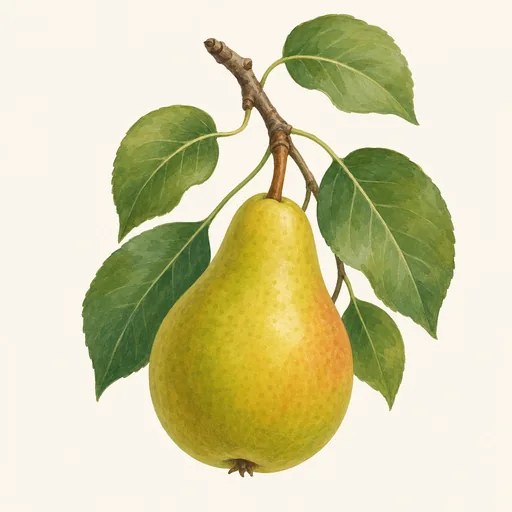
Pear
Pyrus communis · Rosaceae
- Plant outFrom 6 weeks before to 2 weeks after the last frostFeb 27 – Apr 30
- Plant in autumn4–8 weeks before the first autumn frostAug 30 – Oct 3
- Space3–6 m (10–20 ft) apart
- HarvestAfter 3–7 years
Description
The common pear is a deciduous fruit tree grown for its sweet, juicy fruit. It typically reaches 5–15 metres tall if left unpruned, although orchard trees are kept smaller for easier harvesting. Its oval leaves are glossy green, with finely toothed edges, and often turn yellow or reddish in autumn. Clusters of white, five-petaled flowers appear in spring, usually before the tree is fully in leaf. Bees and other insects pollinate the flowers.
Pear fruits vary widely by cultivar. Many have the familiar shape of a rounded base tapering toward the stem, while others are nearly round. Their skins may be green, yellow, brown, or blushed red. The flesh is usually pale, fragrant, and smooth to slightly grainy; tiny clusters of hard cells give pears their characteristic texture. Cultivars differ in sweetness, acidity, storage life, and whether they are best eaten fresh, cooked, dried, or preserved.
Common pears grow best in sunny sites with well-drained soil and a temperate climate. They need winter chilling to flower reliably, but late spring frost can damage their blossoms. Most cultivars produce better crops when another compatible pear cultivar flowers nearby, because they cannot effectively pollinate themselves. Trees are often grafted onto rootstocks that influence their size and suitability for particular soils. Regular pruning helps maintain a manageable shape and encourages healthy fruiting wood.
Unlike many fruits, European pears are generally picked when mature but still firm. They then ripen off the tree, developing a softer texture and fuller flavor. Depending on the cultivar, harvest takes place from late summer through autumn. Pear trees can live and bear fruit for many decades, though they may be affected by pests and diseases, including fire blight and pear scab. Good air circulation, suitable cultivars, and careful watering help keep trees healthy.
Growing Conditions
2.5–10 m (8–33 ft) tall, 2.5–8 m (8–26 ft) wide
- Smallest
- Largest
Full sun, 6+ hours
Tolerates part sun
Moderate
Keep evenly moist, not soggy.
Ideal 15–27 °C (59–81 °F)
Survives down to −34 °C (−29 °F).
pH 6–7 · acidic to neutral
Where it Grows
Planting
When to Plant
Plant pear trees while they are dormant, so their roots can establish before they must support new leaves. For bare-root trees, the usual window is from late autumn, after leaf fall, to early spring, before buds open. In places with mild winters, autumn planting gives roots more time to grow. Where winters are severe or the ground freezes deeply, plant in early spring as soon as the soil is workable. Do not plant into frozen, saturated, or very dry soil. Container-grown pears can be planted over a longer season, but autumn and early spring are still easiest on the tree; avoid periods of intense heat or drought. Choose a day when you can water thoroughly afterward. Before buying, check that the variety and rootstock suit your climate and available space. Most pear varieties also need a different, compatible pear variety flowering nearby for reliable fruit set, so plan for pollination before planting.
How to Plant
Choose a site with at least six hours of direct sun, good air circulation, and soil that drains well. Allow enough room for the tree’s mature size, which depends greatly on its rootstock. If a second pear is needed for pollination, choose one with an overlapping bloom period. Dig a hole about twice as wide as the root system or container, but no deeper than the roots need. Keep the root flare—the point where the trunk widens into the roots—at or just above the surrounding soil level, and keep the graft union above the soil. For a bare-root tree, spread the roots outward; for a container tree, gently loosen any circling roots. Backfill with the soil you removed, firming it lightly to eliminate large air pockets. Avoid adding fertilizer directly to the planting hole. Water deeply after planting, then spread 2–3 inches (5–8 cm) of mulch over the root area, keeping it several inches away from the trunk. Stake the tree if its rootstock or exposed location requires support. During the first growing season, water deeply whenever the upper soil begins to dry, rather than giving frequent shallow sprinkles.
Growth Timeline
- Establishing 3 years
- First harvest possible years 3–7
Planting Calendar
- Plant outdoors: from 6 weeks before to 2 weeks after the last frost
- Autumn planting: 4–8 weeks before the first autumn frost
- Plant out: Feb 27 – Apr 30
- Autumn planting: Aug 30 – Oct 3
Care
Care Calendar
- Prune · Feb 13 – Apr 2
While dormant, remove dead or crossing branches and open the canopy. - Feed · Mar 27 – Apr 30
Feed in early spring only if growth or a soil test indicates a need. - Mulch · Apr 3 – May 14
Spread organic mulch over the root zone, keeping it away from the trunk. - Thin · May 15 – Jun 25
After natural fruit drop, thin a heavy crop to one pear per cluster.
Watering
Water newly planted pear trees deeply after planting, then keep the root zone consistently moist—not waterlogged—while they establish. During the growing season, young trees generally need about 1–2 inches of water per week from rain and irrigation combined. Check the soil a few inches down before watering; sandy soil dries faster than clay. Apply water slowly over the area beneath and just beyond the canopy rather than only against the trunk. Established trees usually need irrigation during prolonged dry spells, especially from fruit set through fruit enlargement. Deep, occasional watering encourages roots to grow downward; frequent light sprinkling does not. Reduce watering if the soil stays soggy, and make sure the planting site drains well. Drip irrigation or a soaker hose helps keep leaves dry. Avoid severe swings between drought and heavy watering, which can stress the tree and reduce fruit quality.
Pruning
Prune pear trees mainly while dormant, in late winter or early spring before growth begins. Train a young tree to a central leader with well-spaced branches that have wide attachment angles; pears often produce narrow, weak branch unions. On established trees, remove dead, damaged, crossing, and inward-growing branches, then thin crowded growth to let light and air reach the fruiting wood. Make clean cuts just outside the branch collar, without leaving stubs. Preserve productive short fruiting spurs, and avoid removing too much of the canopy in one year: heavy pruning can trigger vigorous upright shoots and reduce fruiting. Remove unwanted upright watersprouts selectively rather than cutting every new shoot. If fire blight is present, prune infected shoots during dry weather, cutting well below visible symptoms; clean tools between cuts and follow local extension guidance for disposal and sanitation.
Weeding
Keep a weed-free area around a young pear tree so grasses and broadleaf weeds do not compete with its shallow, developing roots for water and nutrients. A mulched circle extending at least a few feet from the trunk works well; widen it as the tree grows. Hand-pull small weeds or hoe shallowly, taking care not to damage surface roots or scrape the bark. Remove perennial weeds and their roots before planting when possible, because they are harder to control once the tree is established. Check the area regularly during spring and summer, especially after rain, and remove weeds before they set seed. Keep string trimmers and mowers away from the trunk: bark injuries can weaken or kill a tree. If using an herbicide, choose one labeled for use around fruit trees and follow its directions carefully, avoiding contact with leaves, green bark, and roots.
Mulching
Spread 2–4 inches of organic mulch, such as wood chips or shredded bark, over the root zone to conserve moisture, moderate soil temperature, and suppress weeds. Start several inches away from the trunk so the bark stays dry; piling mulch against it can encourage decay and provide shelter for rodents. Extend the mulched area as far toward the canopy edge as practical, especially for a young tree competing with lawn grass. Keep the layer reasonably even, topping it up as it decomposes rather than adding a fresh thick layer each year. Check beneath the mulch occasionally: it should help the soil retain moisture, not conceal persistently waterlogged ground. In areas where voles are common, keep the trunk clear and watch for burrows or gnawing, particularly in winter. Do not mix wood-chip mulch into the soil around the roots.
Fertilizing
Base fertilizing on a soil test, the tree’s annual growth, and leaf color rather than applying fertilizer automatically. Before planting, correct any soil pH or nutrient problems indicated by a test; pears generally do best in well-drained soil with a slightly acidic to neutral pH. An established tree making healthy new growth and cropping well may need little or no added fertilizer. If growth is weak and a nutrient shortage is likely, apply a measured amount of fertilizer in early spring, following soil-test or local extension recommendations for the tree’s age and size. Spread it over the root zone, away from the trunk, and water it in. Avoid excessive nitrogen: it promotes soft growth, can reduce fruiting, and may increase susceptibility to fire blight. Do not fertilize late in the growing season where it could encourage tender growth before winter.
Pest Management
Inspect leaves, shoots, and developing fruit regularly so problems can be identified before choosing a treatment. Common pear pests include pear psylla, aphids, scale insects, and codling moth; local pressure varies. Remove fallen or infested fruit, and keep the tree pruned so you can inspect it and spray effectively if needed. Dormant-season horticultural oil may help control overwintering scale and psylla eggs when used according to its label. Monitor codling moth with locally recommended traps or timing guidance rather than spraying on a fixed calendar. Fire blight, a bacterial disease, causes shoots to blacken and curl; avoid excess nitrogen, remove infected wood during dry weather, and consider resistant varieties where the disease is common. Encourage beneficial insects and avoid broad-spectrum sprays when possible. If a pesticide is necessary, identify the pest first, use a product labeled for pears, and follow harvest-interval and pollinator-safety directions.
Harvesting
Harvest European pears when they are mature but still firm; most become gritty or mushy if left to ripen fully on the tree. Look for a change from dark green toward the variety’s mature background color, and lift a pear gently to a horizontal position: a ready fruit often separates easily with its stem attached. Pick carefully to avoid bruising. Let summer varieties such as ‘Bartlett’ ripen at room temperature; many later varieties benefit from a period of refrigeration before they will ripen properly. A pear is ready to eat when the flesh near the stem yields slightly to gentle thumb pressure. Refrigerate ripe fruit to slow further softening. Asian pears are different: leave them on the tree until they develop their characteristic color and flavor, then pick and eat them crisp. Harvest timing varies by variety and climate, so sample fruit as the expected season approaches.
Growing in Containers
Grows well in a pot of at least 50 litres (13 US gallons), with drainage holes. Best kept outdoors.
Propagation
By grafting
- Collect dormant scion wood from the pear variety you want to grow.
- Keep the scions cool and moist until grafting time.
- Graft a scion onto a compatible pear rootstock in late winter or early spring.
- Align the cambium layers and secure and seal the graft.
- Remove shoots that emerge below the graft.
From seed
- Remove seeds from a ripe pear and rinse off the pulp.
- Chill the seeds in a moist medium for about 8 to 12 weeks.
- Sow the seeds in a free-draining potting mix.
- Keep the mix moist and transplant the seedlings after they establish.
- Use the seedlings as rootstocks or accept that their fruit may differ from the parent pear.
Companion Plants
Keep apart from
- Juniper: Susceptible junipers can host the alternate stage of pear rust, so keep them away from pear trees where this disease occurs.
Common Problems
- Wilting
- Bleached or scorched patches
- Flowers or buds dropping
- Rotting fruit
Fire blight is a bacterial disease of plants in the rose family, especially apple, pear, quince, and some ornamental…
- Rotting fruit
- Insects visible on the plant
Codling moth is a pest of apples, pears, quince, and walnuts. Its caterpillars feed inside developing fruit or nuts…
- Yellowing leaves
- Sticky residue on leaves
- Black sooty coating
- Curled or cupped leaves
Aphids are small, soft-bodied insects that feed by piercing plants and drawing out sap. The group includes many…
- Orange or rust-colored spots
- Spots on leaves
- Yellowing leaves
- Leaves dropping
Rust is a group of plant diseases caused by fungi in the order Pucciniales, not a single species. Different rust fungi…
- Flowers or buds dropping
- Distorted new growth
Poor pollination occurs when too little viable pollen reaches a flower’s receptive stigma, or when pollen fails to…
- Fire blight: Bacterial disease that blackens blossoms and shoots, often leaving them looking scorched.
- Pear scab and rust: Fungal diseases that cause spots on leaves and fruit.
- Pear psylla and codling moth: Insects that damage foliage or fruit.
- Poor fruit set: Late frosts or insufficient cross-pollination can reduce the crop.
- Root rot: More likely in poorly drained soil.
Varieties
A familiar yellow pear that needs a compatible pollinizer for reliable crops.
- early
- juicy
- aromatic
Its firm, brown-skinned fruit is especially good for baking.
- russeted
- firm
- late
The green fruit stores well and ripens after picking.
- late
- juicy
- good keeper
Prized for rich flavor, it is best suited to sites with low fire-blight pressure.
- sweet
- buttery
- dessert
Its small fruit is notably sweet and suited to fresh eating.
- small fruit
- sweet
- late
This cultivar offers better fire-blight resistance than many traditional pears.
- fire-blight resistant
- juicy
Its firm fruit is often used for cooking or preserves.
- late
- firm
- fire-blight resistant
Widely grown in Europe, it bears elongated fruit with sweet flesh.
- russeted
- productive
- dessert
More about varieties
- Bartlett (Williams): Sweet, juicy European pear commonly eaten fresh or canned.
- Bosc: Firm, brown-skinned pear that holds its shape well when baked or poached.
- Anjou: Mild, juicy pear available in green and red forms.
- Comice: Especially sweet, soft pear often eaten fresh.
- Conference: Elongated European pear widely grown in Europe.
- Hōsui: Crisp, round Asian pear with sweet, juicy flesh.
Health Benefits
Pears are commonly eaten as a source of dietary fiber, particularly when the skin is left on. Fiber helps support regular bowel movements and can contribute to a feeling of fullness. Pears also contain soluble fiber, including pectin; as part of an overall balanced diet, soluble fiber can help support healthy cholesterol levels. Their high water content makes them a refreshing fruit, and they provide some vitamin C and potassium.
Whole pears generally offer more fiber than pear juice. Eating fruit such as pears in place of less nutritious snacks can be one practical way to add fiber and variety to a diet, but pears do not treat or prevent disease on their own.
Some people find that pears help with constipation, partly because of their fiber and naturally occurring sorbitol. Those same components can cause bloating or diarrhea, especially in large servings. Pears are also high in certain fermentable carbohydrates, so people managing irritable bowel syndrome may need to limit them. Anyone with a pear allergy, including some people with birch-pollen-related oral allergy syndrome, should avoid pears or seek medical advice about symptoms. People managing blood glucose can usually include a portion of whole pear in a meal plan, while accounting for its carbohydrates.
Fun Facts
- Botanically, pears are pomes and belong to the rose family.
- Bartlett and Williams are names for the same pear cultivar.
- European pears are usually picked mature but still firm and allowed to ripen after harvest; Asian pears are generally ripened on the tree.
- Pear wood is valued for fine woodworking because its texture is smooth and even.
Notice an error or have a question about Pear? Contact us