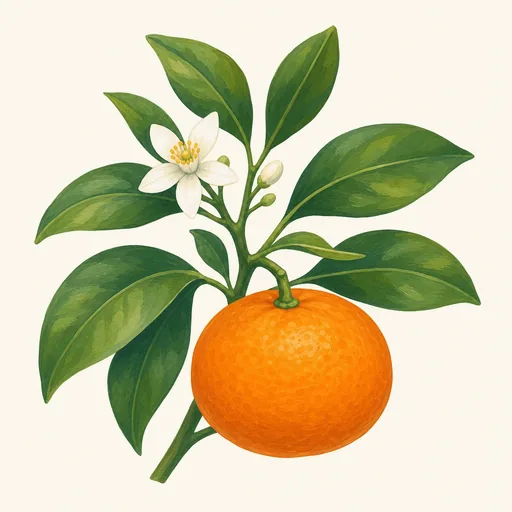
Mandarin
Citrus reticulata · Rutaceae
- Plant out1–4 weeks after the last frostApr 17 – May 14
- Space3–5 m (10–16 ft) apart
- HarvestAfter 2–4 years
Description
Mandarin (Citrus reticulata) is a small evergreen citrus tree grown for its sweet, aromatic fruit. The tree usually reaches 2–5 m (6–16 ft) in cultivation, although pruning can keep it smaller. It has glossy, narrow oval leaves, occasionally thorny branches, and fragrant white flowers. Its fruits are generally smaller and flatter than sweet oranges, with a thin rind that often loosens from the segments and peels easily. Skin color ranges from yellow-orange to deep orange, while the flesh is juicy, divided into segments, and usually sweet with a mild tart edge.
Mandarin is also the name of a broad group of citrus varieties. Tangerines are commonly treated as a type of mandarin; satsumas and clementines belong to related mandarin groups, though many cultivated varieties have complex hybrid ancestry. Fruit size, seed count, peelability, and flavor vary by cultivar and growing conditions. Some fruits are nearly seedless when isolated from other citrus pollen, while others contain numerous seeds.
Mandarin trees grow best in full sun and fertile, well-drained soil. They prefer warm summers and mild winters; prolonged freezing weather can damage trees and fruit. Regular watering is important while trees establish and while fruit develops, but waterlogged roots encourage disease. Flowers appear mainly in spring in many regions, and fruit ripens from autumn into winter, depending on cultivar and local climate. Ripe mandarins are harvested by clipping or gently twisting them from the branch, taking care not to tear the peel.
Mandarins are eaten fresh, juiced, and used in salads, desserts, marmalade, and savory dishes. Their peel supplies fragrant zest and essential oils. The fruit provides vitamin C and dietary fiber. Commercial orchards occur across subtropical and warm temperate regions, especially in Asia, the Mediterranean basin, and the Americas.
Growing Conditions
2–6 m (7–20 ft) tall, 2–4.5 m (7–15 ft) wide
- Smallest
- Largest
Full sun, 6+ hours
Tolerates part sun
Moderate
Keep evenly moist, not soggy.
Ideal 18–30 °C (64–86 °F)
Survives down to −6 °C (21 °F).
pH 5.5–7 · acidic to neutral
Where it Grows
Planting
When to Plant
Plant a mandarin tree outdoors in spring, after the last expected frost, when the soil has begun to warm. This gives its roots a growing season to establish before winter. Choose a period of mild weather rather than planting during a heat wave, prolonged rain, or drought. In climates with reliably frost-free winters, early autumn can also work: the soil is still warm, and the tree can settle in before its next flush of growth. Avoid autumn planting where freezes are possible, because young mandarin trees are especially vulnerable to cold.
A nursery tree in a pot is ready to plant when it looks healthy and is not severely root-bound; you do not need to wait for it to flower or fruit. If your winters are too cold for mandarins outdoors, grow one in a container. Move it outside after frost danger has passed, and bring it into protection before freezing weather returns.
How to Plant
Choose a sunny, sheltered spot with at least six to eight hours of direct light and soil that drains well. Allow room for the mature canopy; spacing depends on the variety and rootstock. Before planting, water the nursery tree and check its roots. If roots circle tightly around the pot, gently loosen them or make a few shallow vertical cuts.
Dig a hole about twice as wide as the root ball, but no deeper. Set the tree so the top of the root ball sits level with, or slightly above, the surrounding ground. Keep the graft union—the swollen join often visible low on the trunk—well above the soil. Backfill with the soil you removed rather than filling the hole with rich compost, and firm it gently. Water thoroughly to settle the soil, then add more soil if it sinks. Spread mulch over the root area, leaving a gap around the trunk to prevent rot. Water deeply whenever the upper soil begins to dry while the tree establishes; avoid keeping it soggy.
For a container, use a pot with drainage holes and a free-draining citrus potting mix. Plant at the same depth as in the nursery pot, and water until excess drains out.
Growth Timeline
- Establishing 2 years
- First harvest possible years 2–4
Planting Calendar
- Plant outdoors: 1–4 weeks after the last frost
- Plant out: Apr 17 – May 14
Care
Care Calendar
- Feed · Apr 10 – Aug 6
Apply citrus fertilizer in divided doses from spring through early summer, following the label. - Prune · Apr 10 – May 14
After frost risk passes, remove dead, damaged, or crossing branches without heavily cutting back the canopy. - Mulch · Apr 10 – May 14
Spread organic mulch over the root zone, keeping it clear of the trunk. - Protect · Oct 11 – Feb 20
Cover young trees during freezes, or move container trees to a sheltered place.
Watering
Water mandarins deeply, then let the upper 2–3 inches (5–8 cm) of soil dry before watering again. Check the soil rather than following a fixed schedule: heat, wind, sandy soil, and container growing all increase water needs. A young tree needs more frequent attention while its roots establish; an established tree can usually be watered less often but should not be left dry for long periods during flowering and fruit development. Apply water slowly over the root area so it soaks in rather than running off. For a potted tree, water until excess drains from the bottom, then empty any saucer. Reduce watering during cool or rainy weather. Avoid keeping the soil constantly soggy, which encourages root rot, and avoid repeated severe drought, which can cause fruit drop or splitting. If leaves wilt, check soil moisture before adding water: overwatered roots can produce similar symptoms.
Pruning
Prune a mandarin lightly; it normally needs shaping and cleanup rather than heavy annual cutting. Remove dead, broken, or diseased branches whenever you notice them, using clean, sharp tools. Cut out shoots arising from below the graft union, since these belong to the rootstock and can outgrow the fruiting variety. Thin branches that rub or crowd the center, but retain enough foliage to shade limbs and fruit from intense sun. If you need to reduce size, make modest cuts just above a suitable side branch instead of shearing the canopy flat. Do major shaping after harvest and after the danger of hard frost has passed in colder areas. Avoid heavy pruning before a freeze or during extreme heat. Sanitize tools between trees when disease is suspected, and avoid leaving long stubs. A well-placed mandarin may need little pruning beyond removing unwanted growth.
Weeding
Keep the area beneath a mandarin free of weeds and grass, especially while the tree is young. Competing plants take up water and nutrients from the same shallow soil that contains many citrus feeder roots. Maintain a clear circle around the trunk and expand it as the canopy grows; a mulched area extending toward the drip line is helpful where space allows. Pull small weeds by hand when the soil is moist, taking care not to disturb citrus roots. Cut stubborn weeds at the surface rather than digging deeply beside the tree. Avoid using string trimmers or mowers close to the trunk: damaged bark can provide an entry point for disease. Check regularly after rain and during the growing season, before weeds set seed. If you use an herbicide, follow its label and protect the trunk, leaves, and any exposed roots from spray or drift. Replace weeds with mulch, not bare soil cultivation.
Mulching
Spread a 2–4 inch (5–10 cm) layer of coarse organic mulch, such as wood chips, over the soil around a mandarin. Extend it outward toward the canopy edge if practical, where many feeder roots grow. Leave at least 6 inches (15 cm) of bare space around the trunk, and keep the graft union uncovered; mulch piled against bark can encourage rot and pests. Mulch slows evaporation, moderates soil temperature, and suppresses weeds, so it is particularly useful for young trees and in hot weather. Apply it after watering or after the soil has been moistened by rain. Top it up as it decomposes, rather than adding another thick layer each time. Keep mulch loose enough for water to penetrate, and check soil moisture beneath it before watering. In persistently wet sites, use a thinner layer and prioritize good drainage; mulch cannot correct waterlogged soil.
Fertilizing
Feed mandarins during active growth with a fertilizer labeled for citrus, following the package rate for the tree’s size and whether it is in the ground or a container. Citrus fertilizers typically supply nitrogen along with nutrients such as magnesium, iron, manganese, and zinc. Begin in spring; split the recommended seasonal amount into several smaller applications rather than giving it all at once. Avoid excessive nitrogen, which promotes leafy growth at the expense of fruit and can increase susceptibility to some pests. In areas with winter freezes, stop feeding well before cold weather so tender new growth has time to harden. Water the soil before and after applying granular fertilizer, and keep it off the trunk. Container-grown trees need smaller, more frequent feedings because nutrients wash out through drainage holes. If leaves yellow despite suitable watering and feeding, consider a soil test or local extension advice before adding extra nutrients; soil pH and root problems can affect uptake.
Pest Management
Inspect new shoots, leaf undersides, and fruit regularly. Aphids, scale insects, mites, and citrus leafminers may damage growth; ants and black sooty mold can signal sap-feeding insects. Start with simple measures: prune badly infested twigs where practical, wash off small colonies of aphids, and control ants that protect scale. Horticultural oil or insecticidal soap can help with certain exposed pests if the label permits use on citrus; cover the target well and avoid spraying during extreme heat or when bees are foraging. Healthy watering and restrained fertilizing reduce stress and overly soft new growth. Watch for Asian citrus psyllids and symptoms of citrus greening, such as blotchy, uneven leaf yellowing and small, lopsided, bitter fruit. Follow local reporting guidance if you suspect them; there is no home cure for an infected tree. Do not move citrus plants or cuttings out of quarantined areas.
Harvesting
Harvest mandarins when they are fully colored for their variety, feel heavy for their size, and taste sweet. Peel and sample one fruit before picking many: color alone is unreliable, especially in warm regions where ripe fruit may retain some green. Mandarins do not become sweeter after picking. Ripening usually occurs from fall through spring, depending on the variety and climate, and fruit on one tree may be ready over several weeks. Use clean pruning snips to cut the stem close to the fruit rather than pulling, which can tear the tender peel or damage a branch. Handle fruit gently and set aside any with broken skin for prompt use. Pick before a damaging freeze if cold is forecast, and do not leave ripe fruit indefinitely on the tree, where quality may decline. Store sound fruit in a cool place for short-term use or refrigerate it to keep it longer.
Growing in Containers
Grows well in a pot of at least 40 litres (11 US gallons), with drainage holes. Can be grown indoors as a houseplant.
Propagation
From seed
- Remove seeds from a ripe mandarin and rinse off the pulp.
- Sow the fresh seeds in moist seed-starting mix.
- Keep the mix warm and lightly moist until the seeds sprout.
- Move seedlings into bright light and pot them up as they grow.
- Expect seed-grown trees to take years to fruit and possibly differ from the parent.
By grafting
- Obtain a healthy, compatible citrus rootstock and disease-free mandarin budwood.
- In spring or summer, cut a T-shaped slit in the rootstock bark.
- Insert a mandarin bud beneath the bark and wrap the union.
- Remove the wrap after the union heals.
- Cut back the rootstock above the bud once the bud begins to grow.
From cuttings
- Take a short cutting from healthy, nonflowering new growth.
- Remove the lower leaves and dip the cut end in rooting hormone.
- Insert it into a moist, free-draining propagation mix.
- Keep it warm and humid in bright, indirect light.
- Pot it up after roots develop; rooting can be unreliable.
Common Problems
- Yellowing leaves
- Sticky residue on leaves
- Black sooty coating
- Curled or cupped leaves
Aphids are small, soft-bodied insects that feed by piercing plants and drawing out sap. The group includes many…
- Winding tunnels in leaves
- Spots on leaves
- Leaves dropping
Leaf miners are the larvae of several kinds of flies, moths, beetles, and sawflies, rather than a single species with…
- Yellowing leaves
- Sticky residue on leaves
- Black sooty coating
- Stunted growth
Scale insects are small, sap-feeding insects that settle on garden and houseplants. Adults often look like bumps on…
- Yellowing leaves
- Wilting
- Stunted growth
- Leaves dropping
Root rot is a general name for the decay of plant roots, not a single disease with one scientific name. It can result…
- Brown or crispy leaf edges
- Wilting
- Bleached or scorched patches
- Leaves dropping
Frost damage is an injury caused when plant tissues become cold enough for ice to form or for cells to lose water to…
- Citrus leafminer: Larvae leave winding trails in young leaves, which may curl or become distorted.
- Aphids and scale insects: These sap-feeding pests can weaken new growth and leave sticky honeydew that encourages sooty mold.
- Citrus greening (huanglongbing): Spread by Asian citrus psyllids, this serious disease can cause blotchy leaves, misshapen bitter fruit, and tree decline. There is no cure.
- Root rot: Poor drainage or overwatering can damage roots and cause yellowing leaves and dieback.
- Cold or water stress: Frost can injure leaves and fruit, while irregular watering can contribute to fruit drop.
Varieties
A widely grown satsuma with easy-peeling fruit and better cold tolerance than many mandarins.
- early
- mostly seedless
- relatively cold tolerant
This satsuma produces sweet fruit early in the season.
- early
- easy peeling
- relatively cold tolerant
Its fruit may develop seeds when other citrus varieties grow nearby.
- sweet
- easy peeling
This traditional tangerine has richly flavored fruit but tends to bear unevenly from year to year.
- aromatic
- seeded
Its bite-sized, easy-peeling fruit suits a home garden.
- small fruit
- seedless
- sweet
Tango bears late-season fruit that remains nearly seedless even near other citrus.
- seedless
- late
- easy peeling
Its bumpy-skinned fruit ripens late and can remain on the tree for an extended harvest.
- late
- seedless
- sweet
This late-season mandarin has mild, sweet fruit and few to no seeds.
- late
- seedless
- sweet
More about varieties
- Owari satsuma: A usually seedless, easy-peeling mandarin that tolerates more cold than many other citrus varieties.
- Dancy: An aromatic, deep-orange tangerine with a rich flavor; its fruit is often seedy.
- Ponkan: A large, sweet, loose-skinned mandarin, commonly grown in warm regions.
- Kishu: A small, sweet mandarin whose fruit is typically seedless when grown away from other citrus pollen sources.
- Clementine: A sweet, easy-peeling mandarin hybrid; fruit may develop seeds if cross-pollinated.
Health Benefits
Mandarins are commonly eaten fresh as a convenient way to add fruit to the diet. They provide vitamin C, which supports normal immune function, helps the body make collagen, and improves absorption of iron from plant foods. Their water content makes them a refreshing snack, while the fiber in the fruit’s segments supports normal digestion. Eating the whole fruit provides more fiber than drinking mandarin juice.
Mandarins also contain potassium and plant compounds such as carotenoids and flavonoids. Carotenoids contribute to the fruit’s orange color; some can be converted by the body to vitamin A. A varied diet that includes fruit is associated with good health, but mandarins are not a treatment for disease, and their antioxidant content does not guarantee a particular health outcome.
Some people use the fragrant peel in food or enjoy its scent for relaxation. Evidence that mandarin peel oil has a specific therapeutic effect is limited. If using zest, wash the fruit first. Concentrated essential oil should not be swallowed or applied undiluted to skin. People with citrus allergies should avoid mandarins, and anyone who has been told to limit potassium should follow their clinician’s dietary advice.
Fun Facts
- Mandarins are known for skins that often separate easily from the segments, making many varieties simple to peel by hand.
- Tangerines and satsumas are types of mandarins; clementines are mandarin hybrids.
- A ripe mandarin can retain some green on its peel in a warm climate. Peel color alone does not reliably indicate sweetness.
- Some varieties that are normally seedless may develop seeds when pollinated by nearby citrus trees.
Notice an error or have a question about Mandarin? Contact us