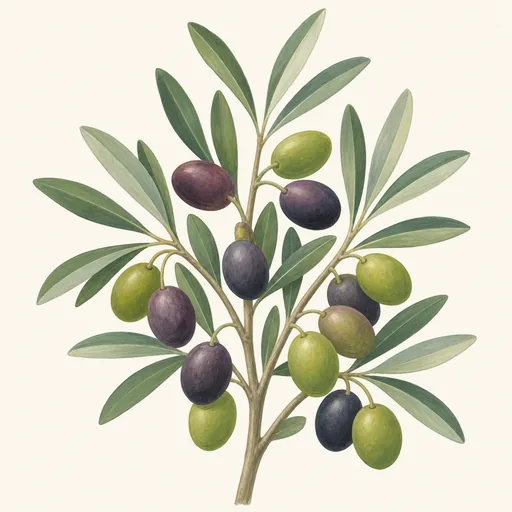
Olive
Olea europaea · Oleaceae
- Plant out1–4 weeks after the last frostApr 17 – May 14
- Plant in autumn6–8 weeks before the first autumn frostAug 30 – Sep 19
- Space4–6 m (13–20 ft) apart
- HarvestAfter 3–5 years
Description
The olive is the fruit of an evergreen tree in the family Oleaceae, native to the Mediterranean region and parts of western Asia. Botanically, each olive is a drupe: a fleshy outer layer surrounds a hard stone containing the seed. Olives vary from small and oval to large and rounded, depending on the cultivar. Ripening fruit turns from green to purple-black; some canned black olives are darkened during processing. The flesh contains oil, especially as the fruit matures, and is a major source of monounsaturated fat, primarily oleic acid.
Olive trees have narrow, leathery leaves with silvery undersides and bear clusters of small, pale flowers. They thrive in sunny places with well-drained soil and Mediterranean-type climates: warm, dry summers and relatively mild, wetter winters. Trees tolerate drought but dislike waterlogging and severe freezes. Most cultivars need some winter coolness to flower well. Trees may live for centuries, and regular pruning helps maintain a manageable canopy. Some cultivars set fruit with their own pollen, while others crop better when compatible varieties grow nearby.
Freshly picked olives are usually too bitter to eat because they contain oleuropein. Table olives are made palatable by curing in brine, water, dry salt, or alkaline solutions, often followed by fermentation; preparation methods affect their flavor, texture, and salt content. Fruit grown for oil is crushed and mechanically processed to separate the oil. Green olives are harvested before full ripeness, while naturally black olives are picked later. Growers choose cultivars for table use, oil production, or both. Trees can bear heavily one year and lightly the next, a pattern called alternate bearing. Harvest generally occurs in autumn or winter in the Northern Hemisphere, and about six months later in the Southern Hemisphere.
Growing Conditions
3–9 m (10–30 ft) tall, 3–6 m (10–20 ft) wide
- Smallest
- Largest
Full sun, 6+ hours
Moderate
Keep evenly moist, not soggy.
Ideal 18–30 °C (64–86 °F)
Survives down to −10 °C (14 °F).
pH 6–8 · neutral to alkaline
Where it Grows
Planting
When to Plant
Plant an olive tree in spring, after the last expected frost, when the soil has warmed and is workable rather than cold or waterlogged. This gives a young tree a growing season to establish roots before winter. In a mild, frost-free climate, early autumn is another good choice: cooler weather reduces transplant stress, while the soil remains warm enough for root growth. Where winter freezes occur, avoid autumn planting unless the tree will have ample time to establish before frost. Check the forecast as well as the calendar; a newly planted olive is more vulnerable to freezing temperatures than an established tree. Wait if the ground is saturated after heavy rain, since olive roots need air and can rot in persistently wet soil. Container-grown olives can be planted outside these preferred windows in suitable weather, but avoid planting during heat waves or freezing spells. In colder regions, grow the tree in a container that can be moved under protection for winter.
How to Plant
Choose a site with at least six to eight hours of direct sun and soil that drains freely. Leave room for the tree’s mature spread; standard olives often need 15 to 25 feet between trees, while compact cultivars may need less. If water stands after rain, use a raised bed or mound rather than planting into soggy ground. Dig a hole about twice as wide as the root ball, but no deeper. Remove the pot, gently loosen any circling roots, and set the tree so the top of the root ball sits level with, or slightly above, the surrounding soil. Keep the trunk’s base exposed; do not bury it. Backfill with the excavated soil, firming it gently to remove large air pockets. Water thoroughly to settle the soil. Add a 2- to 3-inch layer of mulch over the root area, leaving a gap around the trunk. Water regularly during the first growing season, letting the upper soil dry somewhat between soakings; avoid keeping it constantly wet. Stake only if wind prevents the tree from standing securely, and remove supports once it is stable. For a potted olive, use a container with drainage holes and a free-draining potting mix.
Growth Timeline
- Establishing 3 years
- First harvest possible years 3–5
Planting Calendar
- Plant outdoors: 1–4 weeks after the last frost
- Autumn planting: 6–8 weeks before the first autumn frost
- Plant out: Apr 17 – May 14
- Autumn planting: Aug 30 – Sep 19
Care
Care Calendar
- Prune · Apr 10 – May 14
Remove dead or crowded branches after the danger of hard freezes has passed. - Feed · Apr 10 – May 28
Feed lightly in spring if growth is weak or a soil test shows a need. - Protect · Oct 11 – Feb 20
Move container trees to a bright, sheltered place before hard freezes, and protect young outdoor trees during severe cold.
Watering
Water young olive trees deeply and regularly through their first one or two growing seasons, letting the upper soil dry somewhat between soakings. A weekly watering during dry weather is a starting point, but adjust for heat, rainfall, and soil drainage. Established trees tolerate drought, yet trees grown for fruit benefit from consistent moisture during flowering, fruit set, and fruit development. Prolonged drought can reduce the crop and cause fruit to shrivel. Water slowly over the root area rather than keeping the trunk wet, and allow well-drained soil to dry between irrigations. Never leave roots in waterlogged ground: olive trees are particularly vulnerable to root rot. For a potted olive, water thoroughly until excess drains out, then wait until the top few centimetres of potting mix feel dry. Water less during cool, rainy, or dormant periods, and check the soil rather than following a fixed calendar.
Pruning
Prune in late winter or early spring, after the worst frost risk has passed and before vigorous new growth begins. Train a young tree to three or four well-spaced main branches, creating an open centre that admits light and air. On established trees, remove dead or damaged wood, shoots arising from the base or trunk, and branches that cross or crowd the centre. Keep the canopy low enough to reach safely at harvest. Olives generally bear on growth made the previous season, so heavy pruning can sharply reduce the next crop; spread major renovation over several years. Clean pruning tools, especially when moving between trees that may be diseased. In areas with significant frost, avoid autumn pruning, which can encourage tender new growth. An ornamental olive needs only enough pruning to maintain a sound structure and the desired size.
Weeding
Keep a weed-free area around young olive trees so grasses and broadleaf weeds do not compete for water and nutrients while the roots establish. Hand-pull small weeds or hoe lightly, taking care not to damage shallow feeder roots or the bark at the base of the trunk. Clear weeds before they set seed and check again after rain or irrigation. A layer of organic mulch can suppress new seedlings and make later hand-weeding easier, but leave bare space immediately around the trunk. Established trees cope better with competition, although dense weeds beneath the canopy can still consume irrigation water, shelter pests, and interfere with collecting fallen or harvested olives. In a larger planting, grass or other low cover can be maintained between tree rows while vegetation close to each tree is controlled. Avoid letting string trimmers strike the trunk; damaged bark can invite disease and weaken the tree.
Mulching
Spread approximately 5–8 cm of coarse organic mulch, such as wood chips, over the soil around the tree to conserve moisture and reduce weeds. Extend it across as much of the root area as practical, particularly for a young tree, but keep it at least 10–15 cm away from the trunk. Mulch piled against bark holds moisture there and can encourage decay or provide cover for rodents. Apply it over soil that drains freely; mulch cannot correct a waterlogged planting site. Check its depth each year and top it up as it decomposes. In very wet climates or heavy soils, use a thinner layer and watch that the ground is not staying persistently damp. For potted olives, a light surface mulch can slow drying, but leave room to feel the potting mix so you can judge when to water. Do not bury the root flare.
Fertilizing
Olive trees often need little fertilizer when growing well in ordinary soil. Before feeding an in-ground tree, consider a soil test and look at its growth: pale leaves and consistently weak new shoots may indicate a nutrient problem, but they can also result from waterlogged roots. If nitrogen is needed, apply a modest amount in early spring, following the product label; excess nitrogen promotes leafy growth at the expense of fruit and can make the tree more susceptible to some pests. Add phosphorus or potassium only when testing or local advice indicates a deficiency. Avoid heavy or late-season feeding, particularly where tender autumn growth could be damaged by frost. A container-grown olive has a limited nutrient supply; use a balanced fertilizer at label rates during active growth. On alkaline soils, yellow leaves with green veins may signal iron deficiency; confirm the cause before treating it.
Pest Management
Inspect leaves, stems, and developing fruit regularly so problems are caught early. Olive fruit fly is a major crop pest in many regions: monitor with suitable traps and check fruit for punctures or internal damage. Promptly remove fallen or infested olives, harvest ripe fruit without unnecessary delay, and ask a local extension service whether a labelled bait or other control is warranted. Scale insects can cluster on twigs and leaves; pruning to improve airflow, conserving natural enemies, and treating infestations with a product labelled for olives are possible responses. In wet conditions, olive leaf spot can cause dark leaf spots and leaf drop. Reduce prolonged leaf wetness where possible and remove crowded growth; seek local guidance before using a fungicide. Good drainage helps prevent root diseases. Avoid routine broad-spectrum spraying, which can kill helpful insects. If a tree develops unusual, rapid dieback, seek a local diagnosis.
Harvesting
Harvest timing depends on the intended use and local climate. Olives picked green are firm and less ripe; as they mature, most varieties turn purple and then dark, becoming softer and generally yielding more oil. Taste and oil characteristics change with maturity, so growers often pick across a chosen stage rather than waiting for every fruit to turn black. Harvest carefully by hand or with a suitable comb and collection net, avoiding damage to fruit and branches. Keep harvested olives clean and shaded, and process them promptly; olives intended for oil are best taken to a mill as soon as practical, ideally within a day. Sort out rotten or badly damaged fruit. Fresh olives are intensely bitter and must be properly cured before eating; table varieties are commonly cured in brine or by other established methods. Pick before damaging frost and follow safe, tested curing instructions for home preparation.
Growing in Containers
Grows well in a pot of at least 40 litres (11 US gallons), with drainage holes. Best kept outdoors.
Propagation
From cuttings
- Take a 10–15 cm cutting from a healthy, nonflowering shoot in late summer.
- Remove the leaves from the lower half.
- Dip the cut end in rooting hormone.
- Insert it into a moist, free-draining propagation mix.
- Keep it warm and humid in bright, indirect light until roots form.
- Pot it up once it has a substantial root system.
From seed
- Remove the flesh from a fully ripe, uncured olive.
- Clean the pit and carefully nick its hard shell without damaging the seed.
- Soak the pit in water for 24 hours.
- Sow it in a free-draining seed mix and keep it warm and lightly moist.
- Allow several months for germination; expect seedlings to differ from the parent tree.
Companion Plants
Good neighbors
- Lavender: It tolerates the sunny, well-drained conditions suited to olive trees and is commonly grown nearby.
- Rosemary: It shares olive trees’ preference for full sun and well-drained soil and needs little supplemental water once established.
Common Problems
- Yellowing leaves
- Sticky residue on leaves
- Black sooty coating
- Stunted growth
Scale insects are small, sap-feeding insects that settle on garden and houseplants. Adults often look like bumps on…
- Yellowing leaves
- Brown or crispy leaf edges
- Wilting
- Stunted growth
Verticillium wilt is a soilborne disease caused mainly by the fungi Verticillium dahliae and V. albo-atrum. The fungi…
- Spots on leaves
- Yellowing leaves
- Leaves dropping
Fungal leaf spot is a general name for diseases caused by many different fungi, not a single species. These fungi…
- Yellowing leaves
- Wilting
- Stunted growth
- Leaves dropping
Root rot is a general name for the decay of plant roots, not a single disease with one scientific name. It can result…
- Brown or crispy leaf edges
- Wilting
- Bleached or scorched patches
- Leaves dropping
Frost damage is an injury caused when plant tissues become cold enough for ice to form or for cells to lose water to…
- Olive fruit fly larvae damage fruit and reduce its quality.
- Scale insects and mealybugs weaken trees by feeding on sap.
- Olive leaf spot, also called peacock spot, causes dark leaf markings and premature leaf drop, especially in damp conditions.
- Verticillium wilt can cause branches to die back; infected trees are difficult to treat.
- Waterlogged soil can lead to root rot. Frost can also damage young trees and new growth.
- Poor fruiting may result from insufficient sunlight, unsuitable winter temperatures, or inadequate pollination.
Varieties
A popular choice for containers that produces small olives suitable for oil.
- compact
- self-fertile
- early
This relatively small tree bears plentiful fruit when given a long, warm growing season.
- compact
- productive
This Greek variety produces small, oil-rich olives.
- small fruit
- productive
This Italian variety is valued for flavorful oil and can also pollinate other varieties.
- aromatic oil
- vigorous
Plant it near a compatible pollinator, such as Frantoio, for reliable crops.
- cold tolerant
- early
Its fruit can be cured for eating or pressed for oil.
- cold tolerant
- versatile
Grow it with a compatible pollinator for better yields.
- large fruit
- popular for curing
Its olives can be cured green or used for oil.
- firm fruit
- versatile
More about varieties
- Arbequina: A compact Spanish variety grown mainly for its mild, fruity oil.
- Koroneiki: A Greek variety with small fruit prized for high-quality oil.
- Picual: A widely grown Spanish oil olive known for its robust flavor.
- Kalamata: A large, dark Greek table olive, commonly cured for eating.
- Manzanilla: A Spanish table olive often sold green and stuffed.
- Mission: A variety grown in California for both table olives and oil.
Health Benefits
Olives and olive oil are familiar parts of the Mediterranean diet. Olive oil is rich in monounsaturated fat, particularly oleic acid. Replacing foods high in saturated fat, such as butter, with unsaturated-fat sources like olive oil can help support healthy blood cholesterol levels and cardiovascular health. Extra-virgin olive oil also contains polyphenols, plant compounds with antioxidant and anti-inflammatory activity. Research links diets that regularly include olive oil with lower rates of cardiovascular disease, although no single food provides that benefit on its own.
Whole olives provide unsaturated fat and small amounts of fiber and vitamin E. They are often eaten as a snack or added to salads and other dishes. Most table olives are cured in brine, however, and can be high in sodium; people limiting salt intake may prefer smaller portions or lower-sodium options.
Olive oil is sometimes applied to skin as an emollient, but it can irritate some skin types and is not a substitute for treatments for skin conditions. Olive leaf supplements are marketed for various health purposes, yet evidence for specific medical benefits remains limited. Neither olives nor olive products should be treated as a cure for disease. Their best-supported wellness role is as part of an overall balanced eating pattern.
Fun Facts
- An olive is botanically a drupe, a fleshy fruit with a hard pit.
- Olive trees can live for centuries; some ancient trees still produce fruit.
- Most fresh olives are too bitter to eat without curing.
- Green and naturally black olives can come from the same tree: green fruit is picked before it fully ripens.
- Olive trees often produce a heavy crop one year and a lighter crop the next, a pattern called alternate bearing.
Notice an error or have a question about Olive? Contact us