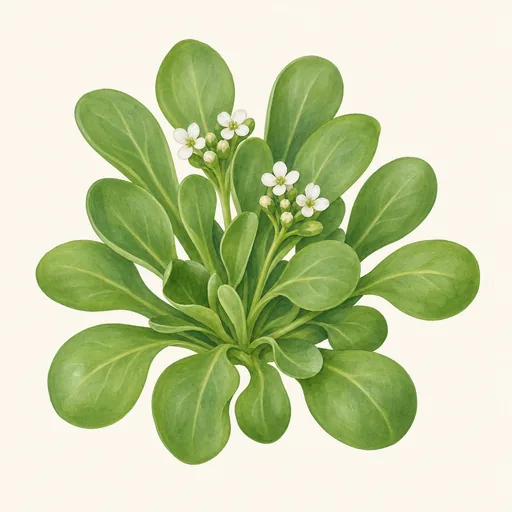
Mache
Valerianella locusta · Caprifoliaceae
- Sow outdoors2–6 weeks before the last frostFeb 27 – Apr 2
- Plant in autumn6–10 weeks before the first autumn frostAug 16 – Sep 19
- Space10–15 cm (4–6 in) apart
- Harvest40–70 days after plantingApr 8 – Jul 2
Description
Mâche is a small, cool-season leafy vegetable also known as lamb’s lettuce or corn salad. It forms a low rosette of tender, spoon-shaped leaves that are usually dark green and have a mild, slightly nutty flavor. The leaves are most often eaten raw in salads, either alone or mixed with stronger-tasting greens. They can also be added to sandwiches or briefly wilted, although prolonged cooking diminishes their delicate texture.
The plant grows best in cool weather and is commonly sown in late summer or autumn for an autumn, winter, or early spring harvest. In mild climates it can remain outdoors through winter; in colder places, a cold frame or other protection can extend the harvest. Mâche prefers well-drained soil and steady moisture. Its shallow roots make it sensitive to drying out, while hot weather can cause it to flower and reduce leaf quality. Because the plants stay compact, they fit well into small beds and containers.
Young rosettes can be harvested whole, or individual outer leaves can be picked while the center continues to grow. Wash the leaves carefully: soil often collects at the base of the rosette. Freshly picked mâche is tender and does not keep as long as sturdier salad greens, so it is best used soon after harvest. If left to mature, the plant produces slender flowering stems and small, pale blue to whitish flowers, followed by seeds. Allowing a few plants to set seed can result in self-sown seedlings when conditions become cool again. Mâche is valued by gardeners because it provides fresh leaves when many warm-season salad crops are unavailable. It is an annual plant, typically grown for its leaves rather than its flowers or seeds. Its compact habit also makes it a useful crop between larger vegetables when space is limited.
Growing Conditions
10–20 cm (4–8 in) tall, 10–20 cm (4–8 in) wide
- Smallest
- Largest
Full sun
Tolerates part sun, part shade
Moderate
Keep evenly moist, not soggy.
Ideal 5–18 °C (41–64 °F)
Survives down to −18 °C (0 °F).
pH 6–7.5 · neutral
Where it Grows
Planting
When to Plant
Mâche, also called corn salad, grows best in cool weather. Sow it in early spring as soon as the soil can be worked, or in late summer to early autumn for a fall crop. For autumn sowing, aim for roughly 6–8 weeks before your first expected hard freeze so plants can establish before growth slows. In mild-winter areas, you can continue sowing through autumn and harvest over winter; in colder areas, established plants may overwinter with protection from a cold frame or row cover. Seeds germinate most reliably when soil is around 50–65°F (10–18°C), while warm soil can delay or prevent germination. If late summer is still hot, wait for cooler weather or sow in a lightly shaded spot and keep the seedbed moist. For a steady supply, make small sowings every two to three weeks while temperatures remain cool. Mâche tolerates frost, but it grows slowly during the shortest winter days.
How to Plant
Direct-sow mâche where it will grow; its small plants are easy to harvest from a garden bed or container without transplanting. Choose a spot with well-drained soil and mix in a little finished compost if the soil is poor. Give it full sun in cool weather or partial shade where autumn days remain warm. Rake the surface smooth, then sow seeds about ¼ inch (6 mm) deep. Space seeds about 1 inch (2.5 cm) apart in rows 6–12 inches (15–30 cm) apart, or scatter them thinly across a small bed. Cover lightly with soil and water gently so the seeds stay in place.
Keep the top layer of soil consistently moist until seedlings emerge, usually within one to three weeks in cool conditions. Once the seedlings have several leaves, thin them to about 3–6 inches (8–15 cm) apart. You can eat the thinnings. Water during dry spells, but avoid leaving the soil waterlogged. A light mulch around established plants helps conserve moisture and keep leaves clean. In cold regions, cover autumn plantings with a row cover or cold frame to make winter harvesting easier. Harvest individual outer leaves or cut whole rosettes near the base. Since mâche grows low to the ground, rinse harvested leaves carefully to remove grit.
Growth Timeline
- Germination 7–21 days
- Growing 40–70 days
- Harvest 3–6 weeks
Planting Calendar
- Sow outdoors: 2–6 weeks before the last frost
- Autumn planting: 6–10 weeks before the first autumn frost
- Germination: 7–21 days
- Sow outdoors: Feb 27 – Apr 2
- Autumn planting: Aug 16 – Sep 19
- Harvest: Apr 8 – Jul 2
Care
Care Calendar
- Thin · Sep 6 – Oct 10
Thin seedlings to 3–6 inches apart after they develop true leaves. - Protect · Oct 25 – Nov 21
Use a row cover during severe freezes to keep leaves harvestable.
Watering
Mâche has shallow roots and grows best when the top layer of soil stays evenly moist, especially while seeds are germinating and young rosettes are establishing. Water gently so you do not wash away the small seeds. Once plants are established, check the soil with a finger and water when the upper inch begins to dry. In mild weather, rainfall may supply most of what the crop needs; in dry or windy conditions, water more often. Aim to moisten the root zone without leaving the bed soggy, since poorly drained soil can encourage rot. Water at soil level when possible, and water early in the day so wet leaves can dry. A thin mulch can reduce moisture swings. Container-grown mâche dries faster than plants in the ground, so check pots regularly, particularly during warm spells.
Weeding
Keep the bed free of weeds while mâche seedlings are small. They grow relatively slowly at first and can be crowded or shaded by faster-growing weeds. Remove weeds by hand or use a small hoe very shallowly between rows; mâche’s roots are near the surface and are easy to disturb. Weed when the soil is slightly moist so roots pull out cleanly, but avoid walking on or working soggy soil. If seedlings emerge too densely, thin them according to the spacing on the seed packet, often to about 4–6 inches apart. The thinnings are edible if clean and healthy. Once rosettes fill in, their leaves help shade the soil, but continue to pull weeds before they set seed. Mulch exposed soil only after seedlings are established, and keep it off the small crowns.
Mulching
After mâche seedlings are established, spread a thin layer of clean straw, shredded leaves, or another loose organic mulch over the bare soil between plants. Mulch helps hold moisture, limits weeds, and reduces soil splashing onto leaves that will be eaten raw. Keep it away from the crowns and do not bury young rosettes; a heavy, wet layer can restrict airflow and encourage rot. In a cool, rainy season, use mulch sparingly and make sure the bed drains freely. For crops overwintered in cold areas, a light covering of loose straw can help protect plants during hard freezes. Pull it back when temperatures moderate so the leaves receive light and air. Mulch does not replace watering: check the soil beneath it periodically and irrigate if the root zone is drying out.
Fertilizing
Mâche is a modest feeder, so start with reasonably fertile, well-drained soil rather than applying large amounts of fertilizer. Before sowing, mix a modest layer of finished compost into the topsoil; this supplies nutrients and helps the soil retain moisture. If the bed was recently composted or previously supported healthy leafy crops, additional feeding is usually unnecessary for mâche’s short growing season. Watch the plants: slow growth and uniformly pale leaves can indicate that a light application of a balanced fertilizer is useful, provided low temperatures, dry soil, and poor drainage have been ruled out. Follow the product label and avoid putting fertilizer directly against the leaves. Too much nitrogen can encourage soft growth and is rarely needed. In containers, use a quality potting mix and feed lightly only if growth becomes weak.
Pest Management
Inspect mâche regularly, especially the undersides of leaves and the soil around the rosettes. Slugs and snails may chew leaves in damp weather; remove them by hand, clear nearby hiding places, and use a suitable bait if damage continues, following its label. Aphids can sometimes cluster on tender leaves. Wash small colonies off with a gentle stream of water, and check again in a few days. Avoid broad-spectrum insecticides that also kill beneficial insects. Good spacing, drainage, and watering at soil level help reduce problems with rotting leaves and fungal disease. Remove badly affected plants and do not compost them if disease is suspected. Row cover can protect young plants from some insects, but lift it occasionally to check for pests underneath. Wash harvested leaves thoroughly, since soil and small insects can lodge inside the rosettes.
Harvesting
Harvest mâche when rosettes have several well-developed leaves and are still tender, commonly about 40–70 days after sowing, depending on the variety and weather. For a whole-rosette harvest, cut each plant at the base with clean scissors or a knife, or lift it and trim away the roots. You can instead pick a few outer leaves from established plants, leaving the center intact for further growth. Handle the leaves gently: they bruise easily. Harvest before plants send up flower stalks, since quality declines as they bolt, particularly when days become warmer and longer. Pick after dew or irrigation has dried, then rinse off grit and dry the leaves before refrigerating. Mâche is best eaten fresh; for a longer harvest, sow small batches at intervals through suitable cool weather.
Growing in Containers
Grows well in a pot of at least 2 litres (0.5 US gallons), with drainage holes. Best kept outdoors.
Propagation
From seed
- Sow outdoors in late summer or early fall when the soil has cooled.
- Scatter seeds thinly in prepared, moist soil.
- Cover with about ¼ inch (6 mm) of soil.
- Keep the soil evenly moist until seedlings emerge.
- Thin seedlings to about 3–4 inches (8–10 cm) apart.
Common Problems
- Holes in leaves
- Slime trails
- Stems chewed or cut through
Slugs and snails are soft-bodied mollusks that feed on many garden plants. Snails carry a visible shell; most slugs…
- Yellowing leaves
- Sticky residue on leaves
- Black sooty coating
- Curled or cupped leaves
Aphids are small, soft-bodied insects that feed by piercing plants and drawing out sap. The group includes many…
- Yellowing leaves
- Spots on leaves
- Fuzzy gray mold
- Wilting
Downy mildew is a group of plant diseases caused by several species of oomycetes, or water molds, rather than one…
- Flowering too early (bolting)
Bolting is the premature switch from leafy or root growth to producing a flower stalk and seeds. It is a normal part…
- Fuzzy gray mold
- Spots on leaves
- Wilting
- Soft or rotting stems
Gray mold, also called Botrytis blight, is a fungal disease caused most commonly by Botrytis cinerea. It affects many…
- Bolting in warm weather: Plants send up flower stalks and the leaves become less tender. Grow mâche in cool seasons.
- Slugs and snails: They may chew holes in the low-growing leaves, especially in damp weather.
- Damping-off: Seedlings can collapse in overly wet, poorly ventilated conditions.
- Mildew and leaf rot: Crowded plants and persistently wet foliage encourage disease. Thin seedlings and water the soil rather than the leaves.
Varieties
Forms small, tender rosettes suited to autumn and winter harvests.
- cold hardy
- compact
Produces compact rosettes of dark green leaves.
- heirloom
- cold hardy
Its broad leaves make larger rosettes than small-leaved types.
- large leaves
- mild flavor
Produces uniform rosettes for cool-season harvests.
- uniform
- cold hardy
More about varieties
- ‘Vit’: A compact, cold-tolerant variety with small, dark green leaves.
- ‘Verte de Cambrai’: A traditional French variety valued for its tender leaves and cold tolerance.
- ‘Coquille de Louviers’: A French variety with small, spoon-shaped leaves and a rosette resembling a shell.
- ‘Dutch Broadleaf’: Produces larger leaves that are convenient to harvest, though it is generally less cold-hardy than small-leaved types.
Health Benefits
Mâche, also called lamb’s lettuce or corn salad, is eaten mainly as a tender salad green. Like other leafy vegetables, it can help add variety, fiber, and micronutrients to a balanced diet. It provides vitamin C, which supports normal immune function and helps the body absorb iron from plant foods. It also contains folate, needed for normal cell growth, and vitamin A precursors that support vision and normal immune function. Its leaves supply some iron and potassium, although amounts vary with growing conditions and serving size.
Mâche is typically eaten raw, so it can be a convenient way to include greens in a meal without cooking. Its mild flavor pairs with fruit, nuts, or other vegetables, making it an approachable choice for people who find some salad greens too bitter. Wash the low-growing rosettes carefully to remove soil, and follow standard food-safety guidance for raw produce.
Mâche is food, not a treatment for disease, and no particular health outcome can be attributed to eating it alone. Anyone taking warfarin should keep their intake of vitamin-K-containing greens reasonably consistent and discuss significant dietary changes with their clinician.
Fun Facts
- Mâche is also known as lamb’s lettuce, corn salad, and field salad.
- The name “corn salad” reflects its history of growing among cereal crops; it is not related to sweet corn.
- Its leaves grow in small rosettes close to the ground.
- Unlike many salad greens, mâche grows well in cool weather and can be harvested in winter in suitable climates.
- Botanically, mâche (Valerianella locusta) belongs to the honeysuckle family, Caprifoliaceae.
Notice an error or have a question about Mache? Contact us